
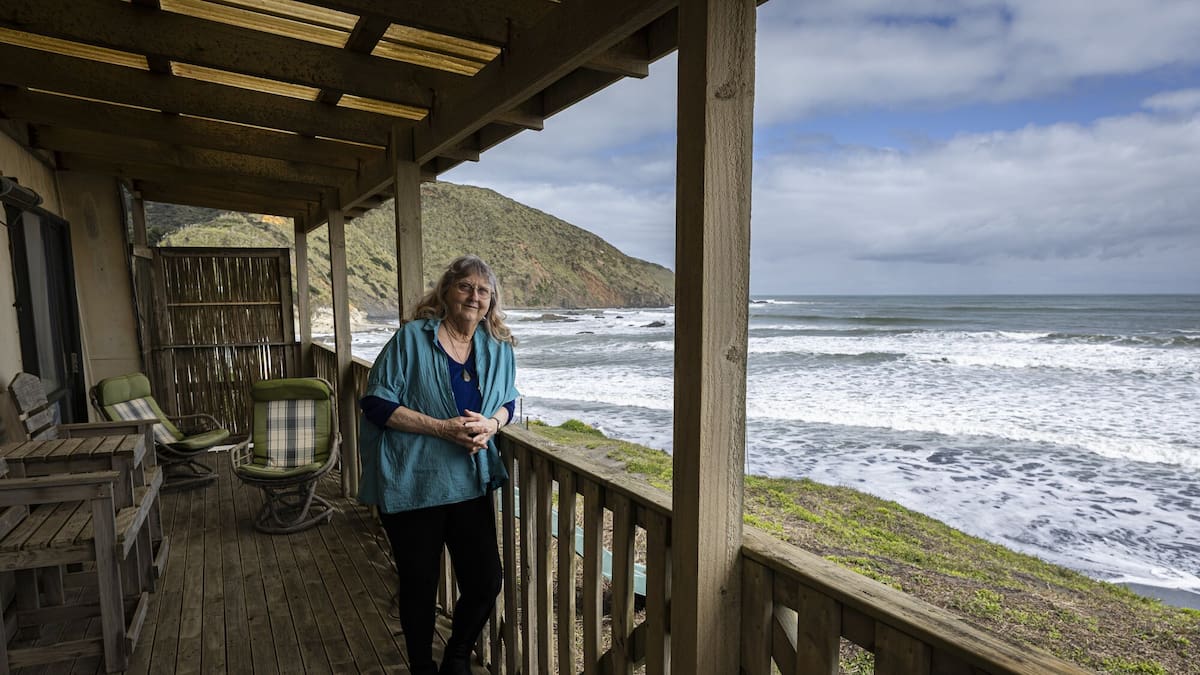
“It’s saved my house,” she said bluntly.
“You just look out and the sea seems quite high, but usually when I walk down, actually it’s fine and the wall is doing its job.
“There’s nothing like opening those curtains when there’s a storm because there’s no street lights … it started not being such a delight when I was at risk of losing the house, so it’s really made all the difference.“
A short walk to the beach is an understatement for Jo Poland. Photo / Christel Yardley, Waikato Times
The seawall’s success marks a long-awaited victory for Sunset Beach Surf Lifesaving Trust chair Malcolm Beattie, who spearheaded the raising of all the funding and campaigned for years to get consents to build from the council.
“You just look out and the sea seems quite high, but usually when I walk down, actually it’s fine and the wall is doing its job.”
The council has previously said an independent commissioner was brought in to determine consent and described the seawall as a community-led effort to protect dunes, public spaces and nearby homes.
Updated comments were sought, but the council could not respond by deadline.
All responsibility for upkeep and funding now rests solely on the trust – a non-sustainable solution going forward, Beattie said.
A comparison of the seawall in April to its current September state. Photo / Waikato Times
“Local and central [government] should have some skin in the game at least working with us … we’re doing council’s work here but we’re the ones that have got the risk and pay the money.
Beattie said that if it took a hypothetical budget of $60,000 a year to contain the sea, the council “spend more than that on toilet paper”.
“This is where people are coming to recreate and that’s a council responsibility to provide services at the beach.”
Beattie said the current council has made steps to forge a working relationship with the community, but it’s all talk before the “money hits the road”.
The seawall has also provided relief on insurance worries for home owners. Poland said she’s not covered because erosion is classified as “a natural event, not a natural hazard”.
She said a 1996 geologist report produced before she built her home made no explicit mention of coastal erosion caused by rising sea levels.
“We get no support at all … there’s a bit of inequity going on from my perspective. As people lose their homes, they go away and they’re quiet because they’re too busy coping with things to keep fighting.
“They need a plan and the Helen Clark Foundation has suggested a new form of insurance for people dealing with the effects of climate change so the cost doesn’t all fall on home owners.”
The risk facing home owners isn’t stopping new faces from joining the neighbourhood, however.
New home owner and Airbnb hostess Ruth Riding is stoked to be a part of the tight-knit Port Waikato community. Photo / Christel Yardley, Waikato Times
Ruth Riding bought a coastal home just two months ago to live out her dream of running an Airbnb and says the risk was “absolutely worth taking”, despite having a few raised eyebrows at the purchase.
“I think people are just surprised, but I think because the seawall had just been put in, there was a lot of hope.”
– LDR is local body journalism co-funded by RNZ and NZ On Air.