
His lawyer Asta Gold told a panel of military members, similar to a jury, that the defence’s case was that her client respected the woman’s wishes not to have sex that night.
Gold said the pair fell into a consensual relationship after that, and it was only after they broke up a month later, and she saw him with another woman, that the allegations arose.
Royal New Zealand Air Force flying officer Hana Tiltman began the trial by outlining the Crown’s case.
She alleged the lieutenant and woman met, went out for dinner with a group, then to some bars, before heading back to the lieutenant’s hotel room.
This is where the Crown says he violated her three times.
Tiltman said the case hinged on the credibility of the woman.
“After all she was the only other person in that room that night.”
Gold gave a brief opening statement, outlining her case, and said when her client broke off the relationship the woman was “understandably upset”.
“[She] was hurt, she was jealous, she was angry but she was not assaulted.”
The woman, the first witness
The woman appeared via audio visual link from overseas and said she and the lieutenant had been out drinking with a group when they peeled off to go back to his room together.
She wasn’t sure about the potency of the foreign drinks they had but said by the time they went off together she had started to drink water and sober up.
She said she was still “completely coherent”, as was the lieutenant, and she remembered everything that happened.
When they got into his room, she said the lieutenant immediately “threw himself” at her and she told him to slow down.
Then they went to one of the two beds in his room and began kissing. She said she asked him if he had a condom because things were “progressing” and he said “no”.
She also said she remembered, around that time, asking if he had been tested for sexually transmitted infections and him saying “yes”, and trying to show her the test results on his phone.
They continued to make out and moved on to the ground when, she said, he “violated” her.
‘But you want it’
She claimed she was shocked and put her hands out telling him to stop and he did until they went back to the bed and he violated her again.
She said she again told him to stop and he replied “but you want it” and she replied “yes, but not like this” and he stopped, they went to bed and cuddled until he again got on top of her and violated her a third time.
She said she “froze”, and he also didn’t move, breathing heavily and looking “possessed” with a “blackness” in his eyes, looking “not there”.
The woman said she started thinking about her options, including screaming, but decided to talk her way out of it because it was “really scary” as it was “the third time he had essentially raped me”.
She said he stopped and some time later she got up to leave, and he pulled her arm and said something like “no, no, no, don’t, I’ll stop”. Because it was “really late” and she was exhausted and had just been “pinned down”, she stayed.
“Why was it that you didn’t leave the room?” Crown prosecutor Sam McMullan asked.
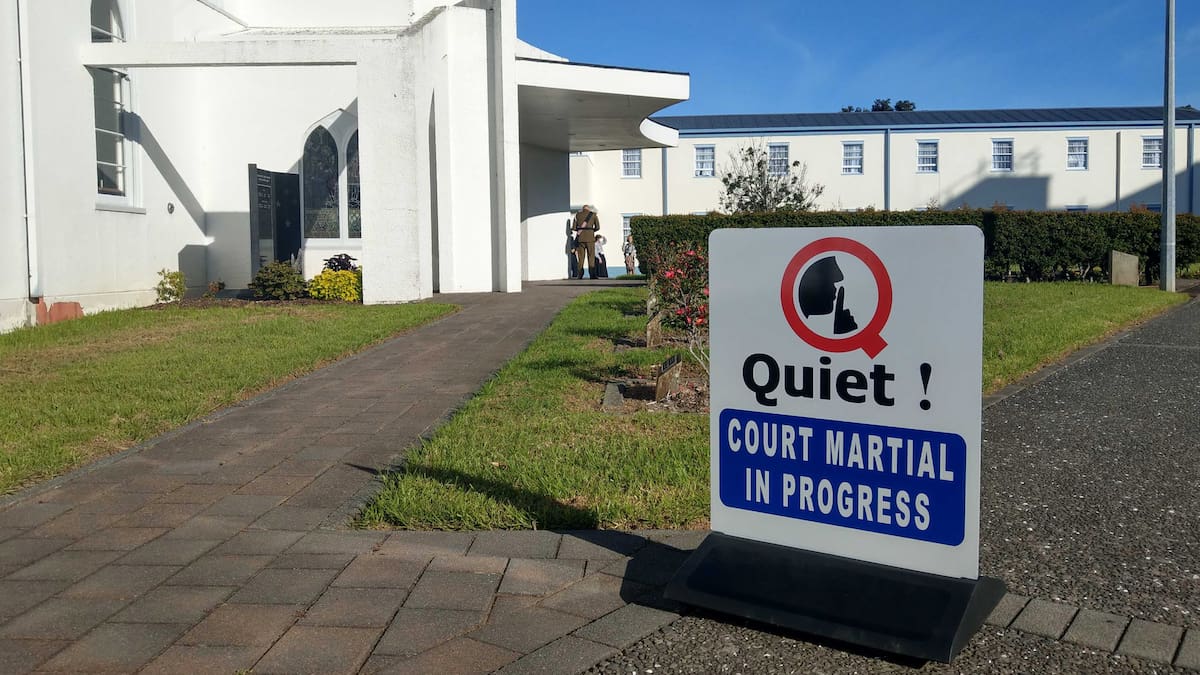
The Court Martial is being held this week at the Devonport Naval Base in Auckland. Photo / John Weekes
“It’s a really good question,” the woman replied, saying she asks herself the same “all the time” when she has flashbacks to that night.
“I hadn’t been able to process anything that happened.”
The next day, she said, the group, including the lieutenant, spent time together and feeling “very hungover”, she didn’t discuss what had happened with him.
McMullan asked why she didn’t bring up the violation with him, to which she answered that they were in a group and she didn’t want the others to hear.
She said she didn’t have much faith in reporting it to the authorities, either.
That evening, the pair met up and had sex with a condom, which she considered consensual, and he stayed at her house a couple of nights later.
A month later
Because of distance, they didn’t see each other much after that, the court heard, but continued to message until about a month passed and they broke it off over text.
McMullan read out a message from the woman that said “alright what’s the deal”, to which the lieutenant replied he didn’t want her to keep guessing when they would see each other.
Because of that, it would be best if they stopped seeing each other, the lieutenant’s message said.
The woman replied in a message saying that he had led her on, calling him a “f***ing coward” and they didn’t see each other again until another month after that when they were both at the same event.
She told the court she saw the lieutenant with another woman at the event.
“I was just very uncomfortable from it, I thought it was a disrespectful thing to do in front of me, especially when he had raped me.”
That was when she first told someone, a man, what had happened to her, she said.
She said she then told the woman the lieutenant was with what he had done to her, and then later, when she saw her with him again, she “essentially confronted both of them”.
The hearing continues.
Ella Scott-Fleming has been a journalist for three years and previously worked at the Otago Daily Times, Gore Ensign and Metro Magazine. She has an interest in court and general reporting. She’s currently based in Auckland covering justice related stories.
Join the NZ Herald’s Open Justice team for Case by Case, a video and podcast series examining the disputes and decisions making headlines across New Zealand.