
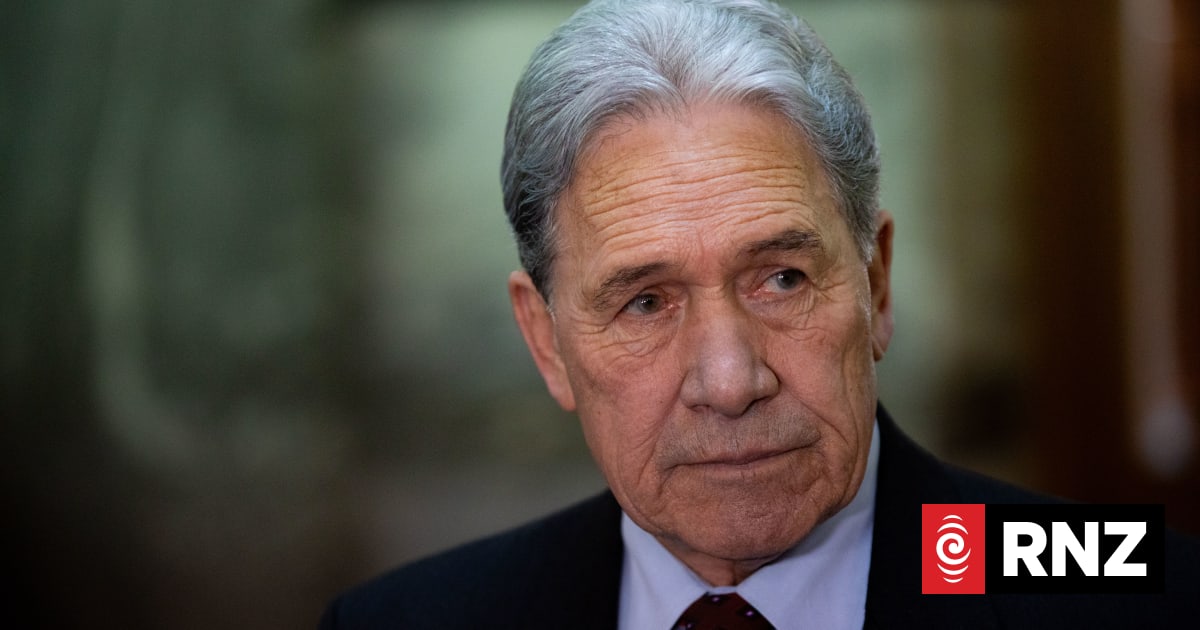
Winston Peters looks back on his stint as Foreign Minister
New Zealand’s recognition of Palestinian statehood is inevitable, the Foreign Affairs Minister says.
In his final speech as minister in this government on Monday afternoon, Winston Peters said his decision in 2025 not to join most other UN member states in recognising Palestine was an example of truly independent foreign policy.
But he told Morning Report recognition was a question of when, not if.
“I just spoke a few days ago to the foreign minister for the Palestinian Authority.
“She understands our position. But I asked the most critical question and got a positive answer – so when are you going to be holding an election so we can recognise an elected state?
“She said very, very soon. Now that’s a giant step forward.”
A lot of countries made a decision on the basis that they would recognise statehood now providing the Palestinians conformed with requirements in the future, he said.
“Well that’s some time never.
“The delightful thing about talking to the foreign minister just a few days ago was that they’re going to hold an election – now we’ve got something to recognise if there’s a properly conducted election.
“That’s progress, serious progress.”
During his speech to the New Zealand Institute of International Affairs at Parliament, Peters took aim at those insisting the country should use megaphone diplomacy, especially against the United States, and stated New Zealand’s nuclear-free policy had a cost.
He called out those who focused on “national identity” rather than the national interest, as well as the underfunding of the diplomatic network.
The foreign minister said he’d conducted foreign policy “in uncertainty’s shadow” ever since coming into office in 2023.
Peters stressed an independent foreign policy, like New Zealand has, can never be “unidirectional”.
“However, for the left and a large section of our media, they define us acting independently only when we are disagreeing with the Americans,” he said, referencing New Zealand’s anti-nuclear policy and the decision not to join the Iraq war in 2003.
“The anti-nuclear policy and the construction of this in David versus Goliath terms bolstered our national self-esteem, no doubt, as it boosted our sense of national identity.”
But a realist would ask whether the anti-nuclear policy “grew or constrained” New Zealand’s agency in the decades following, he said, adding that the answer to that “is far more mixed, because costs did occur”.
Despite not naming those costs, Peters pointed out critics of New Zealand’s foreign policy were never asked to explain what they thought the costs might be “if we followed their advice to use megaphone, rather than quiet diplomacy”.
He told Morning Report while he preferred dialogue to megaphone diplomacy, he had no fear of speaking out.
He said he had stated New Zealand’s case to China’s foreign minister Wang Li just a few months ago.
“I put our position to him very, very clearly. I asked him, why are you having experimental operations in the South China Sea, for example? Why are you firing missiles across the Pacific to countries that were not being warned? I stated that case and then we had a conversation about it.”
Ultimately, he said the “true measure of our independent foreign policy is the extent to which we have agency over decision-making”.
“It can never be confined to pointing a megaphone in only one direction.”
Peters began his speech by acknowledging the “unchallenged” notion that “we face the worst international conditions since 1945”.
In 2026 he said, the United Nations’ ability to effectively respond to current crises was “hamstrung” by abuse of the security council veto.
“The UN is just muddling through, in a weakened state.”
Over the term, Peters made 44 offshore visits and spent 248 days overseas – around two thirds of the political term. He also had 279 meetings with foreign minister counterparts.
Peters said extensive travel would be the burden of any future foreign minister “trying to mitigate against the perennial under investment in our diplomatic network”.
He noted his “budgetary successes” and reiterated his “unshakeable belief” in the positive role diplomacy can play in the world.
“There’s always a way to talk”, he repeated, noting that he had talked with a range of countries, with those who share – and don’t share – New Zealand’s values gaining from understanding each other’s positions.
“From understanding comes opportunity, and from diplomacy comes compromise, a crucial building block for better relations between nations.”
While acknowledging he’d done a lot of talking, he said “we have listened even more”.
“With the greater understanding that comes from listening, we have been able to focus our scant resources on where they could make the most difference.”
Peters did not rule out a fourth stint as foreign minister if he was returned to government at the election.