
…records 350bps cut, second-largest single rate reduction in continent this year
Nigeria has improved slightly in Africa’s interest-rate ranking, moving down one place to become the continent’s third-highest policy-rate economy despite the Central Bank of Nigeria delivering its largest single rate cut in at least 20 years.
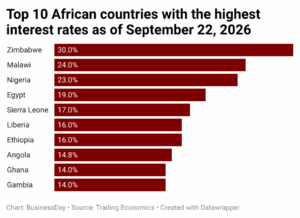
The CBN on Tuesday cut its Monetary Policy Rate (MPR) by 350 basis points from 26.5 percent to 23 percent, moving the West African nation below Malawi, whose policy rate stands at 24 percent, while Zimbabwe remains at the top of the continental ranking with a 30 percent benchmark rate. The MPR rate is the lowest since March 2024, when it was raised from 22.75 percent to 24.75 percent..
Before Tuesday’s decision, data from global economic data provider Trading Economics ranked Nigeria as having Africa’s second-highest policy rate at 26.5 percent.
The size of the reduction was significantly larger than analysts had anticipated. Bank of America had projected a 100-basis-point cut at the September meeting, citing slowing inflation, improved foreign-exchange stability and declining domestic yields as factors creating room for monetary easing.
The CBN’s 350bps reduction was therefore 250 basis points larger than BofA’s forecast, or 3.5 times the size of the cut the bank had expected. The global investment bank had also expected another 100bps cut in November, which would have taken the country’s’s benchmark rate to 24.5 percent by year-end.
The CBN has now taken the rate to 23 percent in a single move, exceeding the two 100bps cuts BofA had anticipated for the remainder of the year.
The latest reduction is also the first change in the MPR since February, when the apex bank cut the rate by 50 basis points to 26.5 percent. The rate was subsequently left unchanged at its May and July meetings.
The decision was taken at the CBN’s 307th Monetary Policy Committee meeting and represents a sharp acceleration in the pace of monetary easing after a prolonged period of tight policy.
The committee also retained the Cash Reserve Ratio at 45 percent for deposit money banks and 16 percent for merchant banks, while maintaining the 75 percent CRR requirement on non-Treasury Single Account public-sector deposits and the liquidity ratio at 30 percent.
Read also: US hikes rates as Africa’s largest economies face MPR decisions this week
The Standing Facilities Corridor was recalibrated to +50/-300 basis points around the new MPR.
The decision comes against a backdrop of moderating inflation and improved foreign-exchange conditions. Headline inflation in Africa’s most populous nation eased marginally for the third straight month to 15.39 percent in August from 15.43 percent in July.
Last month’s reading is substantially below the 23.1 percent recorded a year earlier, giving the CBN more room to reduce the degree of monetary restriction.
The latest move also comes as the naira has remained relatively stable, helping to reduce one of the major risks that previously constrained the central bank’s ability to ease monetary policy.
The CBN has previously pointed to moderating inflation, exchange-rate stability and improving inflation expectations as factors supporting a gradual normalisation of monetary policy.
Tuesday’s decision, however, goes considerably beyond a gradual adjustment.
The 350bps reduction is seven times the size of the 50bps cut delivered in February, highlighting how dramatically the policy stance has shifted within the year.
“The magnitude of the adjustment was largely unexpected and represents a significant shift from the prolonged restrictive monetary policy regime,” said Muda Yusuf, founder and CEO of Centre for the Promotion of Private Enterprise (CPPE). “It signals an important rebalancing of monetary policy towards supporting growth, investment and economic recovery, while preserving price and financial-system stability.”
He added that thereview of the asymmetric corridor around the MPR from +50/-450 basis points to
+50/-300 basis points further reinforces the recalibration of the monetary policy
architecture.
Read also: Global banks expect Africa’s biggest economy to hike rates tomorrow
“The reduction should therefore be viewed not merely as monetary easing, but as an important realignment of the policy rate with prevailing macroeconomic and financial-market conditions. It is significant in this context that the CBN characterised the decision as a recalibration or reset of the monetary policy framework.”
Biggest MPR cut since 2006
The 350-basis-point reduction is the largest single cut since 2006, surpassing the previous record of 200 basis points.
The previous largest reductions were recorded in 2007 and 2015.
In June 2007, the committe reduced the MPR from 10 percent to eight percent, a 200bps cut.
Eight years later, in November 2015, the MPC again cut the MPR by 200 basis points, from 13 percent to 11 percent. It also reduced the Cash Reserve Requirement from 25 percent to 20 percent.
Tuesday’s 350bps reduction therefore exceeds the previous single-meeting record by 150 basis points.
Read also: Bank of America sees Nigeria cutting rates for first time since February
The scale of the reduction is particularly notable because the CBN spent much of the past two years tightening monetary conditions to contain inflation and support exchange-rate stability.
The latest decision signals that the MPC now sees sufficient room to unwind part of that tightening as price pressures moderate.
Second-largest single rate cut in Africa in 2026
Nigeria’s 350bps reduction is also one of the biggest single-meeting policy-rate cuts by an African central bank this year.
Zimbabwe delivered the largest cut, reducing its benchmark rate by 500 basis points to 30 percent in June.
Nigeria’s 350bps reduction therefore ranks as the second-largest single policy-rate cut among African central banks in 2026.
The move is considerably larger than the cuts delivered by several other central banks that have been easing monetary policy this year.
The Bank of Ghana reduced its policy rate by 250 basis points in January, from 18 percent to 15.5 percent, before cutting it by another 150 basis points to 14 percent in March.
Malawi cut its benchmark rate by 200 basis points to 24 percent in March, while Angola has also been pursuing a gradual easing cycle.
The National Bank of Angola cut its key interest rate by 100 basis points to 14.75 percent in September, its third consecutive reduction.
Read also: Higher US rates test Nigeria’s return to global capital markets
The Bank of Zambia, meanwhile, cut its policy rate by 25 basis points to 13.25 percent in May.
The difference in the size of these moves highlights the unusually large scale of Nigeria’s latest adjustment.
Nigeria remains among Africa’s highest-rate economies
Despite the record cut, Nigeria remains firmly among the African economies with the highest benchmark interest rates.
At 30 percent, Zimbabwe has the highest policy rate, followed by Malawi at 24 percent and Nigeria at 23 percent.
The gap between Nigeria and the next group of major African economies is substantial. Ghana’s policy rate is 14 percent, while Zambia’s is 13.25 percent and Angola’s 14.75 percent.
The wide differences in policy rates reflect varying inflation conditions, exchange-rate dynamics and stages of monetary-policy normalisation across the continent.
For Nigeria, the relatively high MPR has reflected the need to contain inflation and stabilise the currency after a period of significant macroeconomic volatility.
The 350bps reduction changes that equation but does not immediately make Nigeria a low-interest-rate economy.
What the cut means for borrowers and investors
The bigger question for businesses and households is how much of the 350bps reduction will be transmitted into actual borrowing costs.
A lower MPR does not automatically translate into an equivalent reduction in commercial lending rates. The extent of transmission will depend on banks’ funding costs, liquidity conditions, credit risk, competition and demand for credit.
CPPE said the rate cut should help ease financing pressures on businesses, improve investment prospects, support economic growth and gradually reduce the government’s domestic debt-service burden.
“The 350-basis-point adjustment should help reduce financing pressures on businesses, strengthen investment prospects, support economic growth and progressively moderate the government’s domestic debt-service burden,” the private-sector think tank added.
It recommends that the effectiveness of the policy should ultimately be measured by four outcomes: the extent to which commercial lending rates fall; the response of private investment and credit to productive sectors; the trajectory of inflation; and the stability of the foreign-exchange market.
For manufacturers, the transmission of the rate cut into lending costs will be particularly important, given the high cost of credit that has constrained investment.
Read also: Cardoso says monetary policy reset to improve transmission, not ease stance
According to the Manufacturers Association of Nigeria, manufacturers faced average prime lending rates of about 27 percent and maximum lending rates of 35.6 percent as of May 2026.
Such borrowing costs were “creating an environment where borrowing for long-term manufacturing capital expenditure is financially unviable,” Segun Ajayi-Kadir, director-general of MAN, said.
Before the CBN’s decision, MAN had called for a further 200-300bps reduction in the benchmark rate over the following two quarters to improve credit affordability for manufacturers.
“With the MPR at 26.5 percent, commercial banks generate spreads by charging manufacturers higher loan rates,” the association said.
MAN also called for a lower CRR for commercial banks that allocate at least 40 percent of their lending portfolios to manufacturers at single-digit interest rates.
The latest 350bps reduction therefore provides significant room for lower funding costs, but the extent of the benefit to businesses will depend on how quickly banks transmit the lower benchmark into their lending rates.
For investors, the cut could also reshape the relative attractiveness of naira-denominated fixed-income assets and equities as market yields adjust to the new monetary-policy environment.
Lower policy rates could put downward pressure on yields across the fixed-income market, potentially reducing returns on government securities and other interest-bearing assets. At the same time, cheaper credit could improve the outlook for businesses that have been constrained by high financing costs, potentially supporting investment and economic activity.
The CBN will now face the challenge of ensuring that the aggressive easing improves credit conditions without undermining the gains made in inflation and exchange-rate stability.
At 23 percent, Nigeria remains among Africa’s highest-rate economies. But Tuesday’s decision has improved its position on the continent’s interest-rate table while delivering the biggest single reduction in the CBN’s MPR in at least 20 years.

Bunmi holds a degree in Economics from the University of Lagos and has over eight years of experience in content writing and journalism.
Her career spans roles as a financial and business journalist at BusinessDay Media and TechCabal, and as Head of Research at SBM Intelligence, an Africa-focused market intelligence and strategic consulting firm.
She also served as Editor at Finance in Africa, a subsidiary of Businessfront and is currently Assistant Editor, Finance (Africa), at BusinessDay.