
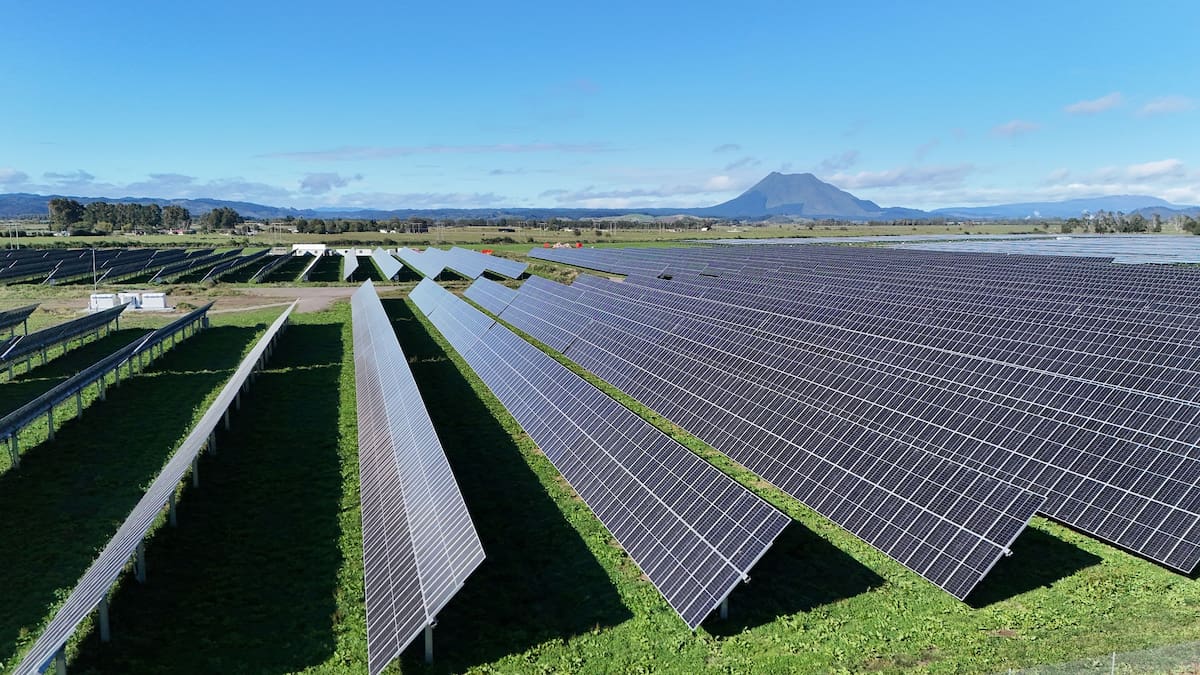
The company was founded in 2019 to bring utility-scale solar to the New Zealand electricity market.
Lodestone develops, constructs and operates utility-scale solar farms across New Zealand and sells the electricity it generates directly to consumers.
Since its inception, Lodestone has commissioned five solar farms.
In July, Lodestone said its Haldon Solar Farm, in the Mackenzie Basin, received a positive decision under the Fast-track Approvals Act, which is aimed at expediting approval for major infrastructure and development projects.
The decision, in final draft form, followed six months of detailed assessment by a fast-track panel.
The solar farm will be built on Haldon Station, one of New Zealand’s premier high-country stations.
The project, 14km southeast of Twizel, will cover 320ha and is expected to take 12-16 months to build at a cost of about $310 million.
Running in Lodestone’s favour has been a sharp fall in solar panel prices.
The International Energy Agency (IEA) estimates that global solar module prices fell by about 50% between 2023 and 2025.
The decline accelerated because manufacturers built a huge amount of new capacity, creating oversupply and intense competition, the IEA said.
Rising bond yields
US Treasury yields continue to spook world equity markets.
US yields are rising on the back of inflation concerns and weak demand at this week’s US five-year Treasury auction.
Meanwhile, oil prices rebounded sharply as comments from Iran President Masoud Pezeshkian tempered optimism around a full reopening the Strait of Hormuz.
US officials indicated the Administration was working with US refiners to voluntarily curb diesel exports.
The US Treasury yield hit 5.11% on Wednesday, having earlier traded at its highest level since 2007.
KMD outlook
KMD Brands (KMD) reported an improved 2026 result, with underlying earnings before interest, tax, depreciation and amortisation (ebitda) of $42m coming in slightly ahead of the guidance provided in July 2026 and more than doubling last year’s result of $18m.
Net debt also came in lower than expected at $48m.
Forsyth Barr noted that both the stronger earnings and lower debt results were supported by $8m of US tariff refunds received during the period.
“Nonetheless, we are encouraged by the operating momentum in the business, particularly for Kathmandu,” the broker said in an analyst’s note.
“We still remain cautious on the execution of balance-sheet deleveraging ahead of the $42m debt facility step-down in June 2027.”
The broker said KMD offers medium-term value if it can execute on its turnaround.
For 2027, KMD guided to a 1% increase in sales in 2027 and a 27% increase in underlying ebitda at the midpoint to $52m-$55m.
This implied an ebitda margin of 5%, it said.
The broker rated KMD as neutral.
Craigs Investment Partners was more critical, echoing the impact of the one-off tariff refund and foreign exchange tailwinds which inflated sales and gross margin.
“While sales guidance for the year ahead is understandably cautious, KMD’s ebitda guidance implies gross profit margin expansion of circa 190 basis points and operating expenditure growth of below 1.3% year-on-year,” Craigs said in a note.
“Given current inflationary pressures, rising interest rates and softening sentiment in Australia, we see this as a tall order.”
The broker was also critical of the business’ net debt position at year end. KMD forecast in July 2026 that net debt was expected to be between $63m-$66m.
“Given KMD raised $65m earlier this year, this implies that the group missed its original guidance by circa $73m.”
Craigs Investment Partners also rated KMD as neutral.
CDC applies for NSW
Infratil’s largest investment, Australian data centre firm CDC, has submitted a development application for a one-gigawatt (1GW) campus in rural New South Wales and started community engagement on a second 200MW site in Perth.
While the latter is within CDC’s 4GW disclosed total portfolio, the 1GW site is additional and the speed at which it is progressing through the consenting process could enable an accelerated development rate, Forsyth Barr noted.
“The reason to accelerate is clear: demand remains very strong, and levered development returns on data centres can be up to 20%.”
The broker was comfortable CDC can fund its developments forecast without additional equity.
But if CDC were to double its build rate, more equity may be required, it said.
“It is not yet clear CDC will accelerate development again, so we leave our forecasts unchanged, but Infratil has numerous options to recycle capital before a capital raise of its own is required, and given development returns remain elevated, the value created from such an acceleration could be meaningful,” it said.
Forsyth Barr has an “outperform” rating on Infratil.
Jamie Gray is an Auckland-based journalist, covering the financial markets, the primary sector and energy. He joined the Herald in 2011. With additional reporting by Tom Raynel.
Stay ahead with the latest market moves, corporate updates, and economic insights by subscribing to our Business newsletter – your essential weekly round-up of all the business news you need.