
Presumably this would mean a new government-funded office, with a budget in the tens of millions, deciding which advocacy groups deserve money: a lanyard-wearer in Wellington choosing which causes are legitimate and which are not. Whether Amnesty or Greenpeace would be treated the same way as the Free Speech Union remains to be seen. I suspect Hager knows the answer.
This is all eye-wateringly undemocratic. But Hager has accounted for that in his cynical framing of us. Our supporters are “the same angry on-call crowd” that can “drown out genuine community voices”. And apparently no one on our board represents the concerns of “socially aware people”, despite four of our board members hailing from ethnic minority groups.
Hager seems to believe the people who donate to us have been tricked, and that free speech isn’t really an issue at all. There was, he writes, “no real crisis”. In his view, our supporters have no agency, and no ability to make up their own minds without being told what to think and when to get angry. Which is presumably why, in his mind, shutting us down wouldn’t trample on the voices of ordinary New Zealanders or violate their right to democratic expression.
I think this all says more about him than it does about the Free Speech Union. It is very easy for those who are part of the intelligentsia, and who move in elite circles, to hold such a view. Social norms and mainstream narratives reinforce themselves, and people end up in bubbles, completely detached from the lives of everyday Kiwis. It is exactly this kind of patronising attitude that many people are sick and tired of having to deal with.
Hager and I come from very different worlds. By his own account, he grew up well off, in a family that owned a large clothing factory in Levin, and, to give him credit, he has spoken openly about his privileged upbringing. I grew up in South Auckland, in a working-class family. Dirt poor, by New Zealand standards. I’ve noticed that you can often tell which people on the left grew up in comfort, and which didn’t, by how relaxed they are about censoring those they disagree with.
Would a Kiwi who truly understood life on the margins push for the state to have the final word on who can and can’t organise? Would they try to discredit a union that has taken on case after case for ordinary, working-class Kiwis?
There is a kind of Free Speech Union derangement among the elite class, and beyond us, a hostility to grassroots organisations generally. Maybe it comes from the mainstream left’s inability to reach the working poor, or to speak their language anymore? The fact that so many everyday Kiwis give us small amounts to fight this fight proves we can reach the people in the Wellington bubble, and Nicky Hager, can’t.
New Zealanders who choose to support us are entitled to do so, regardless of whether or not Hager thinks they should care about our cause. And a writer concerned about the influence of money on democracy ought to recognise the danger in taking that choice away.
The Free Speech Union is a not-for-profit incorporated society and a registered trade union that describes itself as a separate organisation from the Taxpayers’ Union with separate governance and staff. The Taxpayers’ Union’s executive director Jordan Williams is one of the Free Speech Union’s co-founders and one of 11 members on the Free Speech Union Council.
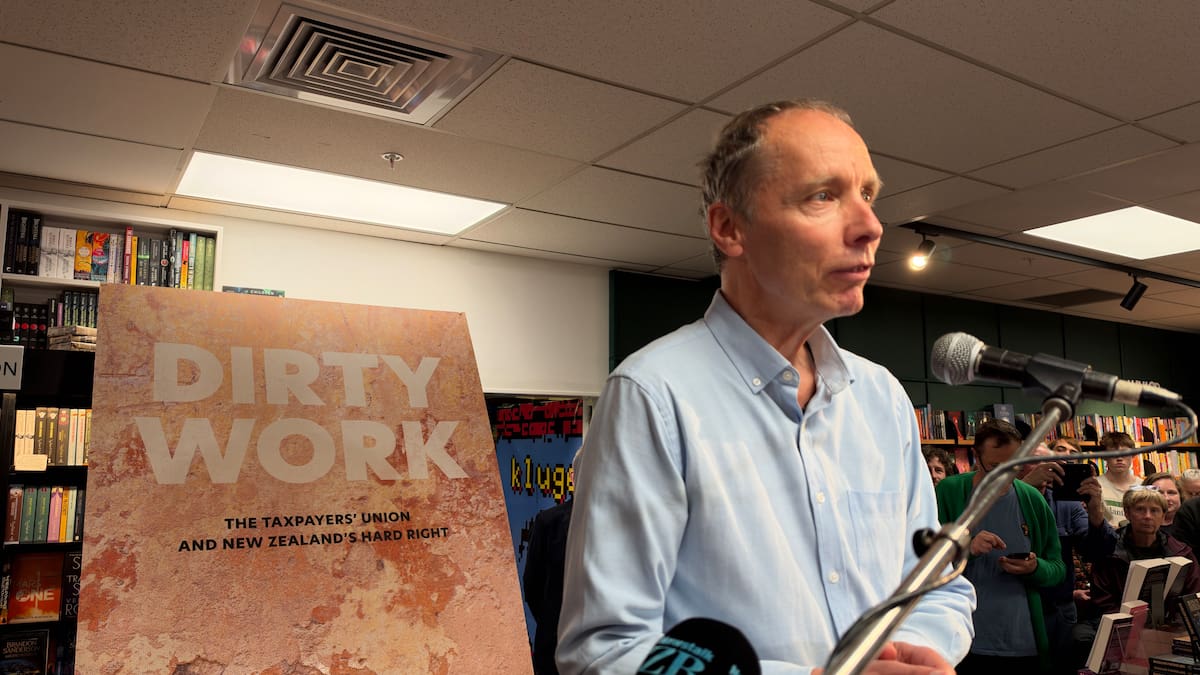
Nicky Hager’s book Dirty Work describes the Free Speech Union as part of Williams’ wider network of right-wing organisations, closely tied to the Taxpayers’ Union and sharing personnel, contacts and political causes.
Catch up on the debates that dominated the week by signing up to our Opinion newsletter – a weekly round-up of our best commentary.