
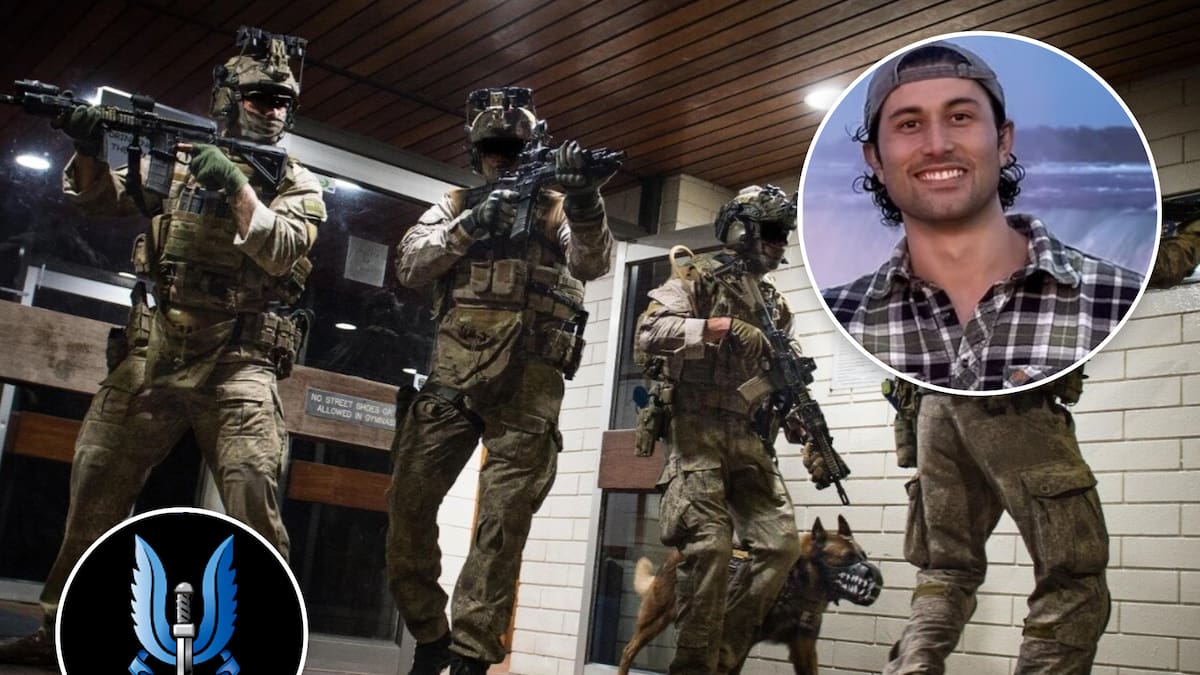
Conaglen’s departure from New Zealand earlier this year while on leave from the unit led NZDF to check whether he was still signed up while working for a private security contractor.
The checks were to resolve questions about whether he had begun such work before formally leaving.
An NZDF spokesperson said: “Lance Corporal Justin Conaglen went on leave without pay in March this year before releasing from the New Zealand Defence Force in August”.
It is unknown when he started other work.
Former NZSAS operator Justin Conaglen was a mountaineer and ultramarathon runner.
Conaglen is believed to have enlisted with the Royal NZ Air Force before undergoing selection to enter the NZSAS.
As a pathway into the elite unit, entry from the air force is unusual, with more NZSAS troopers entering through Navy and the majority through Army.
The Herald has been told there were logistical concerns around returning Conaglen’s body to New Zealand.
A Ministry of Foreign Affairs and Trade spokesperson said: “We are aware of reports of the death of a New Zealander, but we have not been approached for assistance”.
Records show Conaglen pushed himself to extremes as an endurance athlete and mountaineer.
He completed the Taupō 100km ultramarathon in 13 hours 46 minutes in 2020 and another 100km event the following year in 14 hours 52 minutes.
In 2023, Conaglen undertook a winter expedition to climb the 6920m Tukuche Peak in Nepal, with government records listing him as the only climbing member.
The move from the NZSAS into high-risk private security work overseas is not unusual.
The NZSAS has seen a high departure rate in recent years, particularly among experienced NCOs.
Its traditional feeder units – NZ Army infantry – have seen unusually high attrition, leaving fewer soldiers stepping forward to attempt the challenging selection course for the elite unit.
In 2024, the Herald reported senior military leaders were briefed that the NZSAS was “vulnerable to collapse” with a stream of departures cutting deeply into the Regiment’s numbers.
Last year the Herald reported the NZSAS Commando unit – known as D Squadron – was shelved with police reinforcing its counter-terrorism response.
Instead, NZSAS operators in A Squadron and B Squadron were to be called on for domestic terrorism incidents beyond police capabilities.
D Squadron, the ‘Commando’ unit of the NZSAS, was shelved.
Numbers have since fallen further, with the Herald told earlier this year only a handful of special forces operators remained in B Squadron.
With low personnel numbers, relatively inexperienced newcomers and a hollowed-out middle of experienced operators, prospects for significant offshore deployments are limited.
The Herald has been told that contributed to some departing operators seeking private-sector opportunities where they can use their skills and gain operational experience.
At the same time, the private-sector market for highly trained soldiers is growing as conflicts, political instability and attacks on shipping have increased demand for experienced military personnel.
The war in Ukraine has also drawn former soldiers looking to use their skills and gain experience in modern warfare.
The Herald has been told those who have served there are sought after on the wider security “circuit” for their experience gained on a battlefield at the forefront of drone, electronic warfare and other rapidly evolving military technology.
Africa is also offering significant work opportunities with a range of conflicts and other armed threats.
The Herald is aware of former NZSAS soldiers who have worked or are currently working in the Democratic Republic of Congo and in anti-piracy roles along the coast.
The work ranges from protecting executives, mines and energy projects to training local forces, operating drones, guarding ships and, at the sharpest end, supporting military operations.
Former special forces soldiers are particularly sought after, along with people with combat, intelligence, medical, communications and regional experience.
In Africa, foreign contractors have worked alongside government forces in the Democratic Republic of Congo while security companies operate across West Africa and around mining and energy projects.
North Kivu is a province in the eastern Democratic Republic of Congo which was the scene of much fighting during the Second Congo War and the Kivu conflict.
Other areas offering more contracts include maritime security around the Red Sea and Gulf of Aden, while contractors are also sought in Haiti and the Middle East.
Pay varies enormously, with contracts for foreign personnel in the Congo worth about $9000 a month.
Those with special forces experience are particularly sought after, with one current role offering $2000 a day plus expenses for specialist operators at the NZSAS level of capability.
The job offer was to provide personal security for “an executive conducting high-level engagements and logistical co-ordination around various sites within Ghana”.
David Fisher is based in Northland and has worked as a journalist for more than 30 years, winning multiple journalism awards including being twice named Reporter of the Year and being selected as one of a small number of Wolfson Press Fellows to Wolfson College, Cambridge. He joined the Herald in 2004.
Sign up to The Daily H, a free newsletter curated by our editors and delivered straight to your inbox every weekday.