
It led to the Lius’ company collapsing and owing creditors $73m, according to a July liquidators’ report.
To repay some of the debt, the High Court had already ordered the Lius’ remaining land be forcibly sold.
Now, Williams’ team has bought the land for an undisclosed sum, taking the title last month.
It was the second time in six years that a Williams company had bought its former partner’s land in a distressed sale.
Williams wouldn’t discuss the bad blood with the Lius.
But he told the Herald his “dominant feeling” now was that he could do the “right thing” by the land.
“We as a family have cared a lot about what happens to this land.”
Two sales, six years apart
An end to the legal stoush puts most of a 909-hectare block – one of Auckland’s largest private coastal landholdings, bigger than Devonport and Bayswater combined – back under the control of a single group.
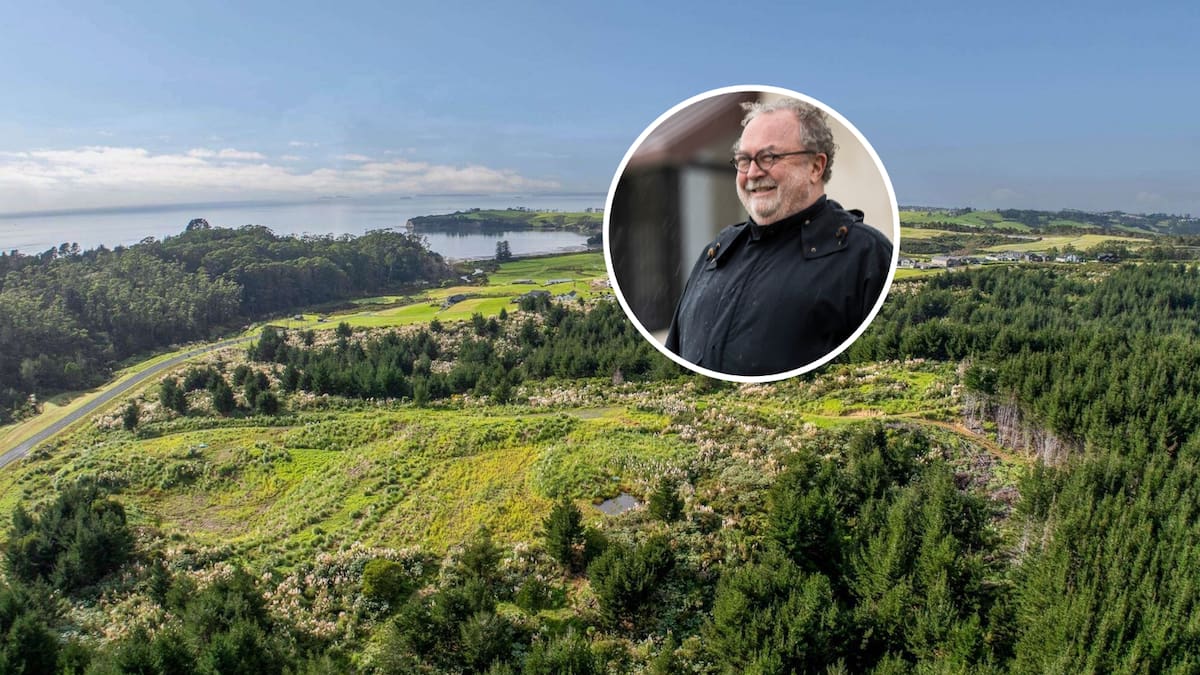
The failed Weiti housing project, south of Whangaparāoa and pictured here in a real estate listing, is next to a marine reserve and became the background for an epic legal showdown between tough businessmen that has resulted in millions of dollars in losses.
The land comprises four main parts.
The first, about 77ha on the coast, was successfully developed into a 150-lot gated subdivision called Weiti Bay, most of which is now privately owned by home owners.
Homes sold in the subdivision were not part of the recent court battles.
Next door, a 36ha site earmarked for more housing and known as Village 1 was sold unfinished in a 2020 mortgagee sale.
The latest land sale this year covered everything left over: a 24ha site called Village 2, earmarked for homes and shops, and 716ha of forested hills running down to the coast.
In 2020, Williams blindsided the Lius, emerging as the surprise buyer of their 36ha site after quickly forming a company and finding financial backers to complete the purchase.
Then this year, his company and its backers won the competitive tender to buy the rest of the undeveloped land, after it had been widely advertised by agents Barfoot & Thompson.
The cost of winning
Progress on developing the land had stalled while the legal battle raged.
In gaining control over all the undeveloped land in recent weeks, Williams’ team now has far more say over what happens to it.
But the fight has come at a cost.
His legal team told the Court of Appeal that his companies owed more than $27m to overseas lender Clearwater and were racking up about $350,000 in interest a month, according to a judgment released in May.
This image from a real estate listing for the forced sale of a second land tranche shows the Village 2 and extra Balance Land parcels that were put up for sale. Village Land 1 was bought earlier by a company controlled by developer Evan Williams.
A judge accepted that they were “haemorrhaging massive amounts of interest”.
With his family companies now owning the land, mortgaged to Clearwater, Williams told the Herald they were weighing up all options.
Those ranged from what he called “retain and develop” to selling the land outright.
In between there were “a dozen or so” possibilities, such as selling some parts, developing others and keeping some as land banks.
But any radical changes could face hurdles, such as the need to rezone the land.
‘Playing chicken’
In 2015, to secure loans to finance the first part of the proposed 1200-home project, the Lius agreed to mortgage part of their land.
Early-stage section sales were expected to repay the loans and deliver the family about $60m.
But in 2019, relations soured as sales stalled and the Lius were yet to receive any of the $60m.
Family head Tong Kuang Liu rejected a rescue plan presented by Williams, walking out of their meeting and later telling his sons that the developer was “worse than a snake”, according to court documents.
The Lius’ company then refused to release land titles to buyers unless it was paid first. A judge later found that the move “effectively tanked the development”.
With no money coming in to repay the loans, the lender put the mortgaged land up for a forced sale.
The family had bet that no one would want to buy the land, leaving the lender to accept a “haircut” on its loans and the family hoping to regain full control for far less, the judge found.
One lawyer called it “playing chicken with the unpaid mortgagee”.
Liu denied having a strategy and instead described himself as disengaging or “playing no ball”.
When Williams’ team bought the land in 2020, the Lius sued.
Development stalled in the Weiti land development as the legal battle raged on.
They claimed Williams had induced them to mortgage the land by playing down the risks, that the sale was a “sham”, and they had been “duped and conned”.
A High Court judge rejected every claim, saying the Lius’ company Green & McCahill Holdings was the “biggest loser”, but had itself to blame.
“Its strategy, deliberately adopted, backfired on it with disastrous consequences,” he wrote.
The road ahead
Williams told the Herald that, throughout the lengthy court battle and twists and turns, his team had to play “the cards that were presented”.
That meant they had no opportunity to plan what they would do with the land if they gained full control, he said.
In recent years, the area around the Weiti land had been transformed, Williams said.
A new 7km Penlink road will link State Highway 1 to the Whangaparāoa Peninsula, crossing the Weiti River on its way via a 535m bridge expected to be about as high as the Auckland Harbour Bridge.
The first stretch of the road, from the motorway to the Weiti land, was expected to open well before the bridge, giving the site faster access to the city, Williams said.
Having been landowners for only a few weeks, his team was ready to consider all options.
“Nobody could make decisions,” he said of the period during the legal fight. “Now we can.”