

Got questions? RNZ has a podcast, ‘No Stupid Questions’, with Susan Edmunds.
We’d love to hear more of your questions about money and the economy. You can send through written questions, like these ones, but even better, you can drop us a voice memo to our email questions@rnz.co.nz,
When was the last time that bank term deposits gave a return above inflation? Periodically, we’re told that New Zealanders are poor savers, but we need a mix of on-call cash and term deposits to deal with unexpected costs, as well as money in a mix of other investments.
With inflation running at 4.1 percent, and bank term deposits offering around 3.55 percent for 180 days and on-call savings rates offering between 0.5-2 percent, those emergency funds are giving negative returns. This is before considering the impact of Resident Withholding Tax, which adds insult to injury.
So when was the last time six-month bank term deposits gave customers a return above inflation?
Simplicity chief economist Shamubeel Eaqub has compiled this chart that gives an indication. This is based on Reserve Bank data on average six-month term deposit rates.
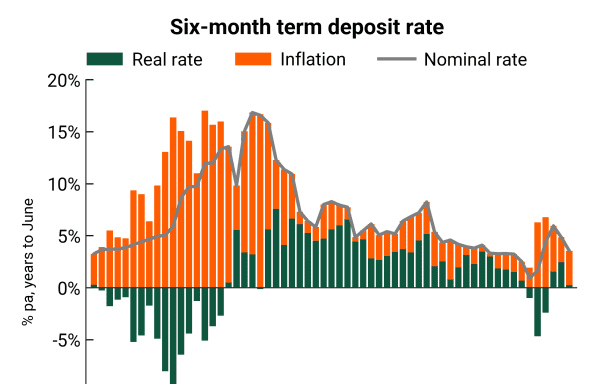
A comparison of six-month term deposit rates with inflation.
Supplied/Simplicity
As you can see, the return above inflation is currently very marginal. Through the Covid years, people with money in a six-month term deposit were, on average, going backwards by quite a bit – but not as much as during the high-inflation times of the 1970s.
It’s a good reminder that there is often a cost to having money in the bank, although I take your point that it is helpful to have some readily accessible.
I’m in a Milford moderate/conservative KiwiSaver fund. Since February, my current balance has fallen from $299,000 to $297,600 and, over that time, I put $1000 in. Is a negative return over the last seven months common in KiwiSaver providers?
I took your question to Murray Harris, who is KiwiSaver head at Milford.
He said the six-month return for the Milford KiwiSaver conservative fund to 31 August was a drop of 0.45 percent, which is in line with your experience.
“As you know, over short periods, even conservative funds can go down in value,” he said. “Conservative funds have been particularly impacted by rising local and global interest rates over the past six months, and even a bit longer.
“The one-year return for the fund is 1.12 percent after fees, but over the recommended minimum investment timeframe of three years, the fund has returned 5.89 percent per annum after fees and 6.45 percent per annum since inception.”
He is offering to put you in touch with someone who can work out whether the fund is the right fit for you.
I have a family trust and a memorandum of wishes. Do I need to have a will as well?
Michelle Pope, principal trustee at Public Trust, says a family trust and a will do different jobs, and most people with a trust still need a will.
“I explain it like this – a family trust deals with assets owned by the trust,” she says. “A will deals with assets you personally own and any debts you may have when you die.
“That means any assets still in your personal name will generally be dealt with through your will. This might include things like bank accounts, vehicles, personal belongings, KiwiSaver or property that was never transferred to the trust.
“You can also choose a guardian for your children through your will. It also deals with any debt owed to you by the trust and transfers powers you may have in relation to your trust, such as appointing or removing trustees.
“A will also appoints an executor, who has the legal authority to administer your estate. Even if you have a trust, someone still needs authority to manage any assets you personally own when you die.”
She says a memorandum of wishes or a statement of wishes is different again, because it provides guidance, but is not generally legally binding.
“When a family trust is established, it’s important to review your will to make sure it aligns with the trust deed and your wider estate planning intentions.
“One thing people can overlook is that assets are not always fully transferred to a trust just because the trust has been set up. In many cases, there may still be a debt owed by the trust back to the person who transferred the assets.
“That debt needs to be considered as part of the estate planning process.
“Here’s a simple example – you might transfer your home to a family trust, but the trust could still owe you the value of that home. That debt remains part of your estate, until it is forgiven, often through a deed or your will.
“That’s another reason why having a trust doesn’t remove the need for a will.”
I would be interested in your views on wills and enduring powers of attorney (EPAs) prepared using online services, which are cheaper than using a lawyer. Are online wills and EPAs legally valid in New Zealand, if they have been correctly completed and witnessed?
What are the main pitfalls or risks of using an online service, particularly in relation to complex family or financial circumstances? Is it worth paying more for a lawyer to prepare these documents, or can a reputable online service provide an adequate and cost-effective alternative for a straightforward situation?
Yes, a will or enduring power of attorney prepared online can be legally valid, as long as it meets all the legal requirements and there are no problems, such as the person not having capacity at the time the will was made or making the will under duress.
Pope said 77 percent of the wills Public Trust helped with last year were online and 70 percent of the EPAs.
“For many people with straightforward circumstances, an online service can be a convenient and cost-effective way to put these important documents in place.
“There’s been a proliferation of online will providers in recent years, which has made wills more accessible than ever before. The watch-out is whether the service can cater for your circumstances.
“Not all providers are set up to deal with more complex situations. For example, if you’re part of a blended family, own a business, have a separation or contracting-out agreement, own assets overseas, have beneficiaries with support needs or you’re concerned about estate claims, getting advice upfront can help avoid problems later.
“Public Trust’s online wills service can cover most scenarios, not just the straightforward ones. Whether your situation is simple or more complex, our online service is designed to guide you to the right level of support.
“It’s a secure, step-by-step process, if you’re wanting to prepare your will or EPAs from home, with support available if needed. If you’d like extra reassurance, you can also choose to have your documents reviewed by an expert before they’re finalised.”
She said it was always sensible to get professional advice, whether you’re working online or in-person.
“One of the biggest risks when it comes to creating a will or EPA is failing to properly execute it. A will generally needs to be correctly signed and witnessed to be legally valid.
“With an EPA, there are specific legal requirements around capacity and witnessing. The person making the EPA must understand what they’re signing, have the capacity to make those decisions and sign in front of an authorised witness, who is satisfied they understand the effect of the document and are signing voluntarily.
“‘Online’ simply describes how the document is prepared. The key question is not whether a document is created online, or in a lawyer’s or trustee company office – it’s whether it accurately reflects your wishes, and has been completed and signed correctly.”
I purchase items periodically for fundraising for a not-for-profit organisation I am involved with. They are purchased from one of those big cheap Chinese products websites.
I note that they suggest I can, if I put my tax details in, have the tax voided? I am a pensioner and pay tax on my pension, but nothing else.
They request my name and tax number. I have tried several times to put this in by selecting the country and then putting in my IRD number, but it doesn’t work.
I wondered if you know how this works or how I can make it work.
Deloitte tax partner Robyn Walker says she thinks this might be a reference to GST.
“We’ve had GST rules since 2019, which require non-resident retailers to register and charge New Zealand GST on sales below $1000 to end consumers – GST is paid directly to New Zealand Customs for imports over $1000.
“The supplier is likely registered for New Zealand GST and trying to determine whether New Zealand GST needs to be charged. GST does not need to be charged on sales to New Zealand GST-registered businesses, because they would just pay it and then claim it back in their GST return.
The non-profit is most likely GST-registered and able to claim back GST on the goods, so it is the non-profit’s name and GST number that should be used when purchasing the goods.”
Sign up for Money with Susan Edmunds, a weekly newsletter covering all the things that affect how we make and spend money.