
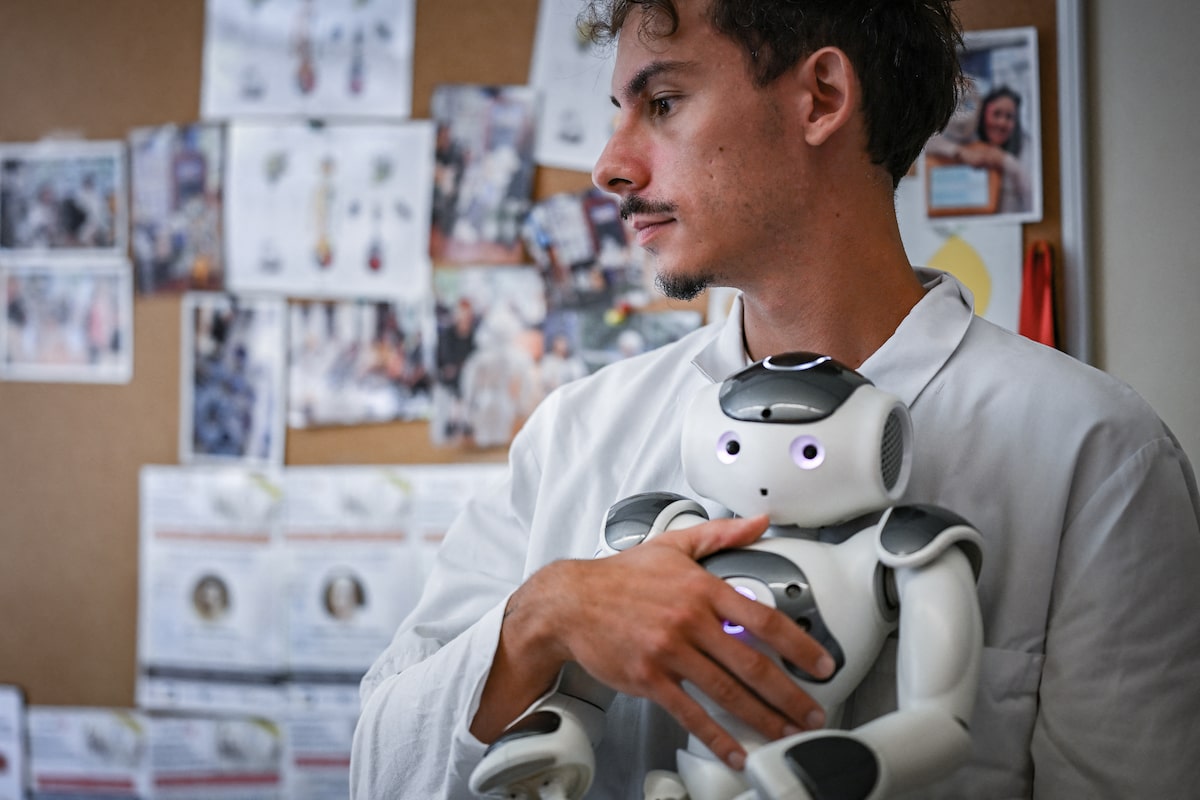
A caregiver holds a robot named Nao during a session at Paris’ Broca Hospital, Sept. 16.LOU BENOIST/AFP/Getty Images
D. Grant Campbell is the author of Surviving Dementia Care: The Realities of Family Caregiving.
You wouldn’t think a dementia ward was a place to ask the big questions surrounding artificial intelligence. When I interviewed people who were caring for relatives with dementia, AI never came up; when I visited dementia wards, we sang songs dating back to the Great War, without a thought for large language models. But if I’d had the foresight, I might have spotted a sign: one woman who sat without speaking, apparently oblivious to her surroundings, but cradling a plastic doll as if it were a baby.
Today, the plastic dolls are giving way to “socially assistive robots” that engage people with dementia in conversation. They may be physical robots, in the shape of dolls or animals, or they may simply be screens or apps on phones that speak and respond. Either way, the power of large language models makes them far more human-like than a plastic doll, and more versatile than the simple robots of 10 years ago, which could only wag their tails and respond to very basic stimuli. These programs can store information about the person’s preferences in music and food; they can engage in conversation; and they can remind people to eat meals, to take medication, and to participate in physical activity.
While early studies stop short of calling AI-based socially assistive robots a miracle, there is plenty of anecdotal evidence that they help; they appear to stimulate people with dementia to emerge from their quiet isolation to engage with those around them, and to provide an emotional affect that soothes anxiety, agitation and loneliness. Above all, they can operate, with unfailing courtesy and patience, at all hours of the day and night, no matter how many times someone asks the same question over and over again.
Can robots and AI companions help seniors feel less alone?
Should we be worried about this introduction of AI into the complex world of dementia care? As with any care environment, we should certainly watch for potential problems. AI systems are subject to artificial hallucinations, in which the system offers up false information as factual certainty; in cases involving medication or monitoring food allergies, they may not be trusted. At times, particularly when interacting with emotionally vulnerable people, AI agents can create a dependency, leading people to disregard the gestures and advice of family, friends and caregivers. And we need to remember that people with dementia, when communicating their thoughts, feelings or needs, are doing so with cognitive deficits that frequently scramble their vocabularies and force them to improvise unusual ways of expressing themselves. If a person asks a socially assistive robot the time over and over and over again, the robot may well answer with unfailing courtesy. Care must be taken, however, to ensure that the robot can discern the purpose behind the questions, which could be a simple desire for social contact, or could be an urgent need to use the toilet.
While these are reasons for concern, we can also expect robot companions to improve over time; with vigilance and good luck, they may turn out to be a great success. And success presents a whole new question: What if they’re better at caring than we humans are?
Let’s face it: Caring for a family member with dementia is something no one can be truly prepared for. It seems to last forever. No sooner do you master one challenge when you’re faced with another. At times, you feel unequal to the challenges, and in those times, you’re willing to consider just about anything to make that feeling go away, even telling an AI agent to do something you’re supposed to do yourself.
And here’s where AI is testing us at a deeper level. While socially assistive AI systems respond with unflagging patience and courtesy, what family member, however loving and devoted, can make that claim? Human caregivers have families and problems of their own; they have bad nights and anxiety disorders and upheavals at work and dark nights of the soul, like everyone else. As the years drag on, and as the loved one’s condition worsens, even the best, most resilient family members wear down.
How AI is helping people monitor loved ones without invading their privacy
If you’re an exhausted caregiver, how will you handle the presence of a robot that seems to do everything right, when nothing you do seems to be enough? Will you remain in the loved one’s life, with all your imperfections, your mistakes, and your painfully slow acquisition of skills? Or will you surrender to the temptation to make that sadness go away, to step back and let someone – or something – do your job better than you could?
Temptations like this are facing us every day in areas where AI is entering the picture – temptations to attain success by avoiding, rather than enduring, the pain and embarrassment of learning through failure. Steven Shaw and Gordon Nave call giving into this temptation “cognitive surrender”: sacrificing our human judgment, whether reasoning or intuition, to the outputs of an AI system. But the decision has a special urgency for the families of people with dementia; the very devices that are designed to encourage loved ones to engage with their families may well end up tempting families to disengage. Like overwhelmed students who turn their learning over to an AI agent, we can easily forget that our loved ones need more than a tool that performs with impeccable courtesy. They need us.