
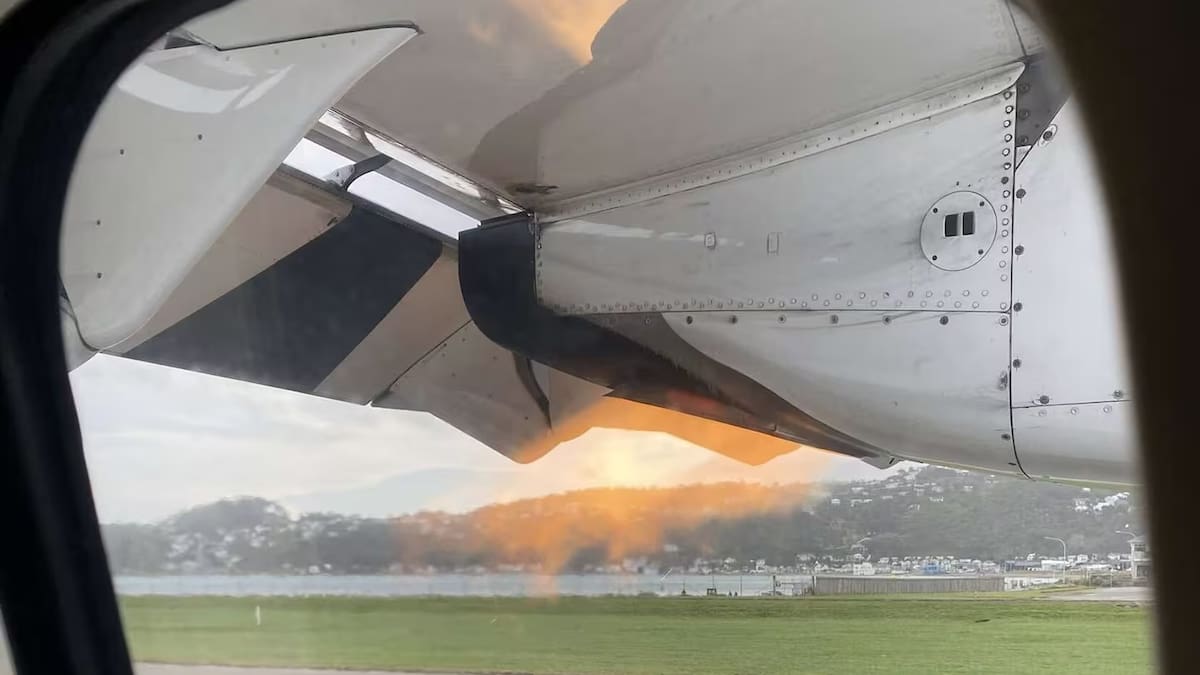
The Air New Zealand ATR72-600 was about to land when the left engine caught fire. A blade in one of the Pratt & Whitney Canada (P&WC) PW127M turboprop engines failed.
Passengers were evacuated with some minor injuries, and the left engine was damaged.
“An engine low-pressure turbine (LPT) blade failed. This caused a vibration and failure of internal air seals, which allowed oil to flow directly into the engine,” the report said.
The TAIC said it was virtually certain the fire was extinguished but because the fire warning light stayed illuminated, the captain ordered an evacuation.
Fatigue cracking caused the blade failure but the TAIC said it could not determine when that fatigue cracking started.
The TAIC said cracking was “likely” present during the overhaul, but not detected during the quality assurance process.
The flight had four crew and 70 passengers on board.
The ATR was cleared to land on the afternoon of Sunday, September 1 when oil pressure on the left engine fell at 4.03.49pm, setting off an auditory alarm and caution light to display.
The caution cleared but returned another three times in about 15 seconds.
Then the fire warning light illuminated. The captain stated “engine fire” and instructed the first officer to make a Mayday call.
The first officer made the call but the tower controller did not hear that because they were making a call on the same radio frequency, giving another plane conditional clearance to line up on the runway.
But the tower controller, watching through binoculars, saw smoke from one of the ATR’s engines and activated the tower’s emergency alarm.
Airport rescue fire service vehicles were dispatched.
The tower controller instructed the next aircraft on approach to abort its approach and go around, while telling all aircraft already on the ground not to move.
Inside the ATR, flight attendants and several passengers reported smoke or haze in the cabin and some passengers were starting to stand up.
An Air New Zealand ATR72-600, of the same type involved in the fire. Photo / John Weekes
“The flight attendant stationed at the front of the cabin made an announcement using the ATR’s public address system instructing passengers to sit down, which they did.”
Both engines were shut down.
A fire-agent bottle, generally installed in the engine cowling or fuselage, was discharged into the left engine nacelle, the housing that surrounds and protects an engine.
The left engine fire warning light stayed lit up, so the captain instructed the first officer to carry out the emergency evacuation checklist.
At 4.07.11pm, the captain announced “evacuate, evacuate” over the PA.
“The flight crew, after confirming the cabin was clear, vacated the aeroplane and joined the flight attendants who were with the largest group of passengers, downwind of the ATR.”
Timeline
4.06.05pm: Captain calls for evacuation checklist.4.07.11pm: Captain announces “evacuate, evacuate” over the PA.4:07.38pm: Aircraft rear-left door and stairs opened. 4.07.43pm: Forward-right exit window opened.4.07.46pm: Forward-left exit window jettisoned onto runway, first passengers leave down back stairs.4.10.01pm: Last passenger leaves through forward-right exit. 12 in total used this exit, 10 carrying baggage.4.10.02pm: Last passenger leaves through forward-left exit. 15 in total used this exit, eight of them carrying baggage. 4.10.18pm: Last passenger leaves through rear-left exit. 42 in total used this exit, an estimated 17 carrying baggage.
“There were some minor injuries during the evacuation, predominantly strains encountered when jumping from the forward two emergency exits,” the report said.
“However, all passengers were able to self-evacuate and walk to the assembly area from where they were eventually ferried to the terminal.”
By the time the ATR had landed, both flight attendants knew there was an emergency with the left engine.
They looked through the windows on the left side to see if there was any further smoke or obstruction.
The TAIC said the lack of an evacuation radio call by flight crew meant when evacuation started, rescue fire service crews had to shift from fire-fighting mode to passenger-control mode without notification.
“Several of the passengers who had evacuated using the forward-left exit moved to join the passengers evacuating using the rear-left stairs. This path took them near the left engine and the propeller,” the TAIC added.
Flying from Christchurch to Wellington, the left engine of the Air New Zealand turboprop caught fire. Photo / Lauren Crawford-Flett
‘Flashover’ danger point
The TAIC said aircraft manufacturers had to show their aircraft, in maximum passenger load configuration, could be evacuated within 90 seconds using only half the total number of emergency exits.
“The likelihood of survival reduces significantly after this time.”
That was because from 90 seconds, the conditions were conducive to “flashover” or near-simultaneous ignition of all combustible materials within a confined space.
In this case, the aircraft was full and evacuation took about 171 seconds.
“It was reported by several passengers that at least one fellow passenger did not hear the evacuation call because they were wearing headphones,” the TAIC said.
“Cabin crew need to be aware of this threat to help ensure passengers receive and understand safety-critical information in a timely manner.”
In other feedback, one passenger said they found the exit hatch heavier than expected, and its removal and disposal too complicated.
Others said they found exits surprisingly small and were surprised they had to jump nearly 1.83m to the ground.
“One passenger thought that there would be a slide available.”
Stairs or slides were not required for exits lower than 1.83m.
The aircraft in this incident had stairs at the rear.
“The videos of the evacuation show several passengers hesitating at the forward exits and requiring time to either pass or throw out their carry-on baggage and position themselves for the jump down,” the TAIC said.
There were no reports of loose baggage hindering passengers leaving their seats.
Flight attendants told passengers to leave their baggage but more than half the travellers took their baggage with them.
The TAIC said possible reasons were:
Not recalling the pre-flight safety briefing instruction to leave baggage behind. Not hearing crew instructions.When the flow of passengers exiting slowed, some passengers felt they had time to retrieve baggage. “Copycat behaviour” after seeing others retrieve baggage. Seeing no flames or smoke, so feeling no obvious sense of urgency. Deliberately ignoring instructions.
“Several passengers endangered themselves after evacuating by walking near the previously burning engine and propellers,” the TAIC added.
Simon Wallace, Aviation Industry Association chief executive, said the safety system on the ATR72 worked effectively so the fire was extinguished.
“But clearly there were aspects of the event that could be improved upon, especially concerning the evacuation,” he told the Herald.
He said issues including passenger uncertainty about whether to bring personal belongings could have caused more harm.
Wallace added: “It is worth the airline reviewing how safety instructions are communicated at the beginning of the flight, as well as how important it is for passengers to pay attention to these instructions.
“At times, safety briefings seemed to be seen as part of the entertainment rather than something to focus on,” he added.
There were no safety videos on board the Air NZ turboprop fleet.
But on this flight the safety briefing included the standardised statement that in case of an evacuation, passengers should leave all baggage behind.
Wallace said more generally, operators should consider whether safety videos were still effective in providing instructions.
Air NZ response
The TAIC said the airline had strengthened training about the use of the rear service door and was refreshing its safety briefing card to more accurately depict the exit height.
It said Air New Zealand in June this year said it was producing a new safety briefing card and strengthening rear service door training, as well as reviewing passenger safety videos and crew commands.
“The commission welcomes the safety action taken to date. However, as this safety action has not been fully implemented, the safety issue remains.”
Air New Zealand told the commission it had aligned cabin crew evacuation commands across fleets, including clear instructions for passengers to leave baggage behind, move quickly and move clear of the aircraft.
Nathan McGraw, Air New Zealand chief safety and risk officer, told the Herald: “Serious incidents like this are rare, but when they do happen, it’s important they are thoroughly investigated and we learn from them.“
McGraw said the airline was grateful to its crew who landed the aircraft safely and evacuated the passengers.
“TAIC found the fire was caused by fatigue in a turbine blade, with no evidence of an Air New Zealand maintenance or operating issue contributing to the failure,” he added.
“The report also identifies important lessons from the evacuation, which took longer than we would want … We accept the findings and have already made changes to strengthen our training, procedures, and passenger safety information.”
Save a life, not a bag
It seems not only New Zealand passengers might be prone to delaying their exits.
The International Air Transport Association (Iata) in June launched a “Save a Life, Not a Bag” campaign.
“The campaign responds to the growing number of cases where travellers have stopped to collect their baggage or take photos during aircraft evacuations,” Iata said at the time.
No bus driver
Wellington Airport had a bus permanently positioned for normal aircraft-to-terminal transfers. But it couldn’t be used on the day of the fire incident because the contracted driver was half an hour away.
Since then, the airport has contracted a bus operator to have a bus ready in no more than 10 minutes in case of an emergency.
The ATR was towed to a secure location and the runway was reopened at 4.47pm.
Engine examined
The left engine was removed and sent to P&WC manufacturing headquarters in Quebec, Canada.
An examination found engine centreline bearing housings were misaligned.
The low-pressure turbine disc showing the failed blade. Photo / P&WC via TAIC
“There was also evidence of circumferential rubbing and blade tip damage in this area, consistent with the core of the engine being misaligned and moving as it rotated,” the TAIC report added.
P&WC found a low-pressure turbine blade breaking loose caused the fire.
Examination of the remaining 46 LPT blades from the same low-pressure disc found another blade with a crack.
The Transportation Safety Board of Canada also investigated and said the blade failed because of “fatigue cracking” and that fatigue crack had likely been present since the blade entered service.
The TAIC said the blade failure caused the engine fire warning and a vibration in the engine causing some air seals to deteriorate.
That in turn allowed oil to leak directly into the engine.
“The combustion of the oil that had seeped on to the engine produced a large volume of smoke, and the temperature … increased to the point that the fire detection warning was activated. The burning oil also resulted in flames and a large volume of smoke coming from the engine exhaust.”
The TAIC said the Pratt & Whitney engine series had been in service for more than four decades, with more than 9000 engines produced, with no similar LPT blade failures ever identified before.
The TAIC found no evidence of a design, maintenance or operating issue to blame for the blade failing on approach to Wellington.
It said the LPT blade failed because of fatigue.
That fatigue should have been identified during engine overhaul procedures and must be addressed to ensure no repeat failures, TAIC said.
The New Zealand safety investigator said it made a recommendation to P&WC and given notice to the Canadian regulator.
“This was a rare but serious technical failure,” TAIC chief investigator of accidents Louise Cook said.
“It shows why maintenance assurance processes need to be strong enough to detect signs of fatigue before components return to service.”
John Weekes is a business journalist covering aviation. He also has experience covering consumer affairs, crime, politics and courts.
Stay ahead with the latest market moves, corporate updates, and economic insights by subscribing to our Business newsletter – your essential weekly round-up of all the business news you need.