
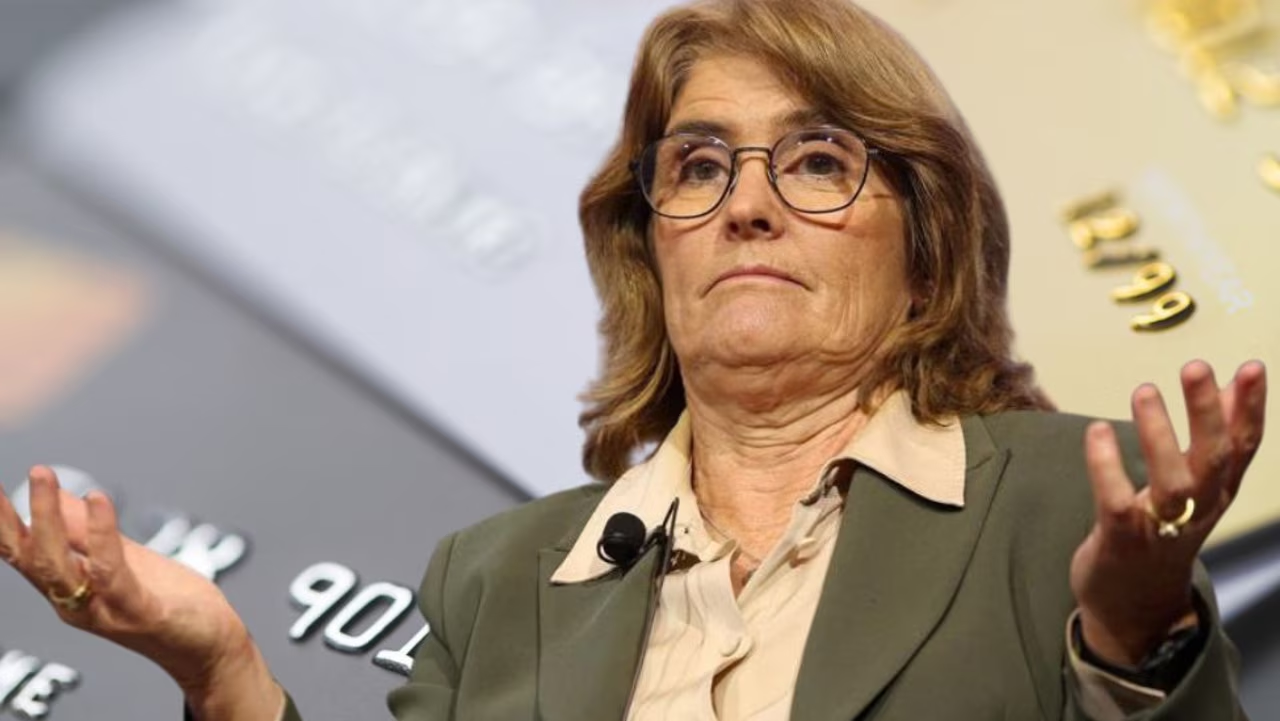
Millions of Australians will change their spending habits once the nation’s ban on card surcharges comes into effect in just four day’s time.
But despite the promise of lower additional fees, uncertainty remains over how it will really impact prices at the till.
Want more finance news? Download our new app and never miss a headline
The Reserve Bank of Australia (RBA) announced the ban on surcharging on debit and credit card purchases will kick in on October 1, ending more than 20 years of the divisive practice.
Some experts are tipping the change could reshape the way customers and businesses interact, with higher menu prices and discounts for cash payments potentially on the horizon.
The RBA has estimated $1.6 billion in savings for consumers each year – but industry figures have claimed that amount could be eaten up by increased advertised charges.
MORE:Aussie bank suddenly kills pay system, millions hit
‘Paying the higher price’
H & R Block’s director of tax communications Mark Chapman explained that card transaction fees racked up by businesses were fully tax deductible.
With that in mind, Mr Chapman said the decision for merchants would be how to deal with having to front the fees during the year.
That could either be upping prices, absorbing costs or finding a “half way house”.
“So this isn’t really a tax change,” he said.
“It’s more of a pricing change.
“The businesses do need to consider the way in which they price goods going forward.
“If they’re going to absorb the merchant fees themselves, they need to think about the implications of that on margins, because 1 or 2 per cent of their margins could potentially mean a difference between profits and losses.”
Mr Chapman explained why it was possible everyone would be paying more from Thursday.
MORE:RBA warns over major change in just days
“The way it’s currently done, the business might charge $100 and there might be a card fee of 15 cents,” he said.
“Going forward, the business can simply charge $100 and it can absorb the card fee.
“But that in effect means that they are only going to actually make $99.85 out of the transaction.
“Or alternatively, they can simply seek to pass it on to customers by increasing the price up to $100.15.
“So everybody, basically, will be paying the higher price whether they are paying by card or not.”
Meanwhile, Fumin Rianto, YouGov’s research director, said a recent survey found 53 per cent of Australians aged 18 and over expected to change their spending behaviour from October 1.
“You’re talking 10 million plus people there,” he said.
“And it’s even higher for Gen Z and millennials – 65 per cent of Gen Z and 63 per cent of millennials.
“So a lot of people expect their behaviour to change in one way or another after the ban comes into effect.”
The YouGov survey found 29 per cent of respondents expected more fees to be included in purchases, and 26 per cent were bracing for higher prices.
It also found 22 per cent of people would be less likely to avoid a particular business because of card fees.
“The other one that’s interesting is 18 per cent expect to make more small purchases by card … with the surcharge being removed,” Mr Rianto said.
“It might not sound like a big proportion, but 18 per cent of all Australians is nearly four million people.
“So millions of people expect to make more small purchases. And I think 11 per cent expect to spend more when paying by card … So about two million people expect to spend more on paying by card.”
Cash is king
Another YouGov finding was that 17 per cent of Aussies expected there to be “more discounts or incentives for using particular payment methods”.
Steve Worthington, a professor at Swinburne University of Technology, was on the same page and even mused that cash could come back into fashion from October.
Card surcharges, or the cost of processing a transaction, currently go directly to the terminal provider, but from Wednesday, businesses will have to either absorb or pass on this cost.
Prof Worthington said merchants might get around this by offering discounts for customers who pay in cash, “which could ultimately see businesses and consumers rethink how they pay”.
“We don’t know how merchants are going to deal with this idea of no surcharging,” he said.
“There may well be a number of them adding a little extra money onto the price of the products … but I think that we’ve all as consumers kind of wised up to this thing.
“Now the ACCC (Australian Competition and Consumer Commission) has said it is perfectly legal to offer discounts on cash.
“And that applies to tradies as well as to merchants.”
The RBA noted in its May report on consumer behaviour that the number of cash payments rose to 15 per cent in 2025, the first upward trend in decades.
Card payments were at 73 per cent, but had fallen slightly from 76 per cent in 2022.
Prof Worthington said the catch to his theory was that it had become harder to access cash due to a drop in the number of ATMs and bank branches, and that collecting cash can ironically be more costly.
“When you open the start of the day, you’ve got to have a float of cash in your tills, which is tied up overnight,” he said.
“Then you’ve got to keep your eye on that to avoid any shrinkage of people dipping into the till. Then at the end of the day, you’ve got to count all the cash. Sooner or later you’re going to have to find some open bank branch to put the cash into.
“There’s a lot of action required to actually hold cash.”
‘No one can afford to overpay’
Restaurant & Catering Australia president John Hart has warned the surcharge ban would squeeze businesses already struggling under strained margins.
He hoped, however, the RBA’s move to cap interchange fees charged by banks for card payments at a lower rate could ease some of that burden.
The cap on debit and prepaid card interchange is due to fall from 0.2 per cent to 0.16 per cent (or from 10 cents to 8 cents where a fixed fee applies), from 0.8 per cent to 0.3 per cent for consumer credit cards.
Mr Hart urged those in the industry to review their banking arrangements to make sure they were getting the best rate ahead of the changes.
“Now is the time for every restaurant, cafe and caterer to pull out their merchant statement and look at it closely,” he said.
“Ask your provider what you are paying on debit versus credit, and how the lower interchange fees will be passed on from 1 October.
“If the savings aren’t showing up, get comparison quotes and don’t be afraid to switch. No one in this industry can afford to be overpaying.”