
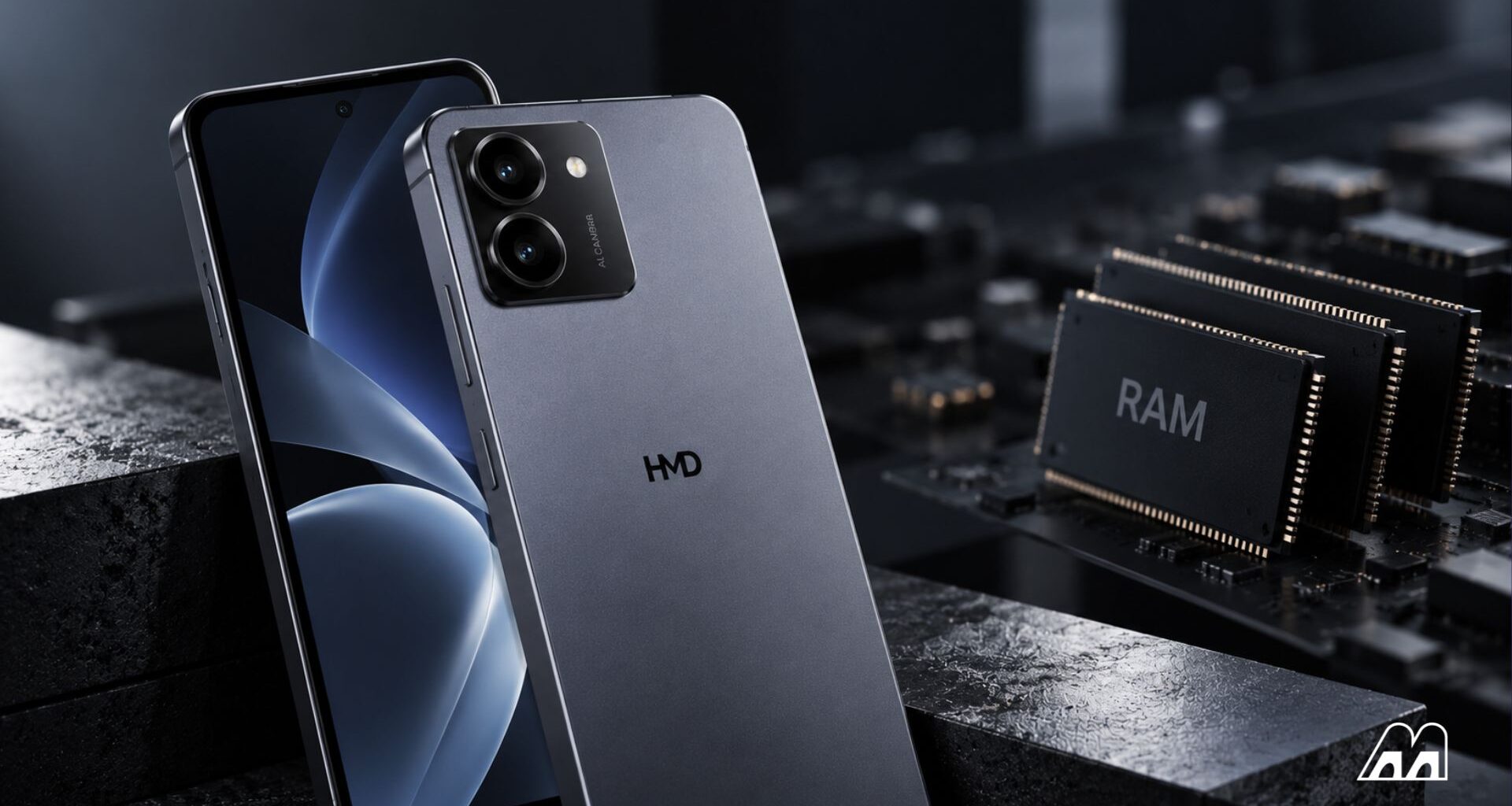
HMD’s next budget phone has leaked as the Aura 2 Pro, and GSMArena ended its report by admitting it could not tell what was supposed to be “Pro” about it. There is an answer, but it is more interesting than the leak itself, because when the Aura 2 Pro is set against the Aura 2 it would sit beside, it gains the kind of upgrades buyers notice in a shop, such as a bigger 90Hz screen, a faster chip and a 50MP camera, while quietly losing things that are harder to see on a spec sheet. That trade is becoming the pattern for cheap phones in 2026, as the AI-driven memory shortage squeezes the part of the market where every dollar of component cost matters most.
HMD Aura 2 Pro Specs: What the Leak Says
According to GSMArena’s report, which cites a source with a good record on HMD leaks, the Aura 2 Pro has a 6.75-inch LCD at 90Hz, a MediaTek Helio G81 chipset with 4GB of RAM and 128GB or 256GB of expandable storage, and a 5,000mAh battery with 10W charging. The rear carries a 50MP main camera next to a 0.08MP sensor and a 2MP sensor that GSMArena describes as decorative, the selfie camera is 5MP, and the phone runs Android 15 Go Edition with an IP52 rating, a side-mounted fingerprint reader and Bluetooth 5.0, in Meteor Black and Icy Blue. HMD has not confirmed the phone, its price or where it will be sold.
HMD Aura 2 (2025)HMD Aura 2 Pro (leak)HMD Aura 3 (April leak)Display6.52-inch, 576 x 12806.75-inch LCD, 90Hz6.75-inch HD+ LCD, 90HzChipsetUnisoc SC9863AMediaTek Helio G81Unisoc T606RAM and storage4GB / 256GB4GB / 128GB or 256GB4GB / 128GB or 256GBMain camera13MP50MP (plus 0.08MP and 2MP)50MP (plus 0.08MP)Battery5,000mAh, 10W5,000mAh, 10W6,000mAhSoftwareAndroid 14 GoAndroid 15 GoAndroid 15 GoDust and waterIP54 (EU models)IP52Not leakedBluetooth5.25.0Not leakedStatusOn sale since March 2025Unconfirmed leakUnconfirmed leak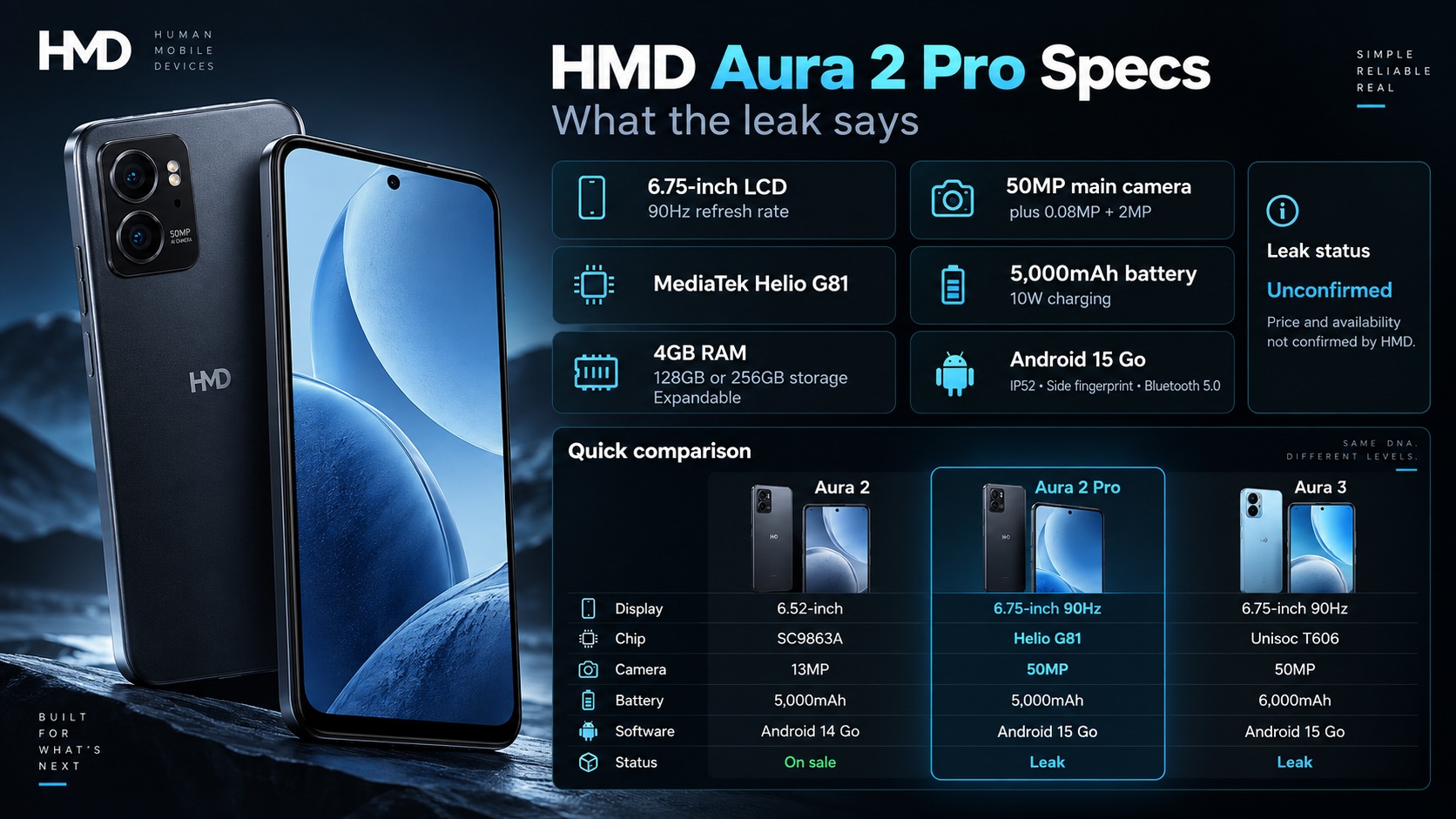 What Actually Makes the Aura 2 Pro “Pro”
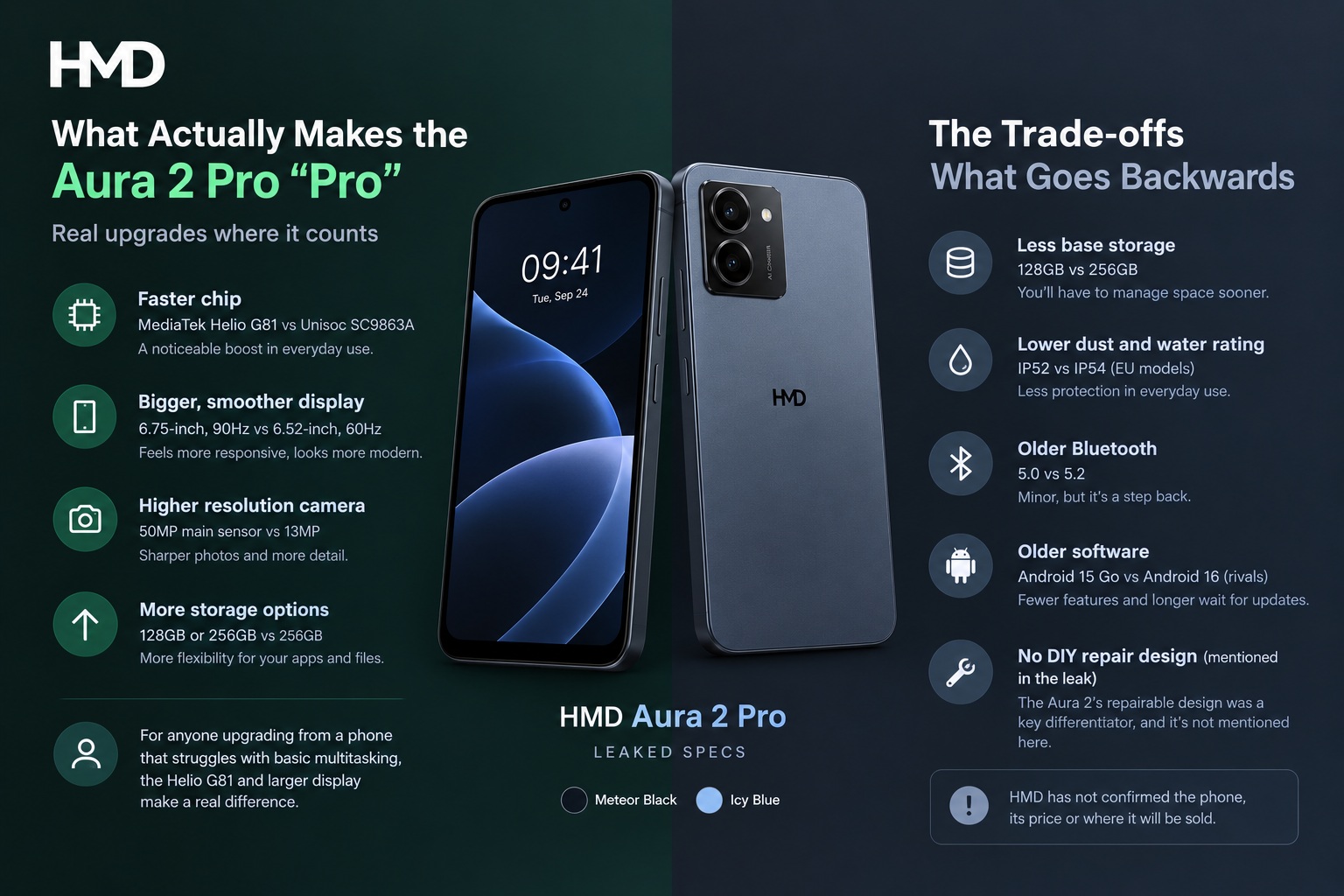
Compared with the Aura 2, which HMD sold for about €100, the Pro label does have something behind it. The Helio G81 is a clear step up from the 28nm Unisoc SC9863A, which relies only on low-power efficiency cores, and the move to a larger 90Hz display and a 50MP main sensor would make the phone feel quicker and look more modern in a store. For someone upgrading from a phone that struggles to open WhatsApp and a banking app at the same time, the processor alone would be a meaningful improvement.
The list of things that go backwards is just as long, though. Base storage would fall from 256GB to 128GB, the dust and water rating drops from the IP54 that EU models of the Aura 2 carried to IP52, and Bluetooth slips from 5.2 to 5.0. The software is Android 15 Go at a time when budget rivals such as the Mivi One 5G are launching on Android 16, and nothing in the leak mentions the repair-it-yourself design that made the Aura 2 stand out, with a display, back cover, battery and charging port that owners could replace themselves.
The Aura 3 Leak Makes the Name Even Harder to Explain
The naming gets stranger when the Aura 2 Pro is compared with a phone that leaked months earlier. In April, the same tipster published specifications for an Aura 3 with a 6.75-inch HD+ 90Hz display, a Unisoc T606, 4GB of RAM with 128GB or 256GB of storage, a 50MP main camera with a 0.08MP helper, a 6,000mAh battery and Android 15 Go, and said it would launch in Nigeria at ₦94,900, IT Home reported. Apart from the chipset and a smaller battery, the Aura 2 Pro described this week looks almost identical.
If both leaks are accurate, HMD is preparing a “Pro” version of an older model that shares most of its hardware with the newer one, and gives up 1,000mAh of battery in the process. There are plausible reasons for that, such as selling different versions in different regions or using whichever chipset is available in quantity, but for buyers the result is a name that says very little about what is inside the box.
Upgrades You Can See, Cuts You Cannot
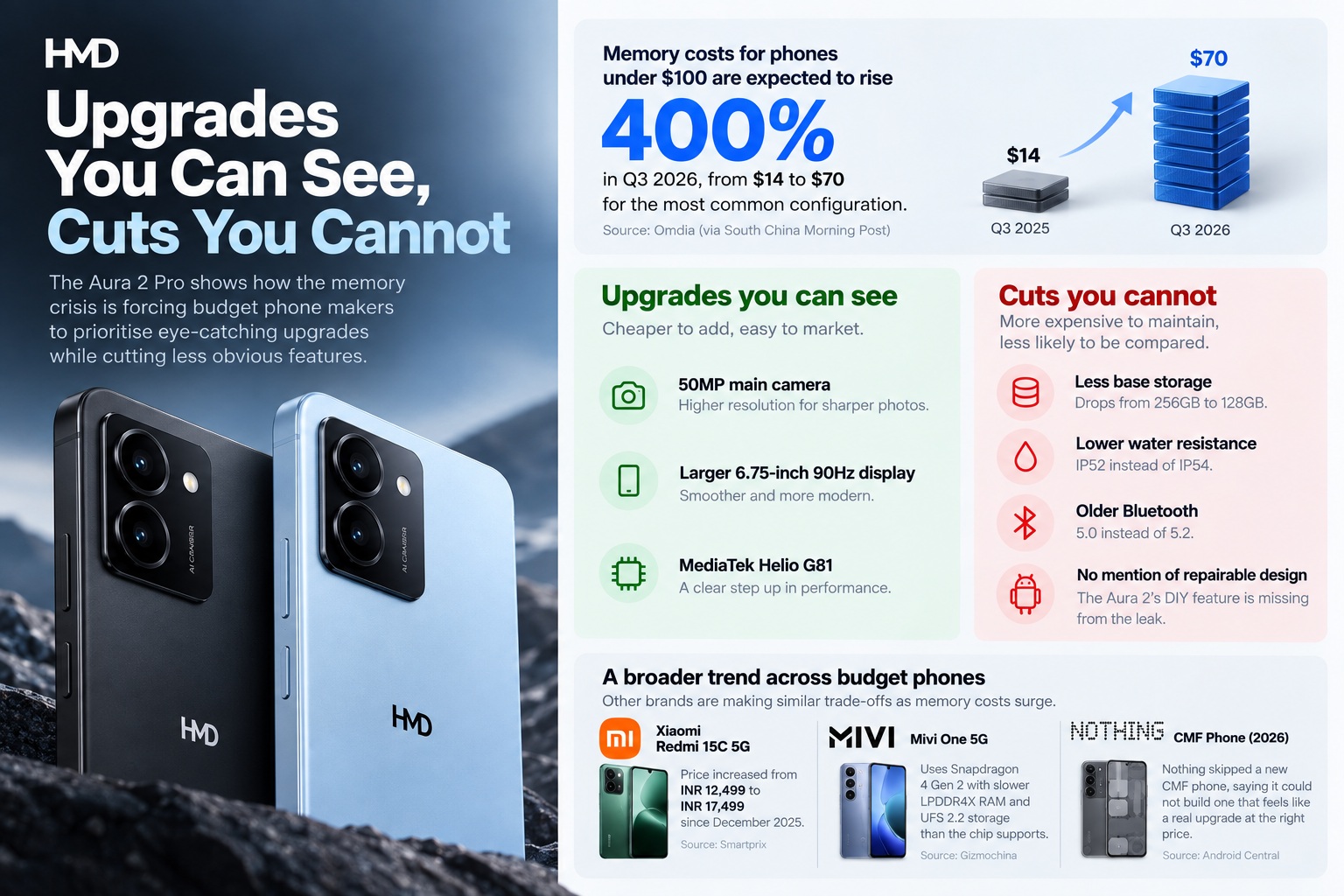
The Aura 2 Pro fits a wider shift in cheap phones this year. Memory has become the most expensive problem in the budget segment, with Omdia expecting memory costs for phones under $100 to rise 400% in the third quarter of 2026, lifting the memory bill for the most common configuration to $70 from $14 a year earlier, the South China Morning Post reported. When memory takes that much of the budget, a manufacturer has two choices, which are to raise prices or to trim the specifications buyers are least likely to compare.
Both are happening at once. Xiaomi’s Redmi 15C 5G launched at INR 12,499 in December 2025 and is now listed at INR 17,499 on Smartprix’s price tracker, while newcomer Mivi launched its One 5G this week with a 2023 Snapdragon 4 Gen 2 and paired it with slower LPDDR4X RAM and UFS 2.2 storage than the chip supports, according to Gizmochina. Nothing went further and skipped a new CMF phone for 2026, with co-founder Akis Evangelidis saying the company could not build one that felt like a genuine step forward at the right price, Android Central reported.
The Aura 2 Pro follows the same logic from the other direction. A 50MP sensor, a 90Hz panel and a faster chip are cheap relative to memory and easy to advertise, whereas the storage tier, the IP rating, the Bluetooth version and the Android release are details most buyers of a sub-€150 phone never check. The global RAM shortage driven by AI demand has made that trade attractive for every manufacturer in this price band, and it is one reason analysts expect the smartphone market to shrink sharply in 2026.
Why African Buyers Will Feel It First
The Aura line has been aimed squarely at price-sensitive markets. HMD launched the original Aura in Kenya in 2024 from KES 13,000, HapaKenya reported, and the Aura 3 leak pointed to Nigeria as its launch market. These are the segments where memory makes up the largest share of a phone’s cost, so they are where the shift from “more of everything” to “more of what shows” will be most visible. In markets led by Tecno, Infinix, itel and Xiaomi, a brand like HMD cannot easily win on price, which makes a visible upgrade and a “Pro” badge a tempting substitute.
What to Check Before Buying a Budget Phone in 2026
For anyone shopping at this level over the next year, the headline specs are the least useful part of the listing, and a few quieter details say more about how the phone will age.
Check the base storage and RAM type first, since manufacturers are now trimming these before anything else, and a 128GB model on Android Go can fill up quickly once apps and updates pile up.Look for the Android version at launch and the number of promised updates, because a phone that starts on Android 15 in late 2026 is already a year behind rivals shipping Android 16.Compare the IP rating and charging speed with the previous model rather than with competitors, since these are the specs most likely to have quietly slipped.Treat labels such as “Pro” as marketing until reviews confirm what they add, especially when a cheaper sibling or a newer model shares most of the same hardware.FAQsWhat are the HMD Aura 2 Pro specs?
According to leaks, the Aura 2 Pro has a 6.75-inch 90Hz LCD, a Helio G81 chip, 4GB of RAM, 128GB or 256GB of storage, a 50MP main camera, a 5,000mAh battery with 10W charging, Android 15 Go, IP52 and Bluetooth 5.0.
Has HMD confirmed the Aura 2 Pro?
No. The specifications and renders come from a leak, and HMD has not announced the phone, its price or its release date.
How is the Aura 2 Pro different from the Aura 2?
It adds a larger 90Hz screen, a faster Helio G81 chip and a 50MP camera, but the leak points to lower base storage, a weaker IP52 rating, older Bluetooth 5.0 and no mention of the Aura 2’s self-repair design.
Is the Aura 2 Pro the same as the Aura 3?
Not exactly. An April leak described an Aura 3 with very similar specs but a Unisoc T606 chip and a larger 6,000mAh battery. Neither phone has been confirmed.
Why are budget phones cutting specs in 2026?
Memory prices have risen sharply because of AI demand, and Omdia expects memory costs for phones under $100 to rise 400% in the third quarter of 2026, so manufacturers are raising prices or trimming less visible specs.