
The joys of reading novels
It’s been a while since I wrote a post for this blog—eight years, in fact. My last was titled “Moving On,” and here I still am, moved on and coming back. In those eight years, I have continued to live with my husband on an off-grid island 100km off the northeast coast of Aotearoa New Zealand, and have continued to write novels and have gone backward rather than forward when it comes to learning how to write them.
The more years that pass, the more workshops I do (mostly as a student, sometimes as the teacher) and, on the plus side, the more novels I read. My old blog posts were about “brains, books and being happy,” but the focus of my new posts will be mainly novels (by both women and men, many recent publications but some published years ago) and why reading them is good for us, from the point of view of someone who is interested in psychology, mental health, well-being, and happiness. All of us, I hope!
I belong to NetGalley, a platform where publishers and authors upload advance reader copies (ARCs) of their books and audiobooks (fiction and nonfiction) months before they are published, and members can request them. If their request is granted, it is hoped that they will review the book and post their review on as many platforms as possible (Goodreads, Amazon, etc.). Any avid reader can register as a reader or reviewer member of NetGalley. There is also a UK branch. So far, I have reviewed 318 books, which marks me as an active member and gives me “Professional Reader” status. Now I often receive e-mails from publishers asking if they can send me a digital ARC.
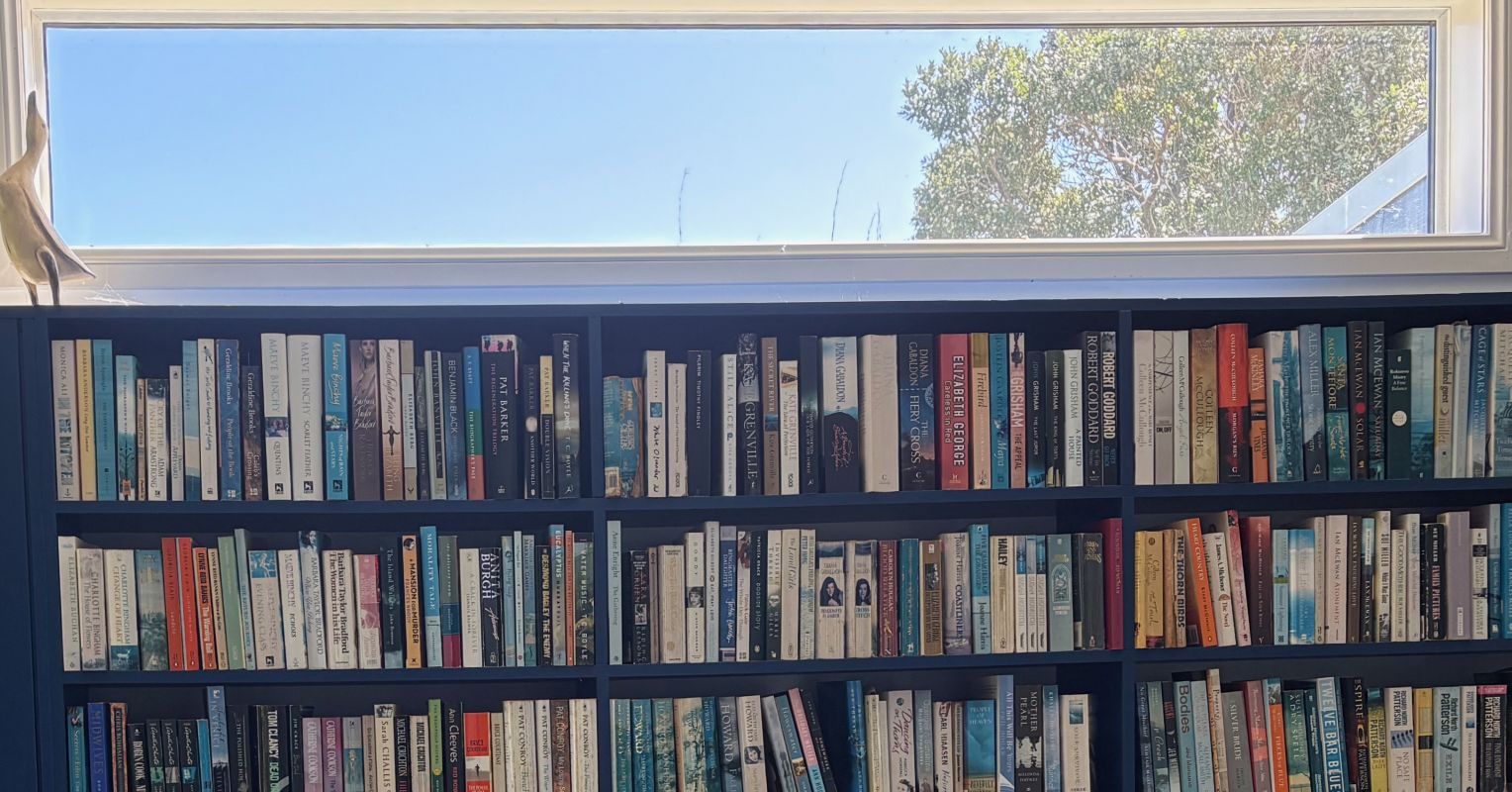
But, of course, I also purchase many books myself because I am addicted. If I read a great review or listen to one of the excellent author interview podcasts available—the UK Waterstones podcast is my favorite—while walking our beach, AirPods allowing me to also hear the sea and the birds perfectly clearly, I’ll likely have the book on my Kindle that same day. Like many readers, I love print books, and my study, where I am writing this, is also our library (photo above).
Public libraries are precious, but not everyone has a library nearby. Living here and reading as many books as I do, if I purchased every book in its printed form, we may have to sell our house, and then where would we put them all? Also, books published in the U.S. or UK can take a long time to make it into NZ bookstores. So I admit, I love my Kindle.
I don’t think it matters how you consume a book: print, e-book, or audiobook. It is still a book. E-books tend to be much cheaper and thus less likely to be a barrier to those with less money. That can only be good.
And for the author, it is far better to have a thousand readers than 20. One of the arguments of traditional publishers is that purchasing print books will provide the author with more money. This is often not true. The royalty rate an author gets on an e-book is usually much higher than on a print book, as the surge in successful self-published authors who make a living from their books attests.
So why do we read novels, or if we don’t (perhaps because we don’t have time), why might we try to fit reading a novel more frequently into our days—or nights? First and foremost, we read novels for pleasure, pure and simple. A way to escape for a while, or a way to relax yourself to sleep. So don’t feel every novel has to be more than that.
But often the novel we can’t put down or continue to think about long after we have reluctantly closed the book is a story that draws us into the minds of the characters, helping us to feel what they feel, perhaps echoing feelings and situations we have experienced in the past or are experiencing in our current lives. This empathy that we feel is perhaps the most remarkable “emotion” that stories can foster. That the written word can be such a powerful stimulus for empathy depends on the reader’s ability to imagine those worlds and the characters and their lives that are described on the page. (And the author’s ability to turn their own imagination into words.)
When we watch a TV drama, our imaginations don’t have to do so much work; many of you will know how easy it is to tear up when someone on the screen cries, even more so if it is the news and a real story. But perhaps a written story can be even more powerful because we can read it at our own pace and stop and reflect on it.
Imagination Essential Reads
Becoming immersed in a story told from the perspective of someone completely outside of our own experience helps us understand diverse perspectives. Historical novels can immerse us in a past era, while science fiction can immerse us in the future. Funny stories that make us laugh, especially those gems that result in fits of giggles, have multiple positive effects on our bodies and mental health. Fully engaged laughter, the sort you couldn’t suppress if you tried, has been linked to about a 30 percent reduction in cortisol, a hormone related to stress. Laughter also releases feel-good brain chemicals like dopamine and serotonin.
Novels that we find difficult to stop thinking about, the ones we want to talk about with our friends and book clubs, are the stories that challenge or support our belief systems, provoke discussion, and sometimes change our behavior. They are the novels that we learn from; fictional characters who find ways to cope with shame or loneliness, loss or grief, can show us new ways that, in time, we too might try. And characters don’t have to be human; they can be a dog or a horse or ET. But human characters, animals, and aliens whose feelings we can empathize with aren’t the only ways a well-told story can evoke empathy or grief. I have found myself in tears when reading a story about a dying coral reef.
I have in my previous posts often written about books, including this one on bibliotherapy. This is a practice where, following an in-depth clinical assessment by a highly trained bibliotherapist (not me!), specific books are then prescribed for the client to read, with the intention of enriching and inspiring the client, as well as speaking to their special problems.
In each new post after this introductory one, I will take one novel (or occasionally a nonfiction book that has empathy at its heart) that I have rated 5/5 and, without of course revealing too much about the story, look at how a reader might learn something about themselves and their own lives and interactions and emotions by thinking about or like those fictional characters. Perhaps I’ll also venture into the emotional and psychological ups and downs of writing fiction. I’ll post my first book blog in a few days, and after that I’ll aim to post once a month, featuring a different book in each blog. At first, most of these will be those sorts of novels book clubs love to read because they raise interesting discussion questions. These can of course cover a wide range: contemporary, historical, cozy mysteries, literary fiction, even thrillers! Hopefully, you will find some novels to read along the way.
I hope we connect again soon through our mutual love of novels! Thank you for reading.