
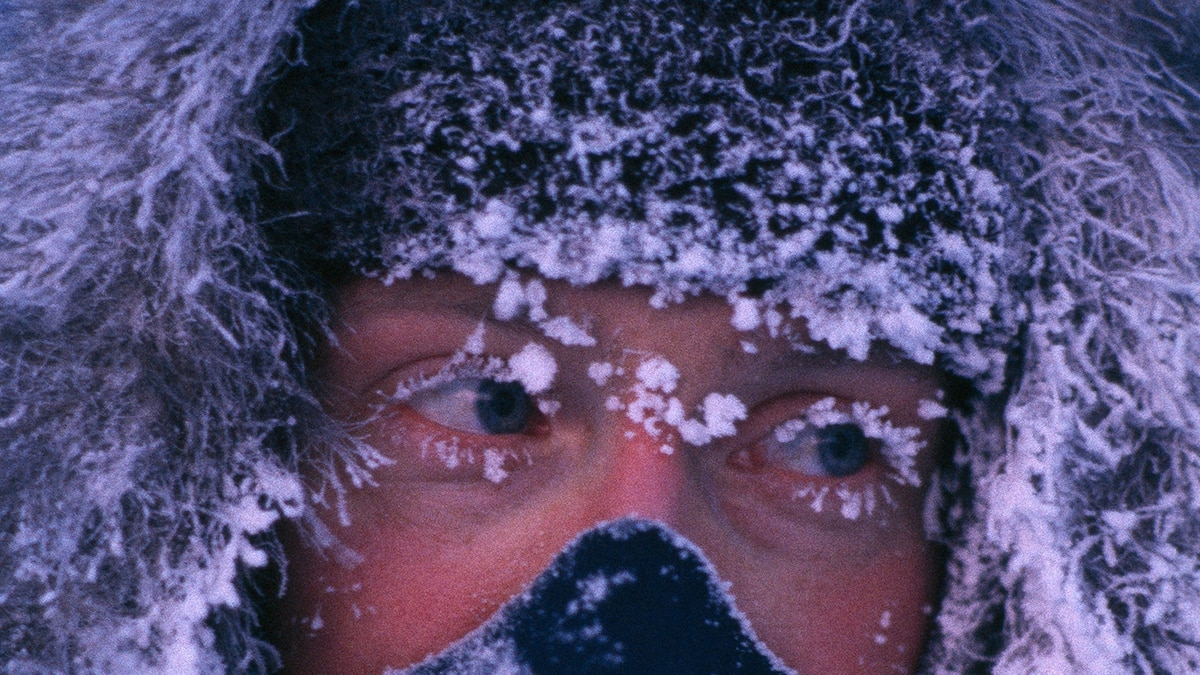
Such visual aids, however, could be wiped out in seconds by fog, low overcast, or blowing snow. These whiteouts obliterated all visual clues of depth, height, and distance and made us feel as though we were suspended in skim milk.
The maxim of polar travel when whiteouts develop is to make camp and sleep until visibility returns. Late in our journey we tested that maxim and lost. When we were only 30 miles from the Pole, heavy cloud cover and light fog enveloped us. By then we were hell-bent to reach our goal, and we traveled blindly on, trying to navigate by means of the wind, which kept shifting, and sastrugi we could barely see.
Six hours later when the sun blinked through the clouds, Paul saw our dogs’ shadows and knew instantly that they were in the wrong place—we were traveling more west than north. We followed the maxim then, made camp, and slept. Paul’s later position fix confirmed we had been off course.
On Day 32 a wild coincidence took place—we ran into the French polar explorer Jean-Louis Etienne. We had left at different times from different jumping-off points, and our routes were not coordinated. Yet in the hundreds of thousands of square miles of trackless polar wastes we nonetheless crossed paths. I noted it in my journal:
DAY 32 (APRIL 8)—Richard was scouting as usual and ran into ski tracks that I figured were two days old. There is only one person on the polar sea, and that is Jean-Louis, traveling solo to the North Pole by skis, pulling a sled. We lost the trail rapidly—the storm here had done a good job covering it up, and it was heading over terrain too difficult for our dogs….Later in the day….I heard something. My dogs made a lunge at forty-five degrees to the right, and l caught a dark figure simultaneously. It was the Frenchman. He was camped on the other side of a pressure ridge…Heard our dogs and went out to investigate.
On April 10 Jean-Louis pushed on ahead of us, traveling far lighter thanks to regular resupply by air. Nevertheless, our route and longer hours of travel got us to the Pole ten days ahead of him, but we were delighted that he, too, succeeded.
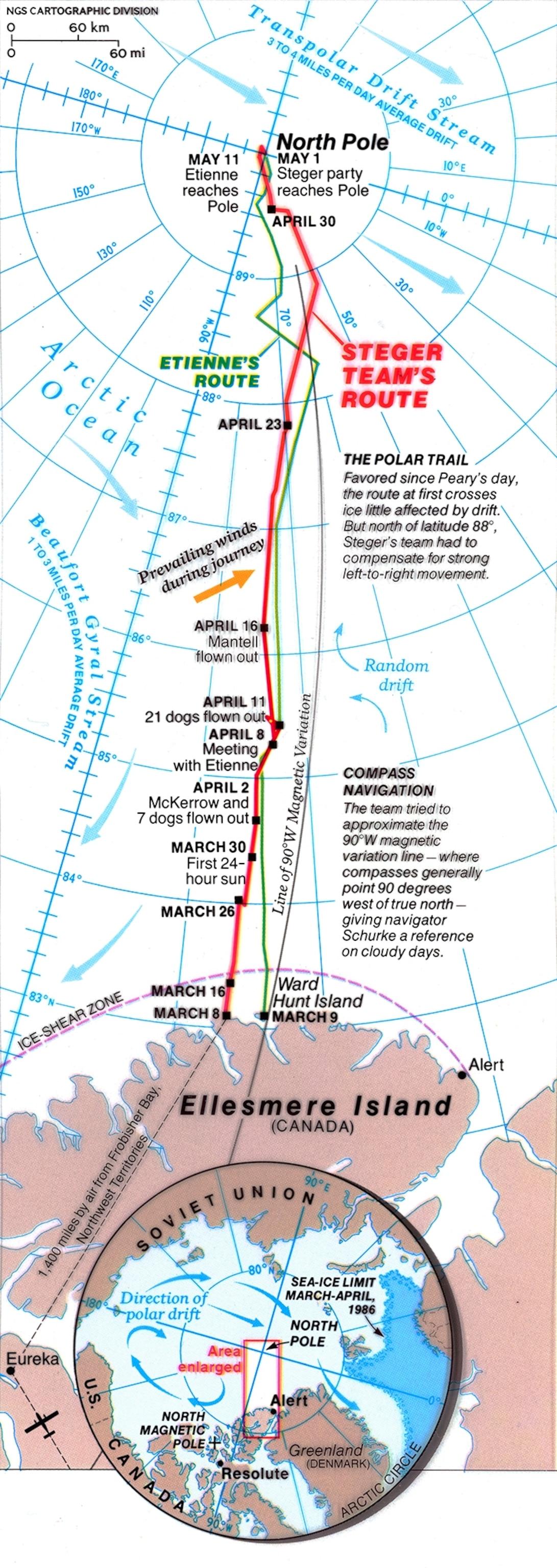
After three years of planning, the explorers set out during the “window” between March, when the sun first shines within the Arctic Circle, and May, when a perilous thaw begins. They mushed a thousand punishing miles about double the straight-line distance succeeding after nearly two months. On April 8 they encountered French explorer Jean-Louis Etienne on his solo journey—which is shown in green.
NGS Cartographic Division, Nat Geo Image Collection
On Day 35 we had the final dog pickup, airlifting out 21 animals and keeping 21 others in three teams of seven each. The sled loads were now down to 700 pounds each, we had come only 170 miles, and we had nearly twice that distance still to go. We faced a real crisis, and my journal reflects the argument that ensued over it:
DAY 35 (APRIL 11)—Paul and I feel the handwriting is on the wall. We are not going to get seven people to the Pole….The only way…is the way Peary did it—the mountain-climbing, pyramidal approach, gradually cutting back on the team’s size, and thus payload, to ensure that at least a few members reach the top.
Brent, Geoff, and Bob share these feelings….Ann and Richard cling desperately to the hope that we can still get all of us there, disregarding the dismal-rations arithmetic that we are faced with.
In the end we compromised, jettisoning some 300 pounds of precious equipment, including two sleeping bags. We zipped four single bags into two doubles and slept three people in each, a situation that was to yield a memorable passage in Ann’s journal: