

The latest report from the college of emergency department doctors shows unprecedented demand and increasing case complexity are taking a toll.
The country’s first ‘State of Emergency’ report, by the Australasian College for Emergency Medicine (ACEM), shows record-high ED presentations – more than 1.4 million annually, up 21 percent from 2015-16.
That’s compared to population growth in the same period of 13 percent.
ACEM Aotearoa New Zealand council chair Dr Michael Connelly said the report was a reality check, and a call to action.
“Rising presentations, more complexity, and loss of capacity is being felt everywhere,” he said.
“Privacy is at a premium, with patients being cared for in corridors and ambulance bays within a metre or two of a complete stranger also needing high-level care.”
Treating patients in corridors was an “everyday occurrence”, Connelly told RNZ.
The report notes that, between 2015 and 2024, inpatient bed supply fell from 2.7 to 2.5 beds per 1000 population – which meant while the absolute number of hospital beds increased, it had not kept pace with population growth and demand.
It was also well below the OECD average of 4.2 beds per 1000 people in 2023.
ED presentation data was sourced from Health New Zealand, which covered a total of 40 hospitals across Aotearoa.
In the latest government target data (March to June 2026), half of the country’s emergency departments showed an improvement in wait times from the last quarter, but half had declined.
Palmerston North Hospital patients faced the biggest waits in the latest stats – with just 55 percent of patients through the department within six hours, a drop on the last quarter – and Capital and Coast came in second to last with 63 percent, although that was an improvement on the last quarter. ED patients in West Coast, South Canterbury and Tai Rāwhiti fared best in the latest stats, with 90 percent seen within six hours.
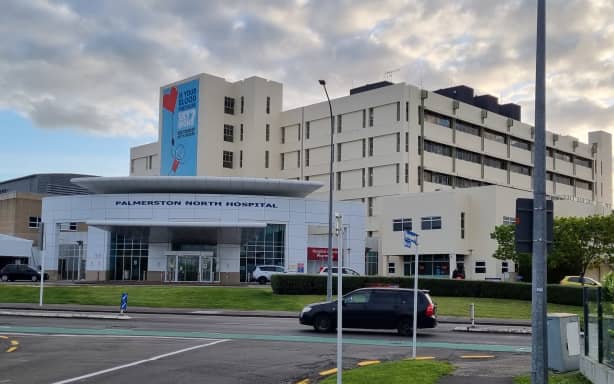
Palmerston North Hospital patients faced the biggest waits in the latest stats.
RNZ / Jimmy Ellingham
According to the ACEM report, 66 percent of ED presentations were triaged as high urgency – that is, categorised one to three on the Australasian Triage Scale – in 2024-25. That’s up from 55 percent in 2015-16.
Māori patients attending the ED rose by 39 percent in this time – almost double the overall ED growth rate.
It was putting patient care at risk, Connelly said – particularly if people remained in ED due to bed block for more than eight hours.
“You push a system to a breaking point and then things start to fail.”
What needs to change?
The report’s priority areas for change are access and flow, workforce, and Māori health equity.
They include a call to invest more in emergency medicine training and retention, and expand and support rural emergency medicine training.
The core message for access and flow was more beds, better patient flow, and better infrastructure.
Despite the call for action on areas of under-performance, there were some positive aspects noted in the report.
Health funding had almost doubled since 2017-18 – although the report notes “nominal figures alone do not show whether funding has kept pace with demand”, due to population growth and an ageing population.
New specialists made up 7.4 percent of the emergency specialist workforce in 2025, with overall growth of around six percent.
The government was working to modernise hospital IT systems, too – Budget 2026 dedicated $153.6 million in funding for Health NZ to expand national cyber security monitoring, strengthen data security processes, and deliver IT safety upgrades across the system.

Health Minister Simeon Brown.
RNZ / Samuel Rillstone
Health Minister Simeon Brown said he valued his ongoing engagement with ACEM on improving emergency care.
“Reducing the time patients spend in ED is one of the Government’s health targets, and results since June 2025, where the report’s data ends, show we’re making progress,” he said.
In EDs nationwide, nearly 9000 more people were seen within six hours than at the same time last year.
“For many years, under successive governments, hospital capacity hasn’t kept pace with a growing and ageing population,” Brown said.
“That’s why we released New Zealand’s first Health Infrastructure Plan, and why we’re delivering 140 new beds through fast-built wards at five of our busiest hospitals, alongside major rebuilds and more than $680 million of health capital investment in Budget 2026.”
The government had boosted funding for aged residential care by around $79m this year, and told providers to take admissions from hospital over the weekend to free up beds quicker.
“We’re also extending urgent care and making it easier to see a GP, so fewer people need to go to ED in the first place,” Brown said.