
Robots can already handle most physical tasks involved in American jobs — but mostly in controlled settings and at a cost too high to replace human workers.
A new study from the AI company Anthropic (ANTH.PVT) suggests this could hold true for decades.
“What work can robots do?” found that robots can perform about three-quarters of physical job tasks in the US, making up 34% of all working hours. At the same time, however, there are “significant barriers to adoption: most robots require highly structured environments, and are cost-competitive with people for just 0.3% of work.”
Robot prices have fallen about 3% a year since the 1990s. If that pace holds, the study estimates, it would take 40 years for robots to become cost-competitive for even 10% of US work.
 Anthropic notes: “Calculated by comparing robot and labor costs. Labor costs are the fraction of time spent on exposed tasks multiplied by occupation total compensation. Given robot cost declines, the curve plots the share of all job tasks for which robots cost less than labor. Tasks are weighted by estimated time demands and occupation employment.” (Source: ‘What work can robots do?’)
The findings run counter to a wave of optimism about humanoid robots. At CES in January 2026, Nvidia (NVDA) CEO Jensen Huang predicted an imminent “ChatGPT moment” for robotics when detailing how the AI hardware giant is training robots. In May 2025, Morgan Stanley forecast a $5 trillion humanoid robot market by 2050.
Robotics bulls argue that AI and mass-produced humanoids could push prices down much faster. In the fast scenario modeled in the Anthropic study, costs fall up to four times faster than the historical rate, and robots learn new tasks twice as quickly. Even in that scenario, robots won’t become cheaper than people for half of today’s physical work until 2050.
“Robots would need to sustain record rates of price declines and quality improvements over the coming decades to enable rapid physical automation,” the paper states.
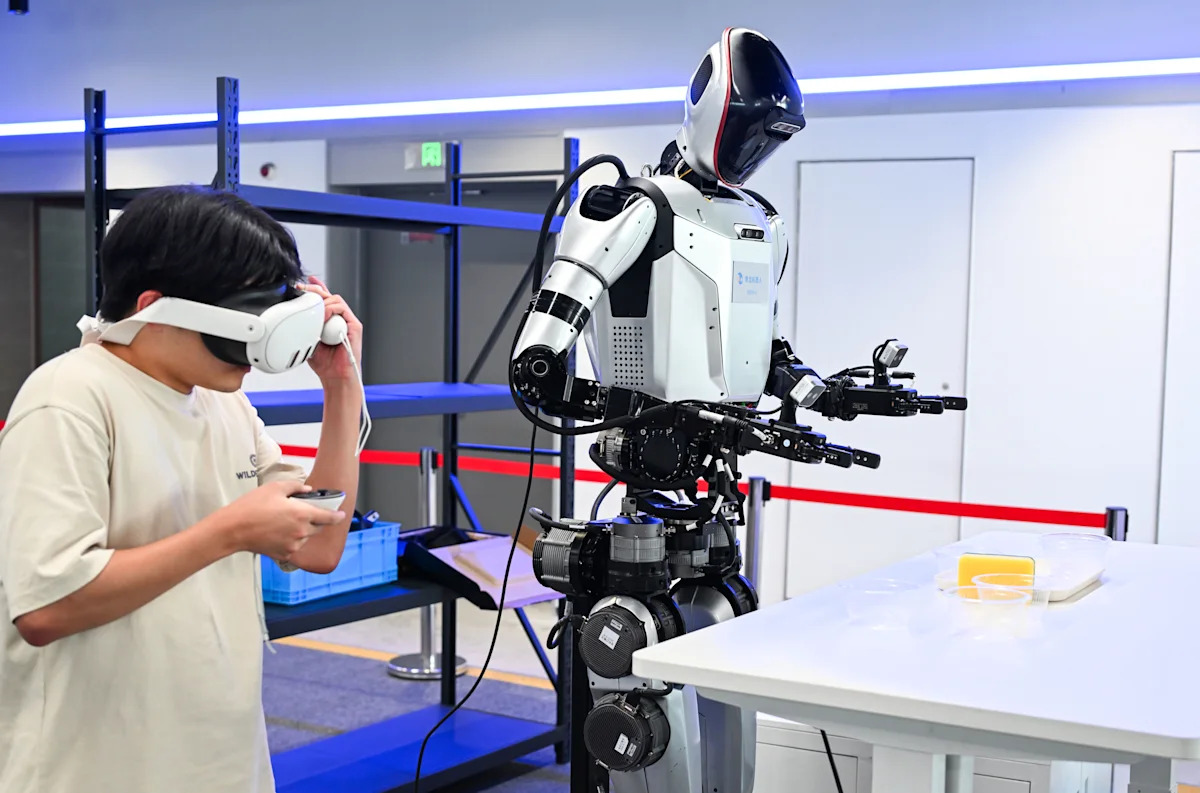
 A staff member trains a humanoid robot at a training ground of National and Local Co-Built Humanoid Robotics Innovation Center on August 26, 2025 in Suzhou, Jiangsu Province of China. (Photo by VCG/VCG via Getty Images) · VCG via Getty Images
After cost, the study found, the main barrier for robots is “capability, such as the dexterity needed to untangle wires. Human preferences and regulations further limit robot adoption for a significant share of tasks.”
In an email note highlighting the paper, Apollo chief economist Torsten Sløk wrote that “even under aggressive projections, widespread physical labor displacement will take decades.” (Disclosure: Yahoo is a portfolio company of funds managed by affiliates of Apollo Global Management.)
“Beyond economics,” Sløk added, “severe bottlenecks in fine manipulation capabilities, regulatory constraints, and human preferences will continue to significantly slow near-term automation.”
What about white-collar jobs?
The picture is less clear for office workers, who are more exposed to large language models (LLMs) that help with non-physical labor.
Anthropic CEO Dario Amodei has repeatedly warned that AI could wipe out half of all entry-level white-collar jobs before 2030. The company’s own researchers have been more measured.
 Anthropic Co-founder and CEO Dario Amodei speaks at the “How AI Will Transform Business in the Next 18 Months” panel during INBOUND 2025 Powered by HubSpot at Moscone Center on September 04, 2025 in San Francisco, California. (Photo by Chance Yeh/Getty Images for HubSpot) · Chance Yeh via Getty Images
A March paper by Anthropic economists Maxim Massenkoff and Peter McCrory found “no systematic increase in unemployment for highly exposed workers since late 2022,” though it did find “suggestive evidence that hiring of younger workers has slowed in exposed occupations.”
In a July 2026 essay posted on X, McCrory concluded: “I don’t expect unemployment to be noticeably higher a year from now — at least not because of AI.”
The new paper, also co-authored by Massenkoff, estimates that about half of all work tasks are exposed to LLMs like Anthropic’s Claude, meaning an LLM could cut the time those tasks take in half.
But that measures what the tools can speed up, not which jobs they replace. The paper’s authors note that cost isn’t the same barrier for software as for hardware, suggesting that white-collar disruption could occur faster than blue-collar disruption.
 Anthropic notes: ‘LLM exposure is the share of tasks rated exposed in Eloundou et al. (2024) (positive β). Occupation exposure to LLMs and robots adds tasks rated at E1 or higher robot exposure. Occupation groups are 2-digit SOC codes, and group averages weight by task time shares and employment.’ (Source: ‘What work can robots do?’
“Robots made with pricey hardware aren’t as easily copied and distributed as software or LLMs,” the authors said. “Compared to LLM exposure measures that assess capabilities but not costs, it’s especially important to distinguish jobs exposed to cost-competitive robots.”
The paper also addressed the opposite question: What work can’t LLMs and robots do today?
“Consider personal care & service jobs, for which around 40% of tasks are exposed,” the paper states. “In-person social interaction and physical contact with humans, which both LLMs and robots struggle with, are important for these jobs. This example suggests that highly interpersonal work, or work requiring delicate manipulation, may be less susceptible to near-term automation. Occupation groups like installation & repair, healthcare support, and community & social service fit this pattern too, with relatively low exposure.”
Internal AI tools helped us analyze the paper and edit a human draft. Humans revised, edited, and fact-checked the article before publication.
Click here for the latest economic news and indicators to help inform your investing decisions
Read the latest financial and business news from Yahoo Finance