
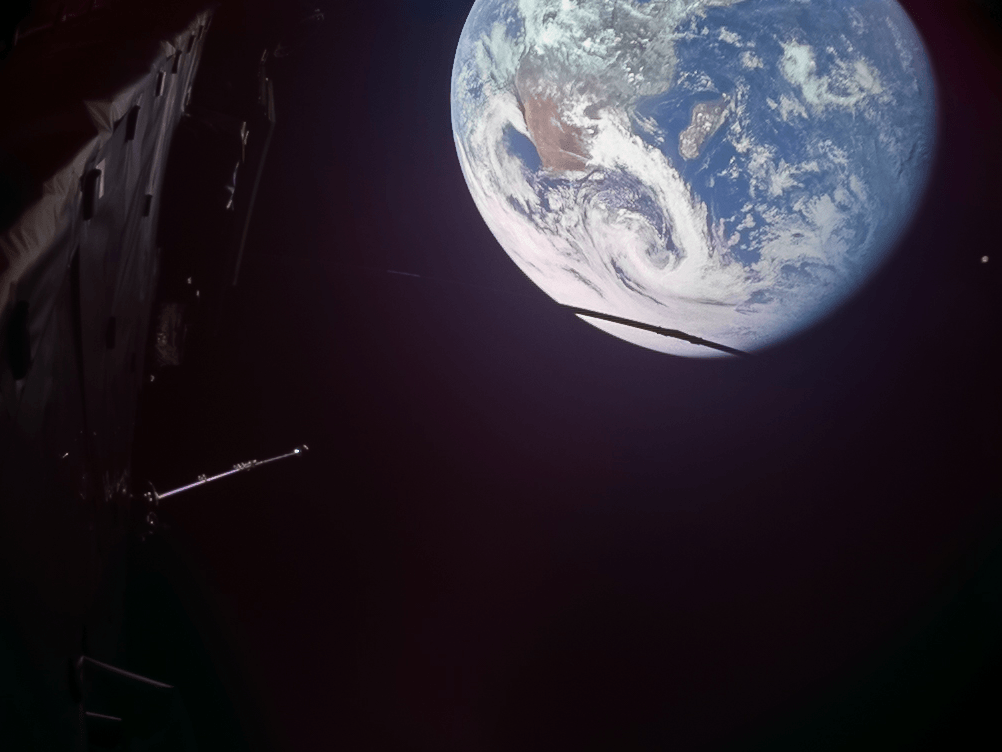
DIAS’s Dr Mika Holmberg talks to us about Juice, the first European-led mission to the outer solar system.
400 years after Italian astronomer Galileo Galilei first wrote about them in his book ‘Siderius Nuncius’ (or The Starry Messenger), scientists are betting on a new spacecraft to find out if Jupiter’s largest moons could sustain life.
The Jupiter Icy Moons Explorer, or the Juice spacecraft for short, is a European Space Agency (ESA) mission that will journey to the gas giant and three of its icy moons – Ganymede, Europa and Callisto – to look for ingredients necessary for life, including liquid water and potential energy sources.
“We had a few measurements – a few flybys”, but nothing substantial, said Dr Mika Holmberg, a researcher with the Dublin Institute for Advanced Studies (DIAS). She is part of a 2,000-people team supporting the ESA mission from Ireland.
The massive project involves 18 research institutes and 83 companies from across 23 countries, including research instruments and hardware provided by NASA and the Japan Aerospace Exploration Agency (JAXA).
Juice is the first European-led mission to the outer solar system and will become the first spacecraft to orbit a moon other than Earth’s moon when it reaches the Jupiter system in half a decade. Its eight-year-long journey began with a launch atop an Ariane 5 rocket in April 2023. It is expected to reach Jupiter in 2031.
Jupiter has more than 100 moons, which altogether form a sort of miniature solar system. The three moons on Juice’s agenda, alongside Io, form the ‘Galilean satellites’ – which Galilei first spotted using his homemade telescope in 1610.
Ganymede is the largest moon orbiting Jupiter (and larger than Pluto and Mercury), and the only one to have its own magnetic field. Existing data suggests it is covered in ice.
Experts believe Europa might be one of the most promising places in our solar system to find present-day environments suitable for some form of life beyond Earth. Meanwhile, data from NASA’s Galileo spacecraft in the 1990s revealed Callisto may have a salty ocean beneath its surface.
NASA’s Europa Clipper, which launched in October 2024, is also on its way to the moon to determine if there are places below Europa’s surface that could support life.
The ESA mission’s primary scientific target will be Ganymede, where Juice will complete numerous flybys before entering into orbit around the moon.
The spacecraft will explore Ganymede’s mysterious magnetic field, its hidden ocean layer, its complex core, its ice content and shell, and how it interacts with its local environment and that of Jupiter.
It will also complete two flybys of Europa, orbiting that moon at a closest approach of 400km. During these close encounters, Juice will explore the geology, surface, subsurface, activity and environment of the moon, which, according to existing research, appears to have a young, active, colourful and distinctively marked surface.
Juice will make its closest encounter with Callisto, where it will reach as close as 200km from the surface during one of its flybys. The spacecraft will end its mission by colliding with Ganymede’s surface in 2035.
“With the instruments that we have on Juice, we can really confirm [habitability],” Holmberg said. She lists out a few, including gravity measurement tools and radars that penetrate thick layers of ice.
Holmberg is accompanied in Ireland by Prof Caitriona Jackman, Dr Hans Huybrighs, Dr Sebastian Cervantes, Dr Eddie Nerney and PhD student Maryam Zeroual from the DIAS planetary sciences team.
Third gravity assist
Earlier this week, Juice completed its third gravity assist – a complicated manoeuvre used by engineers to harness planetary gravity to increase a spacecraft’s velocity.
The assist, according to the ESA, modified Juice’s course by around 20 degrees and added about 3.5km per second in velocity.
“These complex manoeuvres allow spacecraft to travel vast distances through the solar system while using fuel efficiently,” Holmberg explained.
Juice’s very first gravity assist was a Lunar-Earth flyby, which it used to direct itself toward Venus for its second gravity assist. “Technically a gravity assist is also a flyby,” Holmberg explained to me via email, but flybys are typically used to conduct observations and not change the orbit.
“As we prepare for the next phase of the mission, this flyby also offers an important opportunity to test the spacecraft and its instruments before they arrive at Jupiter and begin their scientific investigations.”
The flyby allows scientists to test out the instruments on board to ensure everything is working. “We are doing this so that we know what Juice will encounter once it gets [to Jupiter],” she said.
“Both, so that we have like an environmental context for our measurements…but it also has to do with the spacecraft safety, [so] that we know that the environment is safe for the spacecraft to be in.
“But we also are working with simulations of how the spacecraft itself is interacting with its environment and also how that is impacting our measurements.” Juice is set for one more Earth flyby in January 2029 before it leaves for the gas giant.
Missions like these will prepare us for future trips that look for life. “We don’t know enough about the moons and their environments [today] that we could send such a mission,” Holmberg said.
“If you send [a] €2bn mission and it crashes on the moon…then you wasted those €2bn.”
Don’t miss out on the knowledge you need to succeed. Sign up for the Daily Brief, Silicon Republic’s digest of need-to-know sci-tech news.