
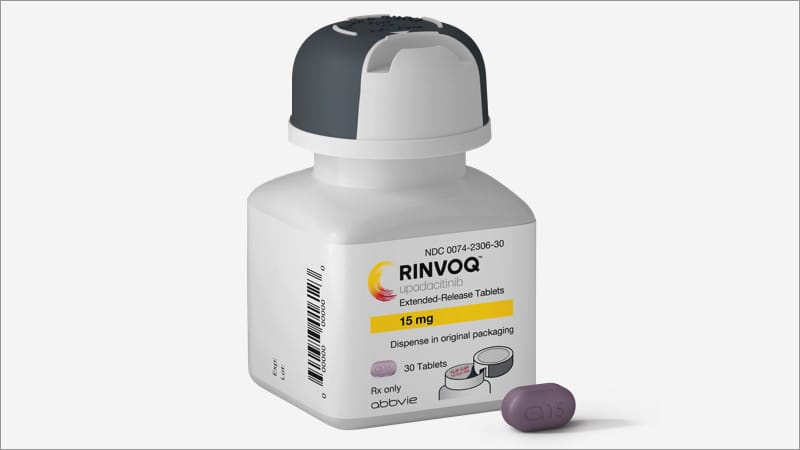
Upadacitinib (Rinvoq, AbbVie) was safe and efficacious out to 76 weeks in patients with nonsegmental vitiligo (NSV), with 28-week data showing efficacy further boosted by the addition of ultraviolet B (UVB) phototherapy.
New results from two ongoing pivotal phase 3 trials were presented October 1 at the European Academy of Dermatology and Venereology (EADV) 2026 Congress in Vienna. Upadacitinib was approved by the European Commission in July for the treatment of adolescents and adults 12 years and older with NSV, who are candidates for systemic therapy, and is under review at the FDA for this indication.
“Facial and total body repigmentation efficacy rates continue to increase with upadacitinib treatment with and without narrow-band UVB over time with no new safety signals,” said study investigator Julien Seneschal, MD, PhD, professor of dermatology at the University of Bordeaux, France, who presented the findings. Upadacitinib plus UV light further enhanced the efficacy of upadacitinib compared to upadacitinib monotherapy, regardless of preceding treatments, he added.
Upadacitinib is a selective, once-daily JAK inhibitor. The ongoing trials (Viti-Up-1 and -2) enrolled a combined 614 patients with NSV involving the face and body with a Facial Vitiligo Scoring Index (F-VASI) of 0.5 or greater and a Total Vitiligo Area Scoring Index (T-VASI) of 5 to less than 50. A total of 308 individuals in Viti-Up-1 (23 adolescents aged 12-17 years and 285 adults aged ≥ 18 years) and 306 patients in Viti-Up-2 (30 adolescents, 276 adults) were randomly assigned to receive either upadacitinib, 15 mg once a day (Viti-Up-1, n = 206; Viti-Up-2, n = 205) or placebo (Viti-Up-1, n = 102; Viti-Up-2, n = 101).
The trials’ initial efficacy endpoints were a ≥ 50% reduction in T-VASI (T-VASI 50) and a ≥ 75% reduction in F-VASI (F-VASI 75) from baseline at 48 weeks of treatment. Both endpoints were met.
Results at 76 Weeks
The new data presented at EADV tracked patients out to 76 weeks, with Seneschal noting that upadacitinib remained effective at this time point.
“For patient groups on upadacitinib and those switching from placebo to upadacitinib at week 48, increasing proportions achieved F-VASI 75 and T-VASI 50 through week 76 with no apparent plateau,” Seneschal said.
At 76 weeks in Viti-Up-1, 55.1% achieved F-VASI 75 and 42.5% achieved T-VASI 50, up from 33.1% and 29.2%, respectively, at 48 weeks. At 76 weeks in Viti-Up-2, 47.4% achieved F-VASI 75 and 40.1% achieved T-VASI 50, up from 27.6% and 26.2%, respectively, at 48 weeks.
Also reported were the results of a substudy that added narrow-band UV light therapy to upadacitinib for up to 28 weeks, which found evidence of added efficacy. A total of 84 patients from both trials who failed to achieve T-VASI 90 at week 48 but met all other eligibility criteria entered the phototherapy substudy. Participants took either upadacitinib alone or with whole-body narrow-band UVB phototherapy administered twice weekly for approximately 28 weeks. The proportion of patients achieving F-VASI 75 increased across all treatment groups, with greater degrees of improvement observed for the combination therapy group.
According to the investigators, the results provided sufficient evidence for further research into the combination therapy.
“When you look at the whole body regarding the T-VASI 50, across 28 weeks the proportion of patients achieving T-VASI 50 increased across all treatment groups, both in the combination therapy and upadacitinib monotherapy,” Seneschal noted. “But you can see numerically greater increases in efficacy in patients receiving upadacitinib plus narrow-band UV light, with 63% reaching T-VASI 50.”
Moderator Marie-Aleth Richard, MD, head of the department of dermatology at Hospital de la Timone, Marseille, France, raised the issue of a potential lack of accessibility to phototherapy in some places.
“Even if you demonstrate clearly that something is better when you have a synergy between the combination upadacitinib and the phototherapy, beyond this, how many patients could have the access to the UV devices and to the UV cabins across Europe, or across the world at this time? In my opinion, this is something which is difficult to achieve,” she said.
Seneschal noted that simple exposure to sunlight as well as in-home devices could be more available and affordable options.
“It could be also natural sun exposure, but it depends where you live, first,” Seneschal noted. “And in France, and now in some other countries, there is the possibility to do home phototherapy that show very good results.”
The trials are funded by AbbVie. Seneschal’s disclosures include receiving grants and/or honoraria from AbbVie, Almirall, Boehringer Ingelheim, Incyte, LEO Pharma, Lilly, Novartis, Pfizer, Pierre Fabre, Sanofi, and Silab.
Scott Harris has covered dermatology for more than a decade. He lives near Washington, DC.