
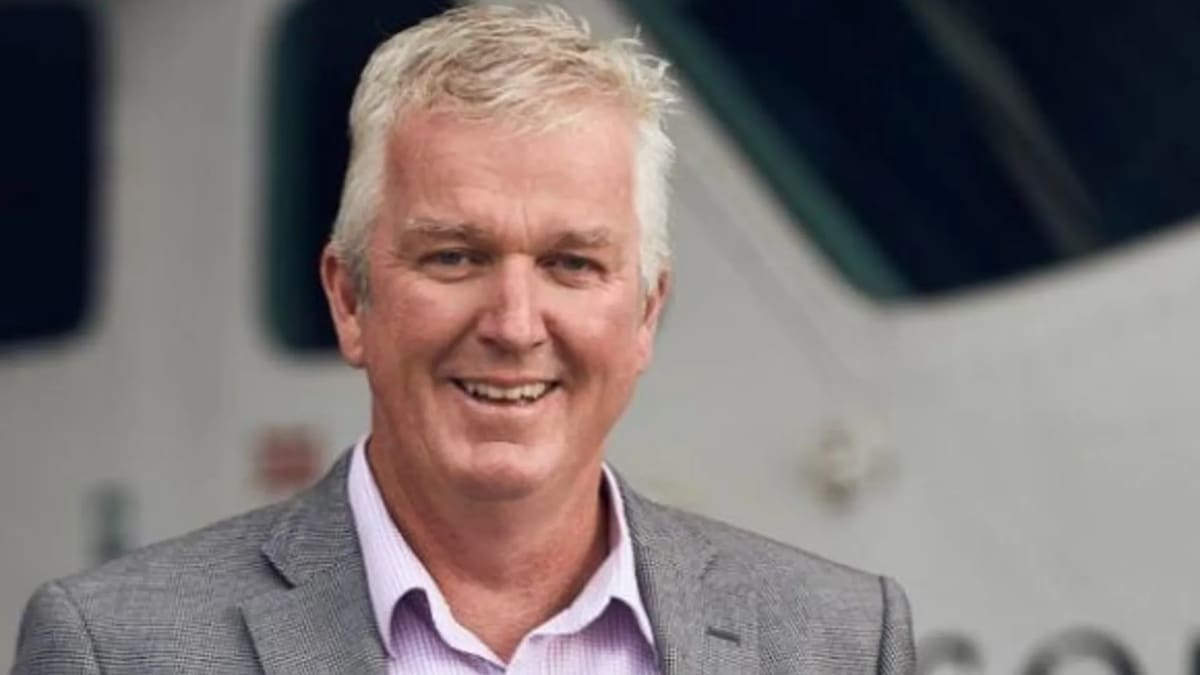
“They can charge what they like.”
Sounds Air managing director Andrew Crawford. Photo / Sounds Air
He said soon after the Iran war broke out, he was told his jet fuel prices would have to be reviewed every week instead of monthly.
“They make stuff up as they go along … The schoolyard bully keeps kicking you and they’re making up the rules.”
Aviation Industry Association (AIANZ) chief executive Simon Wallace suggested the Commerce Commission take a closer look at how energy companies might be passing on rising oil prices to customers such as airlines.
“We’ve now got jet fuel costs back up to where they were in March. They’ve crept up … and are obviously double what they were for all of last year,” he added.
“It’s a discussion we need to have. I’m not suggesting they’re doing anything illegal or it’s a rort.”
Sunair chief executive Doug Roberts said his airline purchased avgas from either BP or Z Energy.
“We negotiate between the two of them and try and get the best deal.”
Roberts told the Herald he was grateful Sunair would receive some of the $5.7 million in new Government funding announced on Monday morning.
He understood Crawford’s frustration.
“It’s a tough commercial environment.”
He said the exchange rate was also a problem. The NZ dollar has fallen from US60c six weeks ago to US56c today.
A Z Energy spokesperson said global fuel market conditions, including Middle East conflict, supply chain disruption and higher international freight costs, were influencing jet fuel prices.
They told the Herald Z did not supply jet fuel to the regional airlines covered in the most recent Government announcement.
“New Zealand imports all of its refined fuel, including petrol, diesel and jet fuel, so local prices are heavily influenced by global supply conditions including international fuel prices, freight costs, and exchange rates,” Z Energy added.
“Recent increases have reflected unprecedented disruption in international fuel markets.”
They said the Commerce Commission had the ability to monitor New Zealand’s fuel market.
“That monitoring provides transparency over pricing and helps ensure competition is working effectively, even as global fuel and freight costs fluctuate.”
Consumer NZ chief executive Jon Duffy said regulators could monitor the “rocket and feather” effect if companies hiked prices quickly and dropped them slowly in relation to major external events.
But he said it was unclear beyond that how effective the Commerce Commission was.
If a company hid surcharges within broader price rises and blamed the war for that, the regulator could use the Fair Trading Act to prosecute.
“There are grumbles and people get suspicions … the problem is, it’s very opaque. There’s so many layers to go into the costs you pay at the pump.”
Andy Bowley, Forsyth Barr head of research, said what an airline paid for jet fuel included “into-plane” costs which came after refining and shipment to New Zealand.
“That may well be the use of Channel Infrastructure’s pipeline between Marsden Point and Auckland.
“It could be storage costs. These services aren’t provided free by the energy companies or the Government.
“These costs in the broader scheme of things are not huge, given where jet fuel prices are.”
The latest Platts-Iata jet fuel price monitor showed global average prices for the week ending September 25 were up 106% on a year earlier.
Public service airlines?
Air Chathams chief executive Duane Emeny says the new funding should have safeguards in place to reassure the public about transparency.
Meanwhile, some in the industry are talking about how to treat regional air connectivity as a public service.
“We should invest in regional aviation as we do in our roads,” Wallace said.
“The Government needs to view regional connectivity as more than just the transportation of commercial passengers.”
Air Chathams chief executive Duane Emeny said a regular support programme for regional routes in New Zealand would probably cost $10m-$20m a year.
He said only truly essential routes would be targeted for support.
There might be some debate about which regions had no viable alternative to air travel.
But he said Chatham Island was an obvious choice.
“You can’t swim there. The ship doesn’t take passengers.”
He said the South Island’s West Coast, Stewart Island, Great Barrier Island and the country’s far north were also likely contenders.
The system would have to be transparent and airlines would need to open their books for it to be credible, he said.
The United States has the Essential Air Service to guarantee some communities keep a minimum level of scheduled air service.
It generally involved subsidising two return flights a day with regional aircraft, or more frequent services with smaller aircraft.
Australia’s Remote Air Services Subsidy Scheme subsidised a regular weekly air transport service for people and freight to remote communities.
In the European Union, member states can impose public service obligations on routes deemed vital for regional economic development.
That can allow subsidies to keep commercially unsustainable regional routes running.
Election
Emeny said he hoped the grants announced today would survive any change of Government.
He said Air Chathams would receive four payments of $300,000.
“They’re not paying out a lump sum. They’re actually saying ‘every quarter we’re going to check in’.”
Emeny said that would help ensure transparency and accountability and there seemed to be multiparty support for some level of assistance for regional airlines.
He said if a free-market or libertarian party gained influence over policy on this issue, then “you would see an acceleration” of market failure.
But he also said it was crucial not to simply throw money at the problem, and airlines must operate efficiently.
“The Chatham Islands way back in the day before me had a subsidised air service and it was hopeless.”
He said sometimes the scheduled airline service in those days never even turned up.
Port Hutt on Chatham Island. Photo / John Weekes
The new working capital funding grants range from $300,000 to $1.2m, depending on the scale of the airline’s operation.
The new grants worth $5.7m were for daily costs such as fuel and wages, and were provided with the expectation that airlines would maintain service levels, Associate Transport Minister James Meager said.
“Significant pressures, including the price of jet fuel and aviation gas increasing by more than 50% since March, have created problems for the operators providing much-needed regional connectivity,” Regional Development Minister Shane Jones said.
A Ministry of Business, Innovation and Employment (MBIE) spokesperson said ministers approved funding caps of up to $1.2m for “large” regional airlines.
They also approved up to $600,000 for medium-sized operators, and up to $300,000 for small ones.
“The specific terms and amounts of funding are subject to negotiations which are currently underway,” an MBIE spokesperson said.
Funds are dispensed from Kānoa, MBIE’s regional economic development and investment unit.
John Weekes is a business journalist covering aviation. He also has experience covering consumer affairs, crime, politics and courts.
Stay ahead with the latest market moves, corporate updates, and economic insights by subscribing to our Business newsletter – your essential weekly round-up of all the business news you need.