
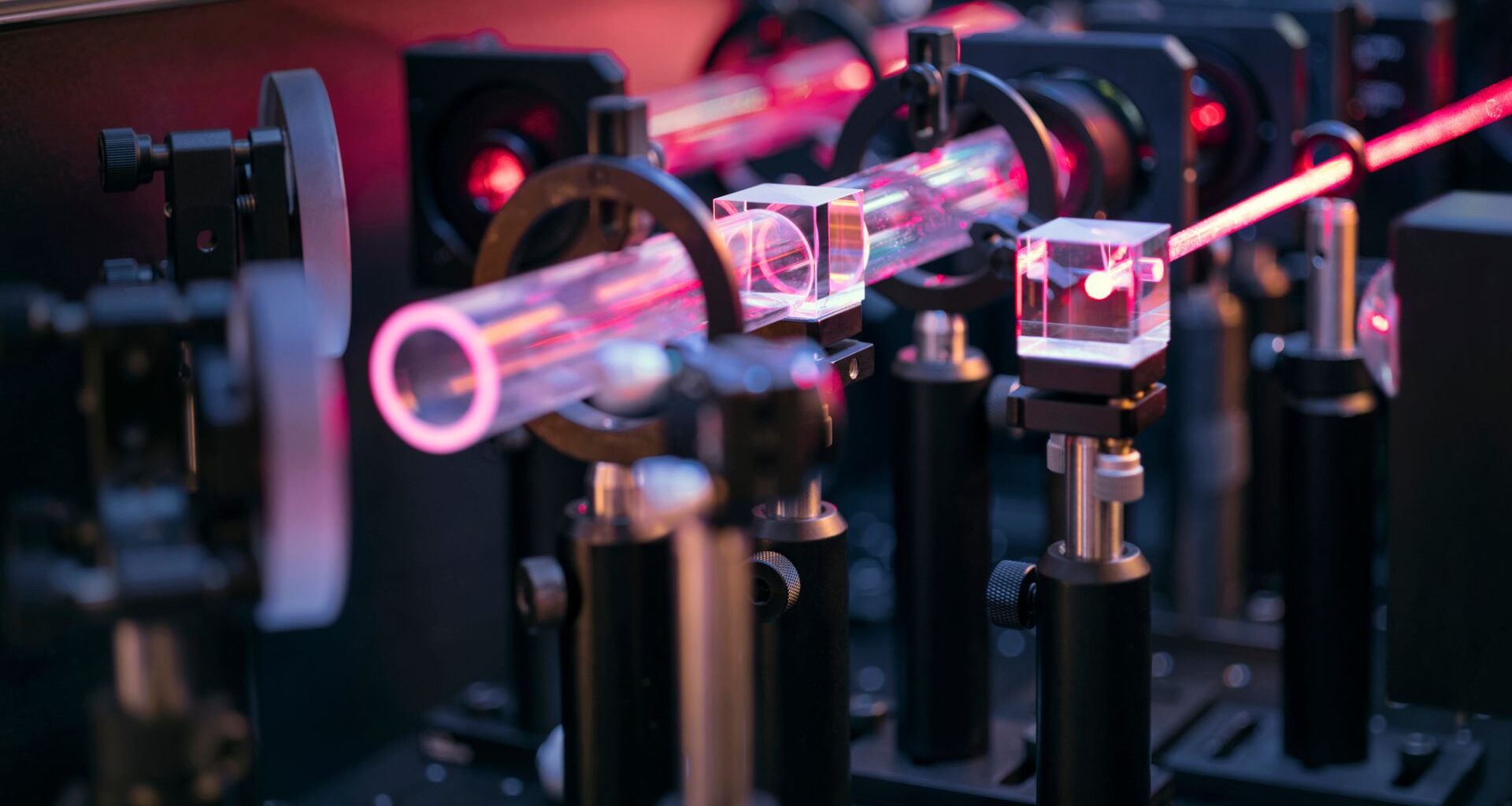
Researchers from the universities of Basel, Ruhr, and Paderborn teamed up to make a major breakthrough in quantum communication by generating photon pairs that are 90 percent identical. These nearly indistinguishable particles can be used to attain quantum entanglement or interference, critical phenomena needed for quantum communication.
Our understanding of quantum physics has opened new frontiers in computing and sensing. Scientists are working with different materials to store and process information at a quantum level and have used a variety of approaches ranging from trapped ions to neutral atoms, superconducting circuits to photons as quantum bits or qubits.
Photons are one of the easiest information carriers to work with. However, to use them in quantum communication, they need to possess exactly the same properties or should be ‘indistinguishable’ from each other. Previous attempts to generate these photons have had limited success, as the photons were either out of focus or correlated only temporarily. The collaborative effort of researchers from Basel. Ruhr and Padelborn solved this hurdle with a semiconductor quantum dot.
Using Biexciton decay
The researchers used a semiconductor quantum dot with an optical resonator to leverage a process known as ‘biexciton decay’ to generate nearly indistinguishable photons. In this process, a molecule consisting of two bound excitons decays and results in the release of an exciton and a photon.
“A quantum dot is often described as an artificial atom within a semiconductor that can generate individual particles of light,” explained Stefan Schumacher, a professor of functional photonic structures at the Paderborn University. “By integrating it into a specialized optical cavity – similar to that found in a laser – the light emission process was specifically accelerated and controlled in this study.”
An exciton is consists of an electron and an electron hole, and in this process the quantum dot is doubly excited, after which the excitation decays. The biexciton cascade thus generates two photons, one after the other. More importantly, the photon pairs can be generated at the push of a button, which is useful for deployment in new-age technologies.
Adjustable purity
The team furthered the research on the interaction of quantum dots with optical cavities carried out by Richard Warburton, a professor of experimental condensed matter physics at the University of Basel.
While this work has helped make breakthrough advances in various fields, the collaborative research team leveraged the science of biexciton decay to facilitate its decay in a controlled manner.
This helped the researchers achieve 90 percent indistinguishability, which is a major improvement over the 60 percent indistinguishability that was achieved previously.
Higher photon indistinguishability means fewer errors in data processing. “The results show excellent agreement with the theoretical prediction and point the way towards generating photons with even higher indistinguishability,” added Warburton in a press release. “They demonstrate that biexciton decay can produce very high-quality photons – provided the system is properly controlled using a cavity.”
“We have found that the purity of the photons generated can also be optimized using the resonator and is limited only by vibrations in the semiconductor’s crystal lattice (phonons),” said Klaus Jöns, head of Hybrid Quantum Photonic Devices at Paderborn University, who was also involved in the work.
“This phenomenon, known as ‘cavity feeding’, must be taken into account in future designs and can then be systematically minimized even further.”
The research findings were published in the journal Physical Review Applied.