
Raising the alarm early about new or fast-spreading weeds is now easier and faster, with a new Department of Conservation (DOC) digital surveillance tool
DOC is launching a new free digital surveillance tool on Tuesday that might have been able to stop tradescantia (Wandering Willie) back in the day, or at least increase the chances.
The tool’s creator believes the Smart Weed Alert Tool – or SWAT – can put a big dent in the country’s billion-dollar weed control problem.
“There’ll be a lot of users, and there’ll be a lot of new weeds that people learn about – sometimes they might wish they didn’t,” Dr Kate McAlpine from DOC told RNZ on Monday.
“It will stop the next massive weed before it gets established.”
‘The whole world is already interested’
McAlpine was at an AI hackathon several years ago when they asked for ideas to turn into tech tools. She had been thinking about weeds – her PhD subject – and the extremely high toll they took on farms, forestry and native species.
Three years, million dollars and input from many smart people later, she is launching SWAT.
Next week she will be at global climate change talks in Armenia, where the tool has won a coveted spot at a biodiversity expo.
“The whole world is already interested.
“Yeah, going global a little bit earlier than I had intended, but just way too good an opportunity … Week two!”
How it works
“Thousands of plant observations are recorded every day, but no one has the time to manually search through them all for signs of emerging weed threats. SWAT does that automatically, alerting people when something important turns up,” said McAlpine.
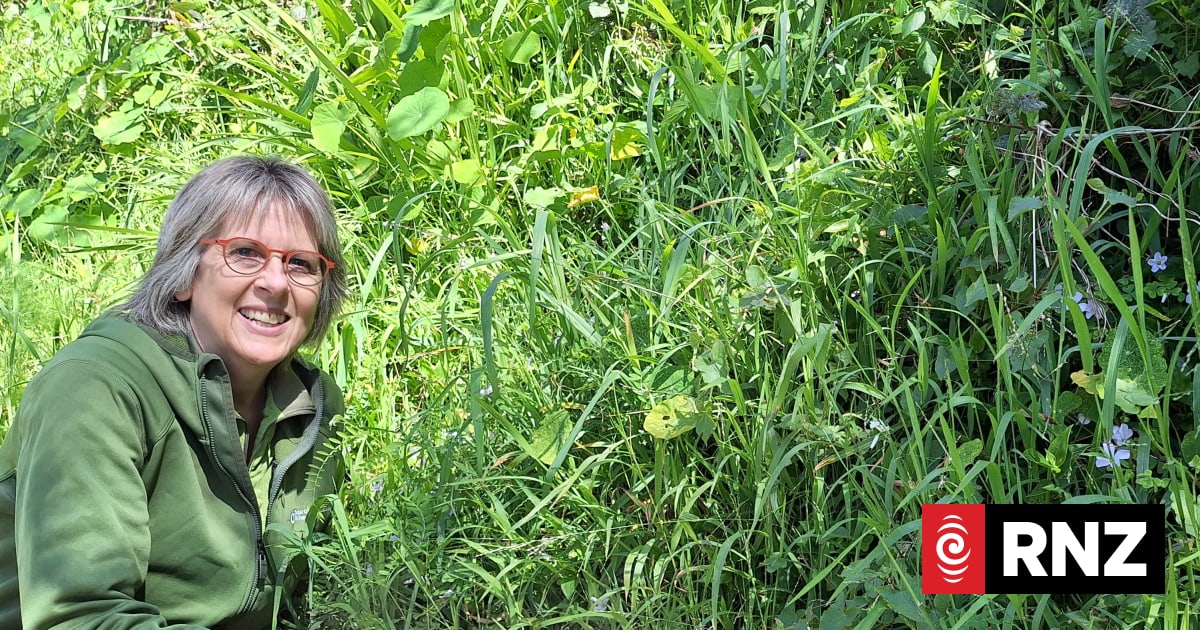
At the top of Rolleston Street, a steep climb from downtown Wellington, McAlpine was recently searching through road reserve banks thick with weeds.
“Probably at least 10 major environmental weeds on this bank… It’s probably double that, to be honest.
“We’ve got arum lily, we’ve got pampas, we’ve got brush wattle, English ivy… liquorice bush down the road a bit.”
Liquorice bush does not taste or smell like liquorice, but McAlpine said it was nastier than that.
“It’s an emerging weed, actually. Just one of those species that’s been sitting in New Zealand for probably decades, just starting to turn up in the wild.”
There are 25,000 other exotic plants like that in New Zealand gardens, where any one of them might escape and start invading.
The open-source digital surveillance system is an early warning system of new weeds and weed spread.
With SWAT, anyone can set up a highly customised set of alerts for types of weed and the places they are found.
The tool will then continually scan local and international databases – including the Global Biodiversity Information Facility – for when people find them.
“SWAT can tell that that’s the first record of that species for the region, or the suburb, or the country, or the island, and will … send anyone who’s got an alert set up with those criteria to say ‘hey, this is the first record for this island or suburb’,” said McAlpine.
Fern alert for Te Papa
There has been a positive reaction to the prototype, according to McAlpine.
“Several councils have said ‘hey, this is amazing’. We just found out about two historical populations that we didn’t already know about.”
Te Papa curator of botany Leon Perrie was alerted by the prototype to a nasty little fern in northern wetlands that popped up recently in Taranaki.
“The thing is, it’s not meant to be there,” Perrie said.
“At the museum I’m interested in documenting them. So ultimately, sure, we want to get rid of the weeds, but it’s a chance to collect a specimen of things that are maybe newly present in the country or in the region.”
Others who received alerts, such as community groups, might choose to root out the weeds, or prioritise other invasive species to tackle that SWAT – with its highly detailed, zoom-in-able maps – showed were a bigger problem in their locale. It can tell them if there was a bio-agent that worked on that pest.
Anybody who has been using plant-spotting sites like inaturalist will automatically add to the dots on the maps at SWAT, making the weed alerts more accurate.
In Waikato, the prototype found six historical infestations the regional council was not aware of.
“You may have just notified us about a serious potential weed on our doorstep!” council pest plants expert Heidi Pene told McAlpine.
“It’s proven its worth already.”
Of particular interest was an historical broom corn millet site very near the northern boundary where agricultural machinery crosses from Auckland to Waikato. SWAT also alerted them to eel grass, field horsetail, variegated thistle and marshwort sites to follow up.
The historical tabs in the maps taught the council about herbarium records dating back to 1939. “We had no idea they’d been around that long.
“This looks like a fabulous tool with wonderful potential,” said Pene.
‘A lot of power’
AI helped build SWAT quickly and relatively cheaply through the Govtech Accelerator programme, which aims to use start-up tech to solve a public problem.
The direct cost of weed control – such as the cutting out of wilding pines – to councils, DOC and others is put at $50m a year.
McAlpine hopes the tool can make like a weed and spread quickly.
“Because nobody’s got enough resources to be doing regular or systematic surveillance.
“There’s a lot of power in this.”