
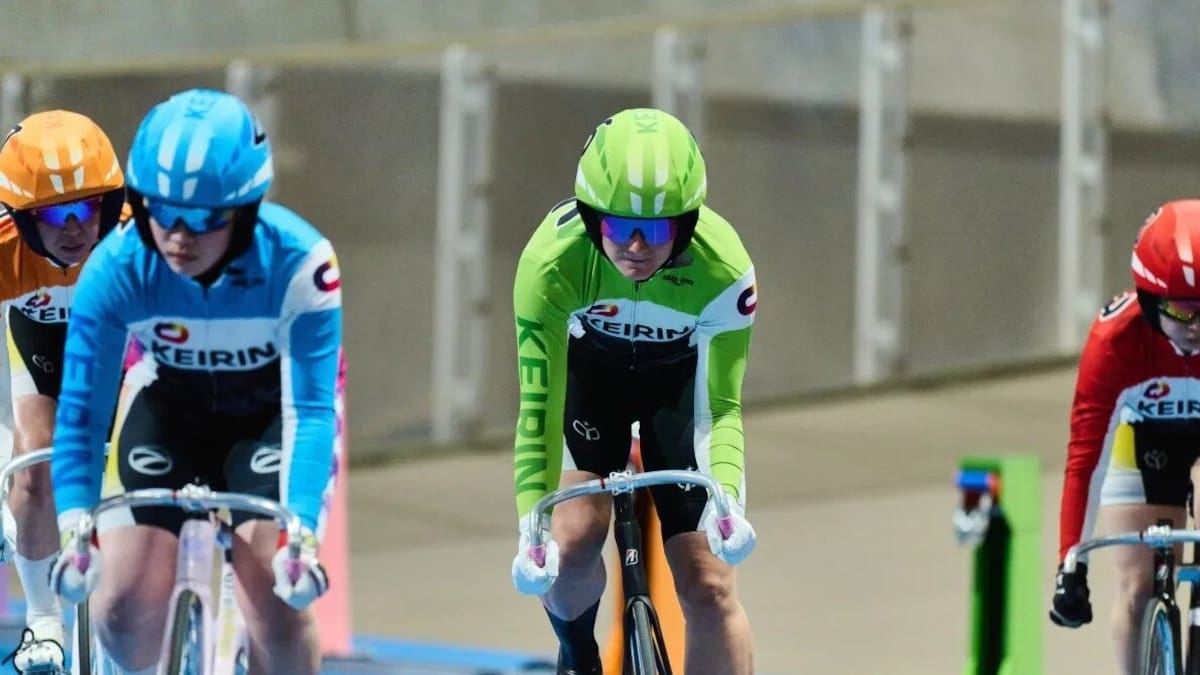
Keirin is big business in Japan. In the year to March 2025, punters wagered ¥1.328 trillion (about $14.8 billion) on the bike races. To ensure fair and legitimate racing and betting, riders are stripped of any method of communication for up to four days around each race.
“It’s a completely different world – very surreal and a little insane,” Andrews says. “It’s something we all know about, but few people outside of Japan have actually been able to experience. I was very lucky to get the invite.
Ellesse Andrews (in red) racing at the Keirin World Series in Hofu. Photo / Cotaro Ishii, More Cadence
“I didn’t expect to take out that many wins, but it was really good, hard racing all the time.” One race was a dead heat with Olympic keirin silver medallist Hetty van de Wouw. “It was very exciting.”
The sport of keirin is taken extremely seriously. Andrews had to attend 10 days of study at Keirin School in Shuzenji in March, sitting an exam on the rules, tactics and traditions of keirin to earn her racing licence.
“It was fascinating just understanding how many riders in Japan are doing this as their fulltime jobs. There are around 2500 men and 300 women who compete year-round. This is their life,” she says.
“The girls I talked to have two or three races most months, and they’re away from home around six days for each race. Some of them had children at home too. It’s crazy.”
Organisers approached the Kiwi rider after she won three medals at the 2024 Paris Olympics, including gold in the keirin, and it piqued her interest. French sprint world champion Mathilde Gros, a good friend of Andrews, had competed in the series before Covid and had also been invited back.
“There were a lot of things I had to consider, especially because I’m part of the New Zealand track team, and the team sprint as well,” Andrews says. “But it’s such an incredible opportunity and this was the perfect year to do it. From this point onwards, with Olympic qualifying now starting, it becomes a little trickier.”
If she took up the offer of living in Japan for four months from May, it would mean Andrews training alone in the lead-up to the Glasgow Commonwealth Games in late July. “But we had a clear focus on strength on the bike and building muscle in the gym during that period, and I knew those were things I could work on while I was away from the team,” she says. So she said yes.
Ellesse Andrews (in green) has had 18 wins from 19 starts in the Keirin World Series in Japan. Photo / Cotaro Ishii, More Cadence
Handing over any data tracking devices – “anything that could emit a signal” – when she arrived at the track, Andrews had to go without the Bluetooth headphones she usually listens to music through before a race.
“My full warm-up was completely no music which is something very interesting for me,” she says. “Next time I could buy an old-school iPod.”
For entertainment, she bought a DVD player and movies from the second-hand Bookoff stores around Japan. “They had every movie I wanted to see,” she says with a laugh. “I would also journal and read quite a bit. And daily routines ended up taking up the time, so I was never bored.”
Andrews discovered distinct differences between the Olympic keirin and the traditional Japanese sport introduced in 1948 to boost morale and raise funds for reconstruction after World War II.
Most of the racing is on outdoor concrete tracks, between 330m and 500m long. The pacer rides a pedal bike rather than motor-pacing by a derny. Seven riders line up in every women’s race (nine in the men), each wearing a randomly drawn colour on their jersey and helmets.
Women ride carbon bikes, while men compete on traditional steel frames with smaller gears. Women aren’t allowed to touch during a race, but men are prepared for body contact – blocking, shoulder barging and head butting – and wear “armour” under their jerseys and down their shins.
It’s a dangerous sport. In July, Olympic silver medallist sprinter Toshiaki Fushimi died after crashing into a side barrier in a keirin race.
“The girls’ racing is very safe,” says Andrews. “There are warnings and disqualifications if we touch. I had to pay a little fine for one.”
Riders are interviewed the night before the race and have to declare the tactics they intend to use.
“I would always say ‘senko makuri’, which means I could go long or I could go short,” Andrews says. In other words, she could sprint from the front early in the race or wait to unleash a burst of speed at the finish. She wasn’t giving much away to the press or punters.
Another difference is in the prizemoney for riders – and it’s significantly higher for men.
“In the men’s grand prix race at the end of the season, the winner can take home around US$1 million [$1.78m],” she says. “The top-earning Japanese woman rider last year won around NZ$500,000 for the year,” she says.
“Prizemoney is something we’ve only had here and there in track racing, like the Champions League I raced in for two years.” It’s not known just how much Andrews earned in Japan, and she departed the series before the season finale.
Ellesse Andrews: “It’s a completely different world – very surreal and a little insane.” Photo / Mike Scott
Andrews wasn’t the first Kiwi to contest the keirin world series. Paige Paterson was among the first international women invited to race professionally in Japan in 2013, and two-time Olympian Natasha Hansen won 26 races during her three consecutive years from 2017. Simon van Velthooven and Sam Webster competed for New Zealand in the men’s series in the past.
Leaving midway through the series to race at the Commonwealth Games – where she won silver in the keirin and bronze in the 1km time trial – was challenging, Andrews admits.
“I didn’t have a lot of feedback through data or times because I’d been training alone,” she says. “I hadn’t had much time with the team for the team sprint for example, or enough time working on starts which are really important in putting a good ride together.
“Unfortunately, I also got Covid beforehand, and it made things a bit tricky. That also happened to me before the 2022 Commonwealth Games, so there was a bit of deja vu. But I felt a lot better as I went through the week – recovering from that illness and getting my indoor track legs back. So I was really stoked about that.”
Andrews expects to be in stronger form when she leaves next week for the world track cycling championships in Shanghai.
She will have had six weeks’ training at home, transferring her strength work in the gym into speed on the track, and will race the team sprint, the individual sprint and the keirin.
The team sprint’s goal is to finish in the top eight to qualify for the 2028 LA Olympics. Andrews will ride with double Olympian Rebecca Petch, Hamilton’s Olivia King and promising Southland teenager Riley Faulkner.
“We’ve done some really good work in the last few weeks and it’s been nice to see all of the different phases of this year come together,” Andrews says. “It’s great being immersed in the team environment again.”
Despite the disconnection from the outside world demanded by keirin racing, Andrews hasn’t ruled out returning to Japan in the future – if the time period was shorter and it worked in with her plans to compete at the next Olympics and defend her titles.
“I’m really glad I went this year. It was a special experience and I got to know these riders so much better,” she says.
“All the girls are quite aligned in the way we understand sport and the way we think. I was able to form some really special friendships that go beyond competition and sport. They’re not always easy to form when you’re competing against each other or have the mindset that friendship is bigger than sport.”
This story was originally published at Newsroom.co.nz and is republished with permission.