
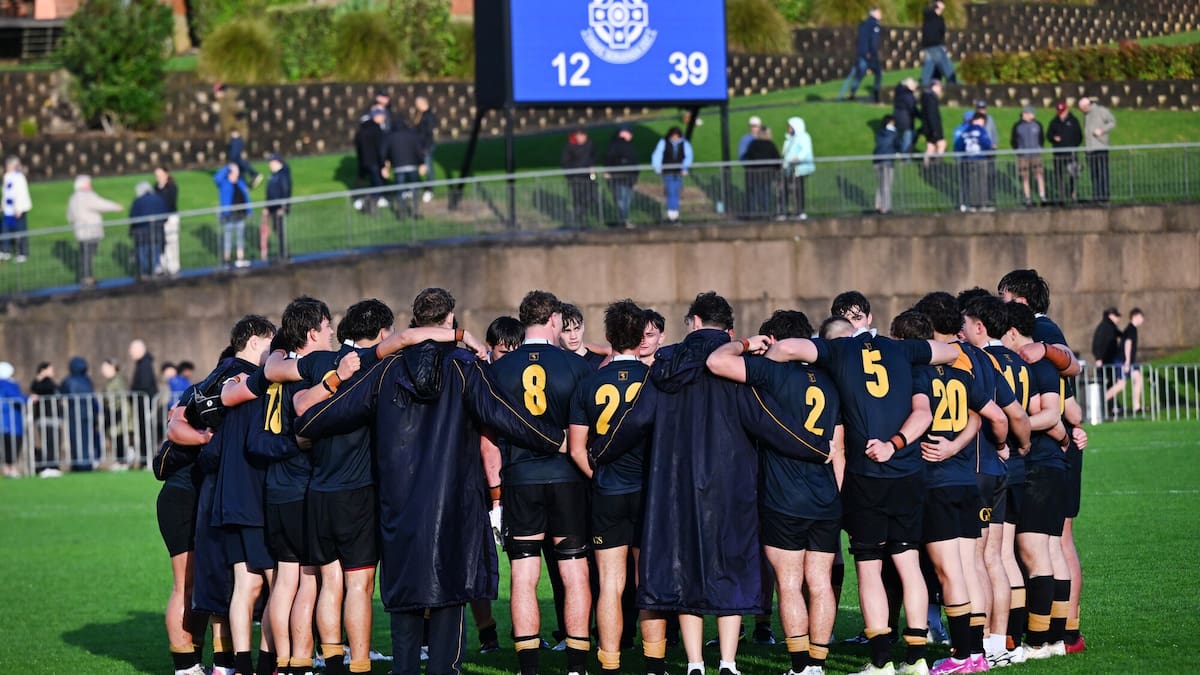
The above schools are all party to the ongoing 1A First XV media blackout, predicated on a belief that media coverage creates a danger to students through an “unhealthy level of scrutiny”.
This case for snubbing media at First XV level was most eloquently argued by De La Salle College principal Myles Hogarty back when the ban was introduced in October 2022.
At the time, Hogarty defended the move, which is yet to be found necessary anywhere else in the country, by highlighting the “negative impacts of unnecessary hype” around the broadcast of games.
“Many of our students already feel enormous pressure when they take the field,” he said. “It is our job as principals to create safer environments for all of our students and we believe this course of action is entirely appropriate, given what appears to be a greater emphasis than ever on commercialising school sport and the potential exploitation of those who choose to play it.”
But might that not also then trigger similar concerns with live broadcasts of First XIII rugby league matches on Sky? Particularly given that, in some cases, it featured the very same players being shielded from those perceived deleterious impacts at First XV level?
We asked Hogarty, via email, if he could perhaps explain, to give followers a better understanding.
Why there was no similar objection to live media broadcast of his college’s rugby league matches? Why was a different policy position adopted? We also inquired as to whether his views on media coverage had evolved at all over the past four years.
There was no reply.
Similar questions were put to Mikaele Taito, the principal of Kelston Boys’ High School, whose team went on to brilliantly win the national premier schoolboy rugby league title with a squad littered with members of their First XV.
But we may never know what the secret sauce was that made these versatile Kelston players so much safer in a rugby league broadcasting environment than a rugby broadcasting one – because, again, there was no response.
Mt Albert Grammar School headmaster Patrick Drumm did at least respond, via an assistant, to our inquiries, to clarify that his school’s team, while also competing in the league tournament, did not actually appear on any of the live coverage. He declined to make any other comment.
The Auckland 1A competition’s ongoing rejection of broadcast media and reluctance to engage about it, has a special fascination – particularly when you compare it with the open-armed approach of other school rugby competitions, as summarised further down here.
Because outside this Auckland bubble, almost globally, we are seeing the final frontier in the ubiquity of sports broadcasting through the intersection of internet, mobile and streaming technologies.
The world of broadcasting is undergoing a huge shift, driven by the rise of live streaming and the increasing influence of content creators, while access points no longer restrict an audience to watching from home or places of mass gathering.
And who knows? Along the way, the rules of fan engagement may be next to be rewritten and blurred as well.
Against this backdrop, Auckland 1A rugby has crafted its unique, metaphorical “petri dish” and four years on, is growing its own microbial anti-publicity culture.
However, the audience and appetite for First XV coverage nevertheless remains substantial – even allowing for reservations about the traditional media landscape, where sports journalism has sometimes been derided as the “toy department” of newspapers because of a perception that articles tend to be written without a critical perspective.
Banning a content creator
Media-wise, the power move of the season came in mid-June when Auckland Grammar School headmaster Tim O’Connor effectively trespassed Herschel Fruean, the rugby analyst who runs the High School Top 200 website and associated social media channels, after he filmed and photographed the school’s First XV in action at St Kentigern College.
“We are not permitting you to enter the Auckland Grammar School campus on Mountain Rd, to watch, film or photograph rugby matches, including this weekend,” he wrote in a cease-and-desist letter.
This was an unprecedented step, even within the reluctant world of 1A rugby.
Fruean shrugged and moved on. However, the decision to ban him at this point was puzzling.
High School Top 200 has been around as long as O’Connor has been headmaster at Grammar, so was a known entity.
On the broader landscape, High School Top 200 remains a quirky media curiosity, with Fruean forever ranking and re-ranking individual players and teams and inviting a $5 per month subscription (though also charitably giving away subs to those in need) for followers.
It’s a niche operation with an audience which likely peaked a few years ago.
To his credit, Hamilton-based Fruean watches more schoolboy rugby than anyone we’ve come across. He’s honest and transparent; a Christian, with a good manner with the boys and a father himself.
The merits of unscientifically ranking props in Southland against those in Auckland or measuring a first five-eighths in Canterbury ahead of an important flanker in Wellington might seem dubious, but it’s just an opinion at the end of the day.
It arguably does more good than harm and promotes the landscape – as long as kids don’t buy into the hype too much. If you don’t like it, don’t read it.
Perversely, the ban has probably helped the numbers and Fruean’s profile. (“Oh, who’s that? Check it out.”)
Still a few signs of Auckland life
Even within circumspect Auckland, there are still a few signs of life on the media landscape.
King’s College stood out for the manner in which the school regularly reported in depth on the exploits of its First XV on the school website.
It even published the school’s season award winners, without privacy or player safety becoming an issue. (For the record, Year 12 No 8 Josiah Fifita won the ASB Cup for Most Valuable Player, fullback Naki Kea-Cameron was honoured with the Richard Hawkes Memorial Trophy for Imaginative Play, lock Sam Coulter took the Peter Overton Memorial Cup for Most Consistent Player and skipper Christopher Hatch was awarded the Condor Cup for Services to Rugby. Easy peasy.)
Now imagine if there was enough co-operation to stitch together and publicise a master list of all the award winners and achievers across all of Auckland.
Media excellence also surfaced in other scattered sites. Sacred Heart College once again circulated almost instantaneous in-house, and ever-so-slightly tribal, match-day summaries of its First XV – mostly penned by lawyer Chris Lynch – to inform the school’s far-flung diaspora. And these occasionally found their way into public spaces.
Speaking of Sacred Heart, the team’s pre-match luncheon promoting their home game against King’s College and the broader heritage of First XV rugby was exceptional in all facets, but particularly the on-stage interviewing of All Blacks legends Sean Fitzpatrick and Ian Kirkpatrick.
Dilworth posted a couple of thoughtful mid-season articles on the school website about rugby development programmes and philosophies.
And at the end of the season, hold the front page, there was even a pre-grand final media release (from Auckland Rugby) titled “Schoolboy rivalries take centre stage at Eden Park”, which put especially media-shy Auckland Grammar in the spotlight, noting its unrivalled rugby heritage.
That was nice for posterity because as it happened, the final not only eluded Grammar on the pitch, but in the school’s coverage as well. While Grammar ran website reports of two of the season’s matches, against St Peter’s College and King’s College, somehow there was no mention of them having contested the 2026 grand final.
Indeed, it was a seasonal quirk that New Zealand’s Media and Communications Minister and Grammar old boy Paul Goldsmith (or P.G. Goldsmith under Grammar convention, where nobody has first names) was in the unusual position of posting more on social media about the Grammar First XV during 2026 than the school itself.
Perhaps he never appreciated how much they avoid publicity. Both Goldsmith and Opposition Kelston MP Carmel Sepuloni posted photos from the 1A grand final at Eden Park. But it’s part of their gig to show how connected they are, even if the schools prefer a disconnect.
Elsewhere, Kelston Boys’ continues to run stylish Instagram clips and photos of the school’s First XV matches. There is never much context around who and what you are seeing – it is low-information stuff – but when set to Westie music, it does have infectious ambience.
And younger audiences heavily favour such short-form highlights on social platforms over full-length games. But the irony here is that the type of clips that the Kelston Rugby account favours are similar to those that got Fruean banned from Auckland Grammar.
Mt Albert Grammar had the best match programme, a natty little eight-pager, something nobody else in Auckland managed.
A high-profile media veteran weighs in
Might pressure finally be building for 1A schools to adopt a more mature and nuanced media policy?
Veteran podcaster, broadcaster and journalist Duncan Garner – who sits on the Mt Albert Grammar board and has a son, Buster Garner, in the school’s First XV – is among those who wants that to occur.
Duncan Garner stressed he was not speaking as a board member or a school representative, but said he would like to see a policy review.
The media blackout predated his involvement with Mt Albert Grammar, he has not yet discussed it with the board and he appreciates all principals have the boys’ best interests at heart – but he nevertheless suspects better arrangements could be found.
“It won’t surprise anyone that I find the blanket ban odd and I understand the frustration of working media wanting to cover the 1A competition,” Garner said. “I don’t think this happens in any other area but here in Auckland.
“I can only assume the intention is to protect the boys from the pressure and potential fallout that can come with media coverage, particularly when that coverage is critical of teams or individual players.
“But that’s the reality they will face when they leave school; it’s a tough world and professional sport, if some of them wish to pursue it, is particularly unforgiving in this area.
“The reality is that social media is awash with highlights and lowlights within seconds of a game finishing, sometimes even before it has finished. Full games of rugby at all levels and ages are routinely posted on YouTube.
“We live in a fast-moving media environment where images, comments and content are circulating constantly. Against that backdrop, a blanket ban on schools dealing with the media is difficult to understand.”
Garner noted that highly successful schools to the north and south of central Auckland, such as Westlake Boys’ High School and Hamilton Boys’ High School, had established respected rugby programmes which sat comfortably with media coverage.
“I also think the principals are sitting on a pile of gold here. There would likely be significant interest from broadcasters and online platforms in covering the competition,” he said.
“That raises legitimate questions about whether someone could make money from it, while still protecting the amateur status of the competition – and, importantly, protecting the boys from even greater pressure.
“There has to be a sensible middle ground between a complete media blackout and a free-for-all. I think it’s worth exploring.”
Garner was among those who witnessed first-hand Westlake Boys’ internal online livestream broadcast of the Blues Cup final, commentated by Mark Watson.
“It was clever and eminently accessible for those unable to attend and I’m sure if the schools saw this operating, they would likely be keen to follow suit, or at least discuss it,” Garner said.
“Hosting the media at Westlake in the pavilion with a bird’s-eye view of the game seemed to be no big deal at all.
“From what I could see, there was respect between all the players and it appeared to go off without a hitch or complaint.
“And Westlake’s leadership, including Hugh McGahan, its head of rugby, all seemed remarkably at ease around the broadcast and it appeared to be part of the furniture.”
Central North Island: The complete opposite of Auckland
Compared with Auckland’s anti-publicity approach, you couldn’t find a greater contrast in rugby product presentation than the promotions-focused Central North Island (CNI) First XV competition.
The CNI continues to lead the way with competition publicity, marketing and promotion. And this season, in conjunction with Whakaata Māori, it broadcast all 54 of its First XV matches in what was the debut year of a three-year agreement.
It was a massive undertaking with a number of logistical challenges but was enthusiastically embraced by the schools and communities in a far-flung set-up, where an away game can mean more than five hours’ travel.
On top of the YouTube livestreams and TV live broadcasts, the CNI generated vibrant midweek promotions such as “Try of the Week” and a running points tally on the championship’s Most Valuable Player to complement match days.
There were also updates on the players with the most tries and the most overall points as the competition went out of its way to be proactively at the forefront of people’s minds.
In this manner, the CNI operated in a completely different rugby universe to the Auckland 1A competition.
CNI competition manager Blair Rogers said his personal view was that anybody deliberately trying to keep rugby away from the public eye was doing the code a massive disservice.
“Everyone involved in rugby in New Zealand has a role, a job, to promote the game,” Rogers said. “Simple as that. No matter what level you’re at, it’s your sport, promote it.
“We’re fighting for eyeballs. We’re in competition with all other sports and must promote the game to a wider audience. It’s not to the detriment of the game.
“And you’re not doing it for the players. You’re doing it to raise the profile at any point or for any people that you can. I feel that’s part of your responsibility as a person who’s involved in the game.
“Why wouldn’t you want to promote it? You’re promoting young men to be the best they can be. Not all of them will get to the highest level, but they can still play and enjoy it and play at a good level with their friends and have good mateship and good memories.
“And hopefully the videos of these guys will still be there on YouTube in 30 years’ time and they can look back on them. I’d love to have a game of me playing back in my day on video somewhere. It’d be cool to show my kids.
“These boys potentially have that opportunity. And that’s the thing – you’re actually creating memories for the future which they don’t understand now. But when they’re older, when they’re my age, they will appreciate these things.”
Rogers said the “Try of the Week” was introduced as a way of trying to create CNI discussion points during the week.
“Within a week of us doing it, we noticed that the Southern Schools started doing it as well.
“But it was just about trying to put some content out midweek and also trying to reward good play.”
Rogers noted how the Matamata College team were particularly proactive in utilising match footage during their longer journeys.
“The Matamata people organised a bus which had a Starlink on it and a large-screen TV at the front and they’d review the game on the way back home, which was quite outstanding,” Rogers said.
But boys from most schools would watch games back on their phones and quickly scrub through passages of play in the dressing sheds.
“They were not even changing back into their uniforms and they were actually looking at parts of the play that they were interested in, a try or a defensive piece. So the feedback was pretty instantaneous for some of these boys as they used technology.”
Super 8 coverage
Whakaata Māori also covered the Super 8 competition again – though inexplicably missed two Napier Boys’ High School games.
On the commentary front, Anaru Ryall worked hard, Dale Husband was capable when focused and Tom Fleming was enthusiastic. However, the rest of the commentary was too often ill-informed and puerile.
Earlier in the season, when showing eight games a day, you could sympathise with a variable quality of announcers. The players are less familiar and resources are stretched.
But by the time regional finals arrive, after months of familiarity with the schools involved, you’d expect the best commentators to be assigned and to provide genuine insight.
Instead, the commentator on the Tauranga Boys’ College-Hamilton Boys’ High School match claimed Etene Nanai-Seturo was an All Black from Hamilton Boys’. There are two problems with this. He wasn’t an All Black and he didn’t go to Hamilton Boys’.
Tauranga fullback Tommy McQuoid scored tries in 12 of 14 Super 8 games, all broadcast on Whakaata Māori. Yet they still got his name wrong. Even at the National Top Four, he was being called “Tommy McQueen” and “Tommy McQuaid”.
Meanwhile, in the Hurricanes Regional Final between St Patrick’s College Silverstream and Napier Boys’ High School, a strong wind heavily influenced the tactics. But this wasn’t mentioned once by the monotone voice, also guilty of butchering names and facts and using a scrum reset as a cue to launch a political diatribe about changes to the school curriculum.
While promoting te reo through sport is intelligent and honourable, the coverage is hampered by distinct complacency.
People don’t expect polished Sky Sport-quality commentary at this level. They should, however, expect some attention to detail in researching the schools involved, information about the players and conveying a sense of what is actually happening in the game.
Some fluent flourishes of te reo can’t disguise poor preparation.
South Island Boys Schools
South Island Boys Schools TV covered all games in the new competition.
But much of the footage came from artificial intelligence (AI) cameras, which made numbers hard to see. This was often complicated by the lack of a scoreboard.
Assigning students to commentary created a fun and varied presentation. It worked best when schoolmates personalised their own friends. Nick Bewley fronted the “Game of the Round” on TVNZ and did a solid job, often with students as his sidekick.
Donny Bell and Greg Heller were welcome voices and Southland had a distinctly local flavour. If bias is declared, that is absolutely fine. This is tribal stuff.
Sky Sport
When Sky Sport dropped First XV rugby broadcasting for two seasons in 2023, it underestimated the game’s widespread appeal at that level.
In almost every community in New Zealand, a First XV brings together friends, parents and teachers who care about it, not to mention former students and staff.
By being Auckland-centric, Sky missed the fact that a strong audience exists beyond the City of Sails and competitions like the Super 8 or South Island Boys’ Schools in particular have strong appeal.
But since returning to First XV broadcasts in mid-2025, Sky has done a worthy job with the matches it covered.
However, still being without those marquee Auckland fixtures, Sky has had to be more creative in engineering match-ups that people actually want to watch and engage with.
In that respect, this season’s experiment in going well off the beaten track to cover the Kerikeri High School-Bay of Islands College match in late July and sell the local derby angle was a bold move. But in retrospect, it didn’t work as a spectacle.
Meanwhile, Sky’s First XV coverage – and this goes for the NPC, too – would be aided by more local voices.
Former All Blacks and professional broadcasters bring instant credibility. It must be a vicarious joy for a schoolboy and their parents to be endorsed by leading rugby authorities.
Too often, however, commentators have no connection to an area and struggle to identify the unique character or nuances of the place they’re talking about. For example, James Parsons commentating out of a studio in Auckland won’t bring the same local knowledge to a game in Wellington as someone immersed in it on the ground.
Best school media
Feilding High School is still the gold standard for school coverage of First XV rugby nationwide.
Feilding offers timely match reports, complete with opposition scoring details, pre-match team lists, player of the day details and acknowledgement of team and player milestones and when records have been broken. There are match-day photos, video links and all the information anybody might need to better consume their product.
Other schools making commendable efforts include Wellington College, Palmerston North Boys’ High School, Napier Boys’ High School and Taieri College.
Tribe has spoken
The Tribe mobile phone app is particularly valuable for First XV rugby.
It offers scores (sometimes in real time) schedules, tables and occasionally commentary and appears to have been designed with sports fans in mind, rather than sports organisations.
Especially for Auckland 1A followers, on match days Tribe is quite the antidote to the Stone-Age media policies. It is quicker and, incongruously, often more reliable when there is a discrepancy with official match details. It is also delightfully simple to navigate and offers a decade of previous data it has stored.
Is it true blokes spend more time on this app than Tinder?
Buzzword of the year
In pre-match team-naming social-media memes, substitutes have often been melodramatically labelled as the “Bomb Squad”, “finishers” or “impact” players (though if they were genuinely impactful, you’d probably want them starting).
But Kelston took pretentious euphemisms to a whole new level in referring to those on the pine in the Blues Cup final as the “Fresh VII”.
That one might need a fresh pair of eyes.
# Disagree with anything here? We welcome alternative viewpoints. Email us at nzschoolboyrugby@gmail.com.