
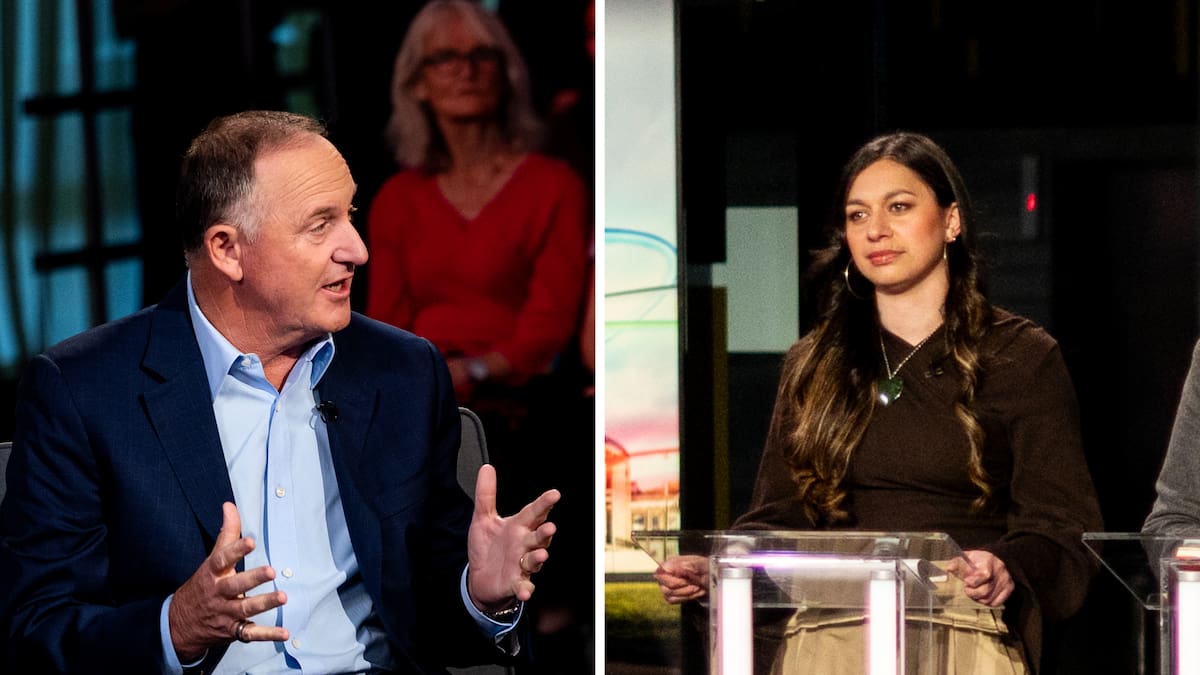
Key said New Zealand’s issue isn’t a lack of opportunity, but “it’s can we get over ourselves and have both a political consensus, which is extremely difficult to do, and the desire to do it”.
He referred to a question posed during Tuesday night’s leaders debate about whether it was morally acceptable for any one person to be a billionaire.
“What sort of wowsers have we become if we’re going to sit there and say, ‘oh, we’re going to celebrate the Warriors and the All Blacks and we think a bunch of other people are really good, who are sportspeople or artists or whatever, oh, but if you’ve built a world-class space company like Peter Beck, oh, that’s morally offensive, if you’re Graeme Hart and you’ve built the best packaging business in the world, that’s morally offensive’.
“That is nuts, so if we want New Zealand to do better and be great, we have to have vision, we have to have ambition and actually collectively we have to all say we’re going to be better off because of that.”
Sir John Key speaks with Ryan Bridge during the NZ Herald’s Future of New Zealand debate. Photo / Dean Purcell
The Greens’ Tamatha Paul picked up on the topic later, saying those who had built such wealth had often used public infrastructure to innovate and had received public grants.
“But that means they need to pay their fair share. I am not saying they shouldn’t exist altogether. They need to pay their fair share.”
Appearing alongside Key was Guy Haddleton, who host Ryan Bridge introduced as the panel’s “billionaire”. Haddleton is a Kiwi entrepreneur who has co-founded software companies and was an early investor in Xero.
Asked what it was like when people talk about billionaires “like that”, Haddleton said he didn’t listen.
“It is meaningless. My life hasn’t changed. You get to a stage where, what do you want to do with life, and I want to give back,” he said.
Haddleton said New Zealand had an issue: that we didn’t know our direction.
“I think we need a united vision for the country that expands beyond three years. We need that beacon that says to us, in 20 years’ time, we will grow our domestic pie by 2%, 2.5%, whatever we choose, we do it every year and whoever is in leadership, drives that vision.”
How New Zealanders adapt to AI’s increasing prevalence in the workforce was also debated.
Julia Pahina, a co-founder of Fibre Fale, which seeks to create pathways for Pacific people into the technology industry, said it was a conversation workers needed to be part of.
“Those people that are making decisions around governance and around employment are not necessarily putting in place guardrails to protect worker rights,” she said.
“That goes across every single community. The Pasifika community is particularly vulnerable because we were brought over to New Zealand to be working in areas that are seen as less valuable, but are ultimately what the backbone of this country is built on.”
A group of influential Kiwis spoke about the country’s future. Photo / Dean Purcell
She questioned who benefited from the productivity and efficiency gains brought about by new technology.
She said someone looking after their elders or working multiple jobs doesn’t have the same capacity to retain “as somebody that is insulated, that is able to access an Ivy League course”.
Jamie Beaton, the Crimson Education founder who helps students get into top international universities, said there was an opportunity for Kiwi children to get access to “elite, high-quality education nationwide”, mentioning charter schools.
“Actually, why can’t these people access Ivy League education? I think that’s actually very close-minded,” Beaton said.
He said it was a “really negative belief” to suggest that disadvantaged communities can’t access top universities, mentioning individual students who have had success at institutions such as Harvard.
“The last several years have seen historic success from them in the [US].”
Pahina said mentioning individual testimonials “puts a lot of pressure on the rest of the community to believe that they have to be that one single story”.
Later in the night, representatives of the main political parties gave their views on some of the key issues of the debate.
Asked what young people struggling to find work should do when AI may be taking their jobs, National’s Nicola Willis said that showed the need to grow the economy.
“That’s why we need to back the investors, we actually need to back the employers, we need to back the people taking risks, the entrepreneurs who want to do something new and not punish them with more taxes.”
Labour’s Barbara Edmonds said there is still a need for humans in professions like the law.
“You still need to understand the legal strategy even though you could have AI do the discovery.”
Jamie Ensor is the NZ Herald’s chief political reporter, based in the press gallery at Parliament. He was previously a TV reporter and digital producer in the Newshub press gallery office. He was a finalist in 2025 for Political Journalist of the Year at the Voyager Media Awards.