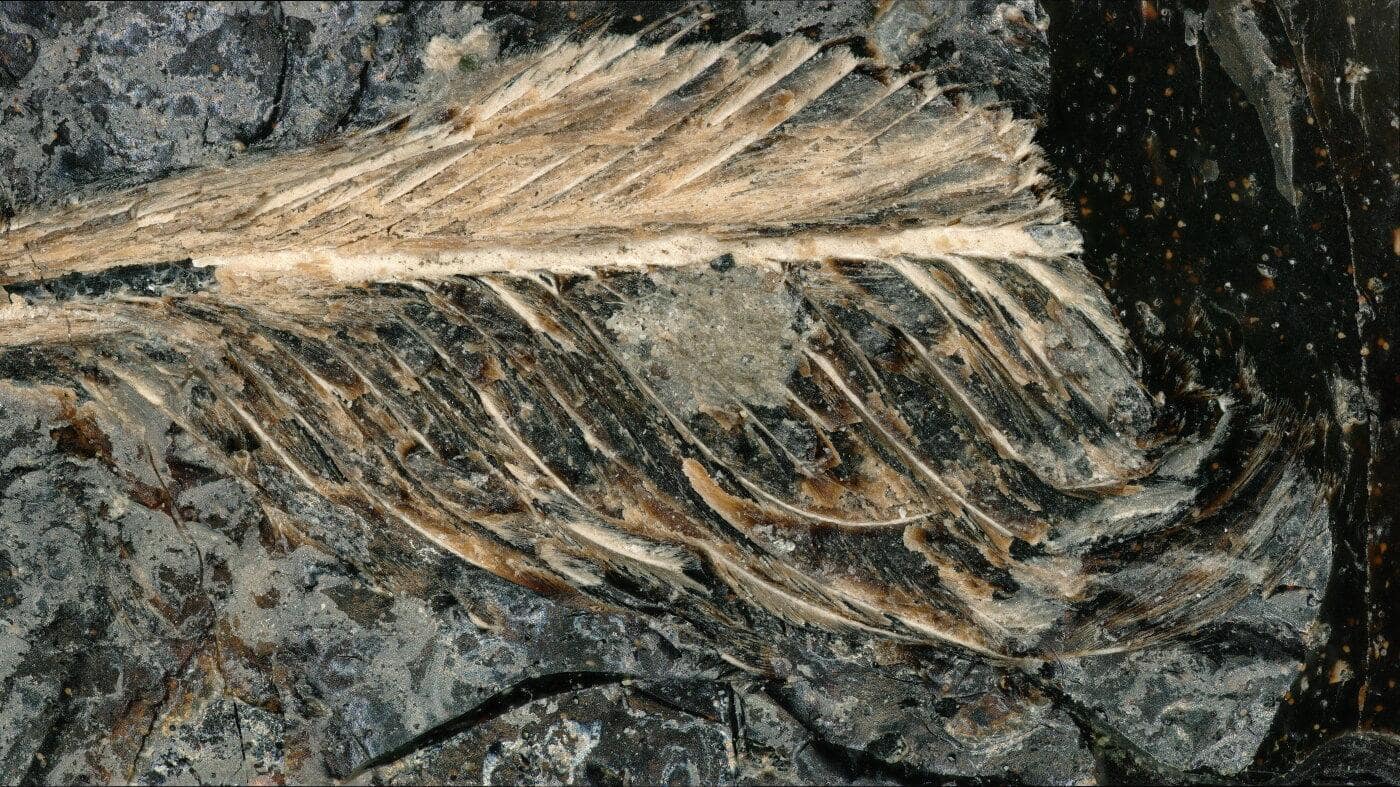
 The fossilized feather exposed on the surface of the fossilized dinosaur poop. Image credits: O’Connor et al./Current Biology.
When a team of researchers finally looked inside the fossilized dropping, they found not just one remarkably well-preserved feather, but several feathers, along with bird bones and tiny fish scales—the remains of a diving bird that was eaten by a dinosaur near the end of the Cretaceous, not long before the asteroid impact that transformed life on Earth.
This is “arguably the best-preserved feather ever recovered from Mesozoic lithic deposits,” the researchers note in their study.
The feathers are giving scientists a rare look at birds that lived 66 million years ago, just before an asteroid struck Earth and wiped out the dinosaurs and many other species (end of the Cretaceous period). They may help explain why these ancient birds disappeared while the ancestors of modern birds survived.
Scanning the dinosaur dung in detail
The fossil was discovered in 2016, when paleontologist David DeMar Jr. was searching for fossils in Montana’s Hell Creek Formation. He picked up a small, broken piece of fossilized dung and noticed something unusual on its surface.
“I picked it up and scanned its surface through my hand lens, and that’s when I couldn’t believe what I was seeing — a tiny fossil feather,” he told The Times..
The coprolite (fossilized poop) was about the size of a cherry and probably came from a medium-sized theropod. The researchers mention dinosaurs such as Nanotyrannus or Anzu as possible examples, although they cannot identify the animal that produced it. Researchers later used micro-CT scans and 3D surface scans to examine its contents without breaking it apart.
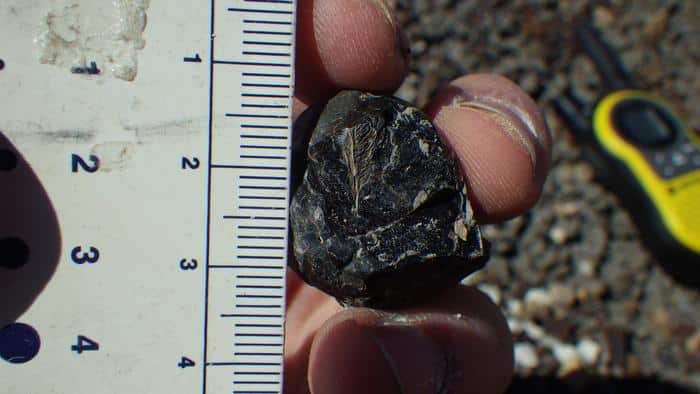 Fossilized feather inside the dinosaur poop fragment. Image credits: David DeMar, Jr.
Inside, they found four feathers in total: two wing feathers and two fluffy body feathers. The most striking was a 9.3-millimeter-long primary feather preserved in three dimensions. Instead of leaving behind only a flattened outline, it retained its original structure, including a lightweight interior surrounded by a harder outer layer.
“This is the best feather we’ve ever seen in a Mesozoic deposit. It’s like a feather you could pick up off the ground,” Jingmai O’Connor, one of the researchers and an associate curator of fossil reptiles at the Field Museum in Chicago, said.
The second wing feather was smaller but had a similarly lightweight structure. The other two feathers were softer-looking body feathers with a more primitive arrangement of branches.
The coprolite also contained two leg-bone fragments, measuring 18 and 12 millimeters long. Their shape suggests they belonged to a hesperornithiform, a group of short-winged, flightless diving birds related to modern birds but wiped out at the end of the Cretaceous. The feathers are the first hesperornithiform feathers ever found.
Two tiny fish scales found alongside them probably belonged to a gar. They likely came from the bird’s last meal, eaten shortly before the bird itself became the dinosaur’s meal.
×
Thank you! One more thing…
Please check your inbox and confirm your subscription.
The feathers tell a story about survival
Some of the feathers had features associated with keeping water from penetrating the plumage, an obvious advantage for a diving bird. Their lightweight, stiff construction also resembles feathers found in modern birds.
One feature was especially important. The primary feather had a square shaft with a sponge-like center, a combination not previously seen in any Mesozoic feather. The next-oldest known example of this sponge-like structure is about 10 million years younger.
This means some of the structural features associated with modern feathers were already present in birds before the asteroid struck Earth.
However, the two body feathers were different. They had a more primitive structure, with loosely arranged branches. These feathers probably helped keep the bird warm, but the researchers suggest they may have provided poorer insulation than the plumage of modern birds.
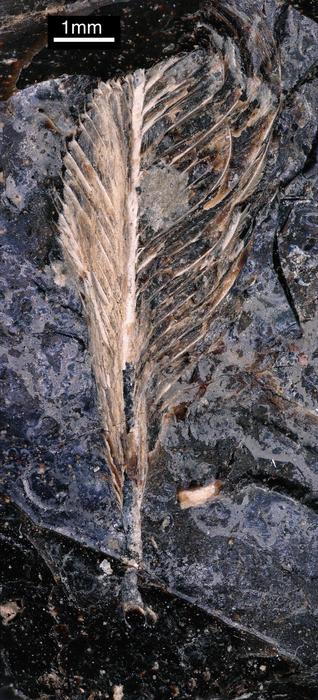 An image of the preserved feather. Image credits: O’Connor et al
This could have mattered after the asteroid struck 66 million years ago. Dust, sulfur and soot thrown into the atmosphere blocked sunlight and caused temperatures to plunge in what is often called an ‘impact winter.’ With plants dying and food chains collapsing, animals also had to cope with a much colder environment.
So maybe these primitive feathers “were good enough to keep them warm during the greenhouse world of the Mesozoic, but not good enough to keep them warm during this environmental catastrophe that was triggered by this impact event,” O’Connor added.
That is an intriguing idea, but it remains a hypothesis. A handful of feathers from one individual cannot establish that insulation determined which bird lineages survived the asteroid impact. Other traits almost certainly mattered as well.
A new place to look for ancient feathers
Feathers are made largely of keratin, a tough material that many animals cannot digest completely. Some may therefore survive inside fossilized dung. However, well-preserved three-dimensional feathers are exceptionally rare in the fossil record, particularly from the final part of the Cretaceous.
Moreover, these are the first reported fossil feathers from a coprolite, making fossilized dung an unexpected source of information about ancient birds.
“As far as I know, no one has ever thought to look for feathers or to study feathers in coprolites, so this project was really exciting,” O’Connor said.
The researchers now suggest that other coprolites in museum collections could contain similar remains. Finding more feathers could help scientists work out whether differences in plumage really played a role in determining which birds survived the asteroid impact.
For now, this single coprolite captures an extraordinary chain of events that happened right before the mass extinction event: a bird ate a fish, a dinosaur ate the bird, and the dinosaur left behind a dropping that preserved evidence of the bird for 66 million years.
The study is published in the journal Current Biology.