
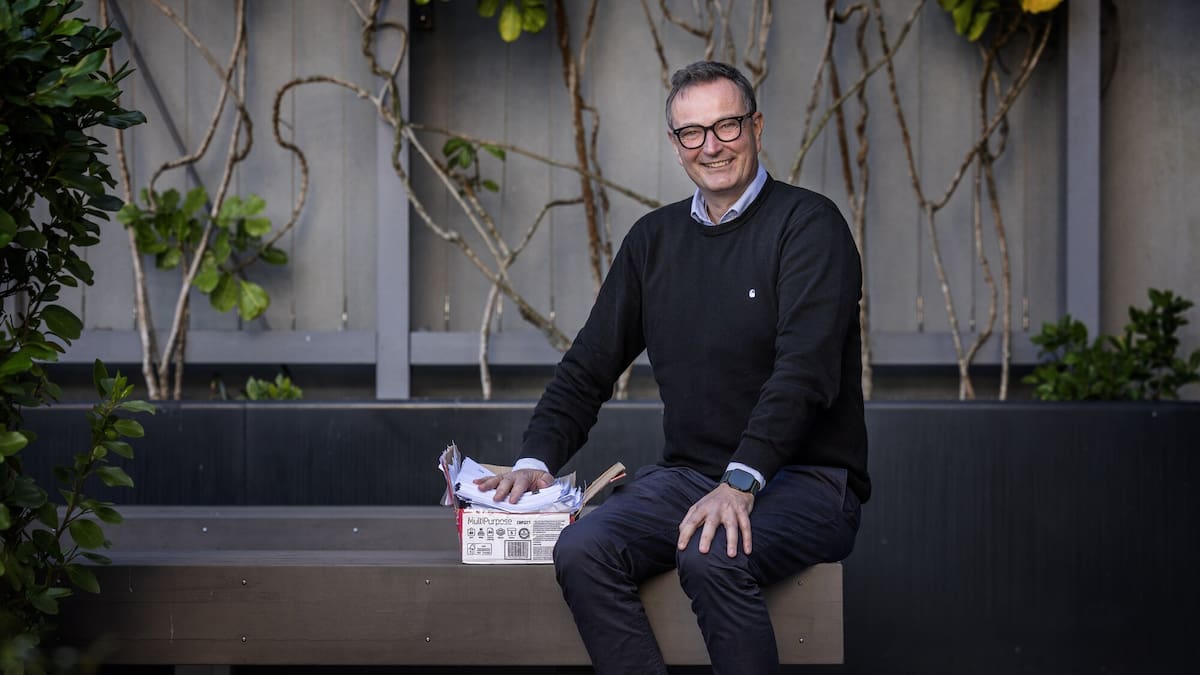
Ryan’s original intention
As reported by the Herald in August, Ryan received four parking tickets in Parnell and the central city in late 2025, totalling $85.
He disputed them and asked for a defended hearing.
During the legal process, Ryan was given evidence showing how the cars collect footage as they operate, with hours of video of identifiable people on streets, around private premises and church grounds.
AT confirmed the cars capture more than rule-breaking vehicles.
Ryan believed the footage amounted to extended surveillance, more than required to identify infringing cars, and questioned whether the video collection breached the Privacy Act, the Evidence Act or the Bill of Rights Act.
Some of the documentation Paul Ryan received from Auckland Transport. Photo / Mike Scott
AT said it was confident the footage complied with relevant legislation.
Ryan felt it should be tested in court.
“What I received was video footage of pretty much everything going on in Parnell on those streets at that time of day,” he told the Herald.
On the day of the June hearing, AT withdrew all four tickets, so no court tested the evidence.
Ryan then applied for costs, asking for $71 to cover parking and travel for the June hearing and printing his court documents.
Two JPs heard the application in the Auckland District Court on September 14.
Findings from the hearing
The justices did not rule on whether the footage was lawfully gathered, saying that was not necessary to decide in a costs application.
What did count was how AT handled the tickets once Ryan disputed them, the JPs found.
Once AT knew Ryan was disputing the tickets and wanted a court to decide the matter, the council-controlled organisation could not reasonably keep handling them as ordinary unpaid fines.
“In those circumstances, we find that the referral or continued treatment of the disputed infringement notices as a debt collection through Baycorp was not reasonable or proper,” the JPs ruled.
In his written submission to the court, Ryan said AT’s referral of his parking tickets to Baycorp was wrong in two additional ways.
He argued this bypassed the court process, because once he asked for hearings, AT was required to take the tickets through the courts.
“Only a court can turn a ticket into a fine,” he said after the hearing.
He also argued that passing his details to Baycorp breached his privacy by sharing his personal information with the debt collection agency before any court had determined liability.
“It does provide Baycorp with information it couldn’t otherwise get,” he said.
The justices did not rule on whether the referrals breached privacy law or whether AT’s arrangements with Baycorp were lawful.
Ryan was awarded $240, above the $71 he asked for. The reason for this was unclear, but the JPs noted he had attended other hearings.
An Auckland Transport licence plate recognition vehicle in operation. Photo / Michael Craig
AT’s legal response
In a letter dated September 30, AT’s special counsel for litigation told Ryan the organisation was considering appealing the costs award.
The letter also outlined that AT anticipated Ryan would appeal that decision.
AT proposed that both sides abandon any appeals and drop any other proceedings, in “full and final settlement of all claims or potential claims arising whatsoever from this matter”.
AT would pay the $240 as part of the deal, which was open until October 6.
Ryan rejected AT’s proposal.
“I am not prepared to surrender my legal rights in exchange for Auckland Transport complying with that order,” he told AT’s lawyer in an email reply.
“If Auckland Transport considers it appropriate to spend public money appealing a $240 costs award, that is a matter for Auckland Transport.
Auckland Council takes over parking infringements
On October 1, public parking transferred from AT to Auckland Council.
The council told the Herald it was not in a position to comment on the court’s decision or the legal status of Ryan’s case.
Head of parking services John Strawbridge said the council balanced the opportunity to dispute parking infringements with paying fees and following up unpaid tickets.
About 60% of parking tickets were paid upfront, 20% were paid through a payment plan or after contact from Baycorp and 20% were referred to the Ministry of Justice, Strawbridge said.
“We are always looking for opportunities to improve our processes and this case will be no exception.”
Mike Scott is a senior visual journalist at the New Zealand Herald. His work spans writing, photography and video, and he has won numerous journalism awards, including Videographer of the Year and Best Documentary. He has worked in media for more than 25 years, producing stories across New Zealand and internationally.
Sign up to The Daily H, a free newsletter curated by our editors and delivered straight to your inbox every weekday.