
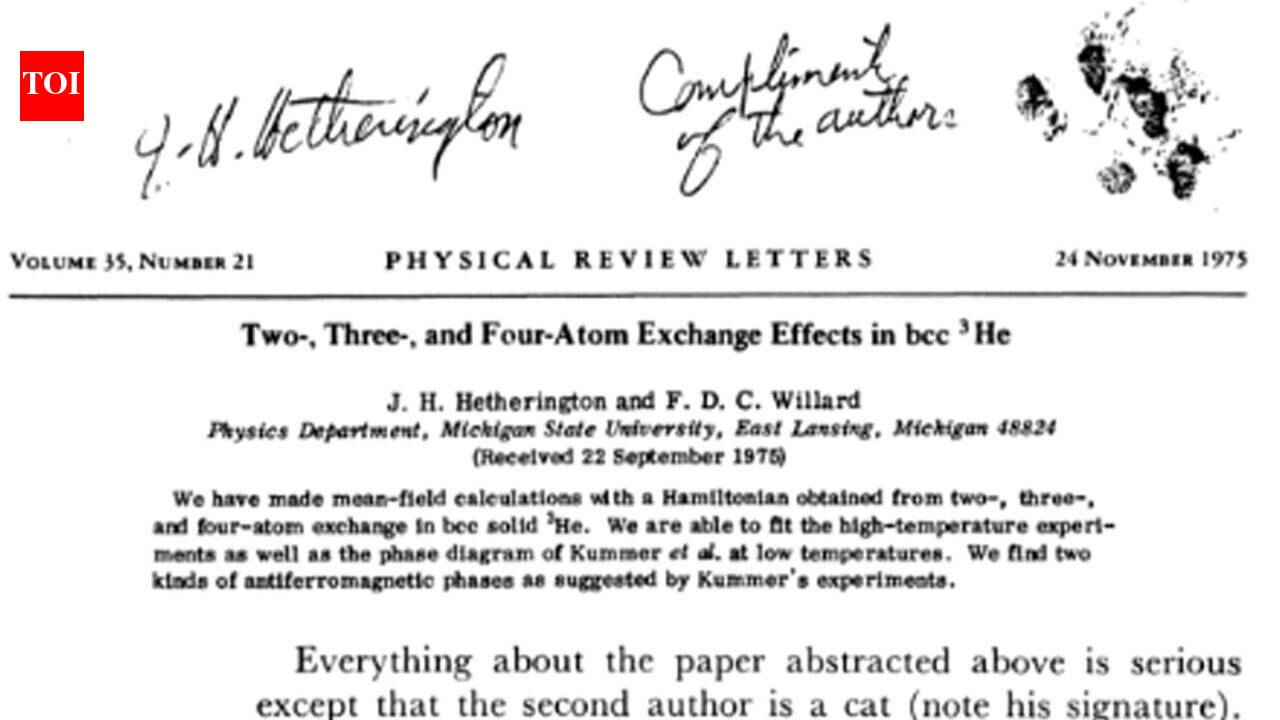
 In 1975, physicist Jack H. Hetherington added his cat as a co-author; the paper was published in a top physics journal Getting a research paper published is difficult enough for most scientists. In 1975, American physicist Jack H. Hetherington faced an unusual problem with his manuscript. His solution was even more unusual. He added his cat to the list of authors.The cat’s name was Chester, a Siamese belonging to Hetherington, who was then a professor of physics at Michigan State University. Chester did not conduct experiments, analyse data or write a single equation, but his name still appeared on a research paper published in Physical Review Letters, one of the most respected journals in physics.The paper, titled “Two-, Three-, and Four-Atom Exchange Effects in bcc 3He”, was published on November 24, 1975. Its subject was serious physics, involving the behaviour of helium-3 and atomic exchange effects at low temperatures. The unusual part was the second author listed on the paper: F.D.C. Willard.F.D.C. Willard was Chester.
It all started with a problem in the manuscript
Hetherington had completed his research and was preparing to submit the paper to Physical Review Letters. He had written the manuscript using the pronoun “we”, even though he was the only researcher who had worked on it.A colleague who read the paper before submission pointed out that the journal did not allow a single author to use “we” in this way. Hetherington was therefore faced with two choices. He could rewrite the manuscript, which had already been typed, or he could find another author.He chose the second option, although not in the way anyone would have expected.In his later account of the episode, Hetherington explained that changing the paper to an impersonal style seemed too difficult at that stage. After thinking about it for an evening, he asked his secretary to change the title page and add the name of his family cat.Chester was given the name F.D.C. Willard for the publication. The name was based on a scientific-style version of the cat’s name, while Willard was also the name of Chester’s father.With that small change, the manuscript had two authors.The journal accepted the paper.
In 1975, physicist Jack H. Hetherington added his cat as a co-author; the paper was published in a top physics journal
What was the research about?
The amusing story behind the authorship should not obscure the fact that the paper itself was genuine scientific research.Hetherington’s work focused on helium-3, an isotope of helium that contains two protons and one neutron. The paper examined exchange effects involving two, three and four atoms in solid helium-3 under particular conditions.Helium and its isotopes have long been important in low-temperature physics because they display unusual properties as temperatures approach extremely low levels. Research involving helium-3 has contributed to the understanding of quantum effects and the behaviour of matter under such conditions.Chester, of course, had no role in any of this. His contribution was limited to helping his owner avoid rewriting a manuscript.
How did people discover that F.D.C. Willard was a cat?
Hetherington initially kept the joke relatively private. He sent signed copies of the paper to a small group of friends and colleagues, and Chester even left his paw print on some of them.The unusual authorship eventually became known more widely after a visitor to Michigan State University asked to meet Willard. Since Willard was not available, the request caused some amusement among those who knew the truth. It did not take long for the story to get out.Hetherington later recalled that once people realised who F.D.C. Willard really was, the story attracted considerable attention.The physicist himself apparently did not regret the decision. He also understood that having a cat listed as a co-author was likely to make people curious about the paper and the research behind it.
Chester later became a sole author
The story became even more unusual a few years later.In 1980, F.D.C. Willard appeared as the sole author of another article related to helium-3. This time, the article was published in the French popular science magazine La Recherche.That gave Chester a rather remarkable publishing record. He had first appeared as the co-author of a research paper and later appeared as the sole author of another article.Chester died in 1982, but his unusual place in the history of scientific publishing did not disappear.
Why the story would not work the same way today
Scientific publishing has changed considerably since the 1970s. Authorship is now closely linked to a researcher’s contribution and responsibility for the work. A person listed as an author is generally expected to have contributed substantially to the research and to be able to take responsibility for the published findings.A cat obviously cannot meet those expectations.The Chester story therefore belongs to a very different era of academic publishing. Hetherington was not seriously claiming that his cat had contributed to the physics. He was looking for a humorous solution to a problem with the wording of his manuscript.The episode also highlights how much scientific publishing depends on conventions that can seem surprisingly specific. In this case, a single word in a manuscript led to one of the strangest author listings in the history of physics.
Even the American Physical Society remembered Chester
The story was still familiar in the physics community decades later. On April 1, 2014, the American Physical Society published an April Fool’s announcement about making papers authored by cats freely available under an open-access initiative.The announcement jokingly referred to the tradition of cats in physics and mentioned Schrödinger’s famous thought experiment involving a cat.The joke worked because physicists already had their own real-life feline author to remember.F.D.C. Willard was not the first cat to become associated with science in popular culture, but he may be the most unusual example of a cat whose name actually appeared on a published scientific paper.For students, the story is a reminder that the history of science is not always as serious and predictable as it may appear in textbooks. Behind the equations, experiments and journal articles are researchers who sometimes find themselves dealing with very ordinary problems.In Hetherington’s case, an awkward use of the word “we” resulted in his family cat becoming part of the scientific record.Nearly five decades later, the research paper remains accessible, but it is the name F.D.C. Willard that continues to attract attention. Chester may never have understood helium-3, but he certainly managed to leave an unforgettable paw print on the history of physics.