
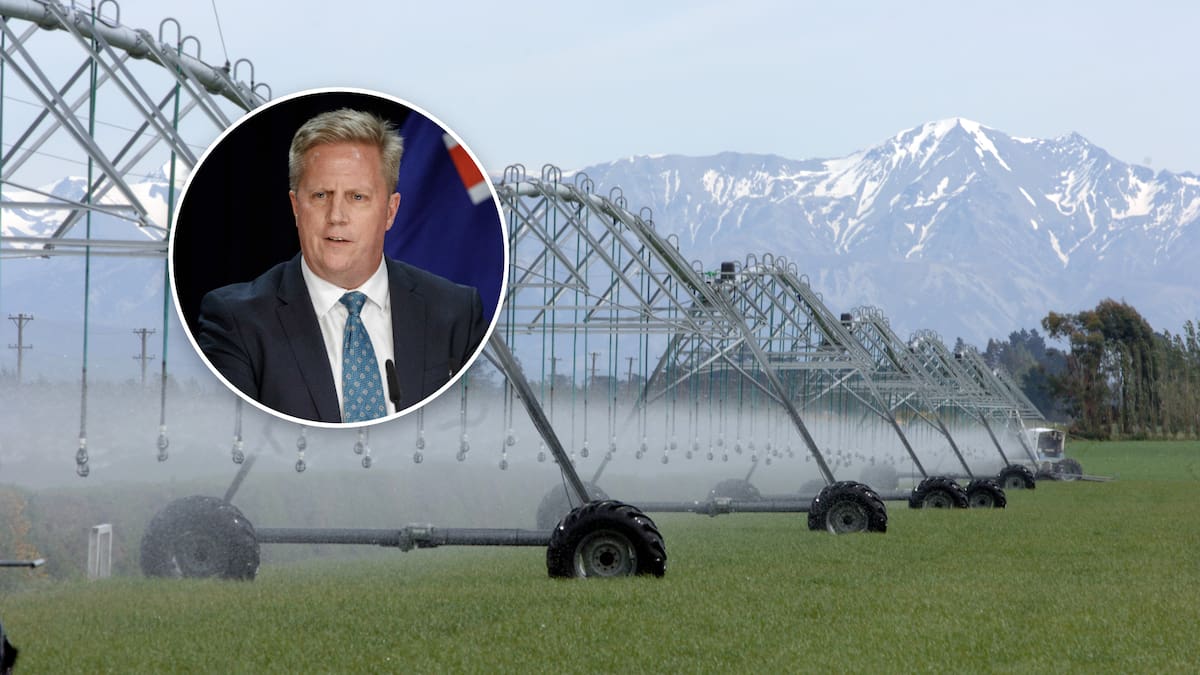
The $300m in loans was not replacing current private funding, but meant the Government was taking a role to help address the issue.
National leader Christopher Luxon at Feilding’s Rural Day, which he attended with MPs Todd McClay and Mike Butterick. Photo / Mark Mitchell
National said it would also develop the first long-term water infrastructure pipeline in partnership with farmers, growers, councils and iwi. It would also publish a rural and provincial water-use strategy in 2027, which would include a national storage register.
On fertiliser, National has promised to negotiate security agreements with key supplier countries to protect New Zealand-bound products from export restrictions and improve supply-chain certainty. This comes after significant disruptions to shipping routes, global fertiliser prices and availability amid the ongoing conflict in Gaza.
National MP for Rangitīkei Suze Redmayne competing in a gumboot race while campaigning at the Feilding Rural Day. Photo / Mark Mitchell
Butterick said that, without reliable access, the farm sector could not sustain its current production.
“New Zealand plans for fuel security and energy security. National believes we should also plan for fertiliser security to protect New Zealand’s productive economy.”
The party would also, if elected, create a $10m fund to partner with domestic fertiliser manufacturers to support pathways for long-term domestic nitrogen production and the transition from natural gas to electrification.
National leader Christopher Luxon in Feilding. Photo / Mark Mitchell
“National will prioritise reducing reliance on imports and improve certainty of availability for our farmers.”
Earlier today, the Act Party announced it would campaign on ensuring agriculture remained a curriculum subject for Year 11 students.
The party’s agriculture spokesman, Andrew Hoggard, said he had written to Education Minister Erica Stanford seeking confirmation that it would remain a standalone subject for Year 11 students.
“I’m gutted to learn this isn’t the case,” he said.
“We’re a food- and fibre-producing nation, so learning about our biggest exporter shouldn’t be an unconventional subject.”
Luxon, speaking at the Rural Day, said experts had advised that Year 11 was too early to introduce such a specialised science, but it was included for Years 12 and 13.
Julia Gabel is a Wellington-based political reporter. She joined the Herald in 2020 and has most recently focused on data journalism.