
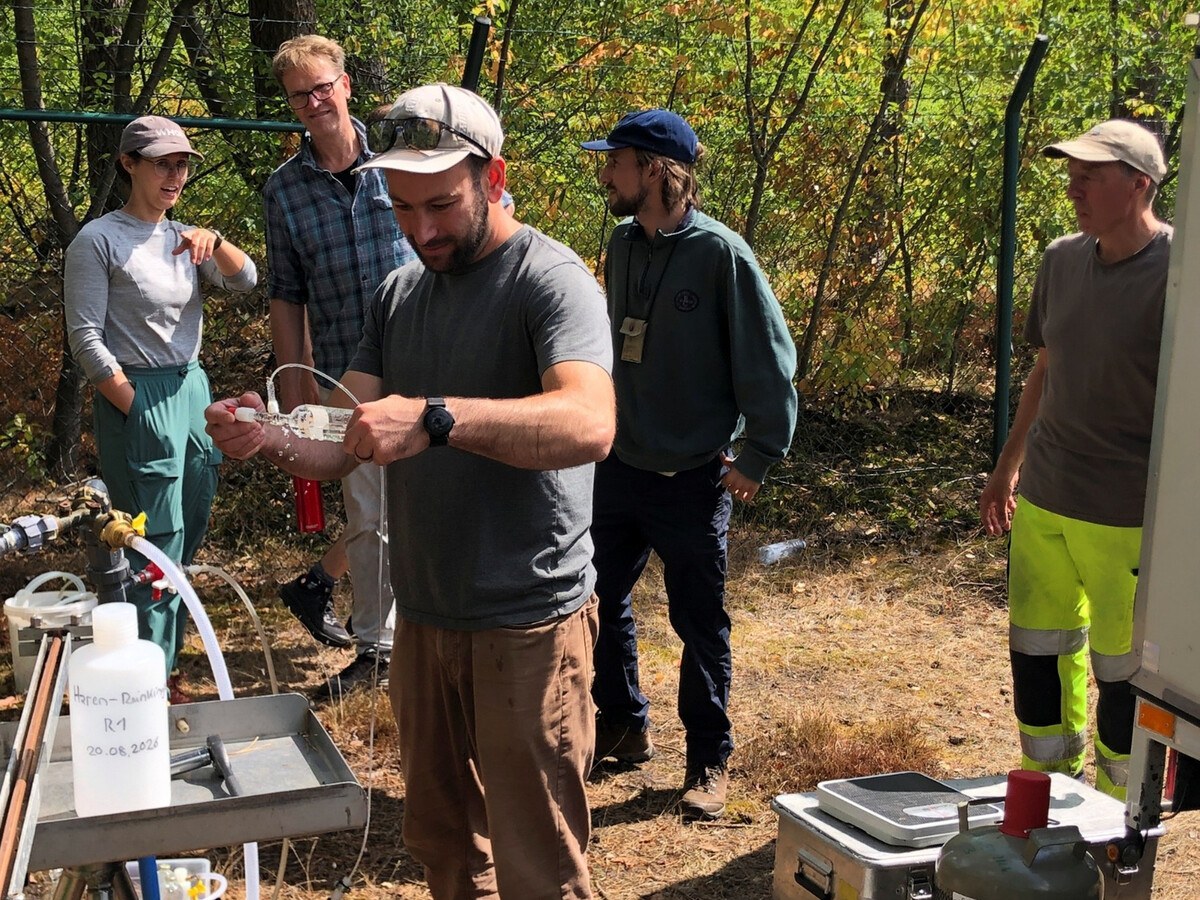
New study ‘opens the door to a much more complete picture of the sources and fate of nitrogen in groundwater systems,’ says UCD’s Dr Alan Seltzer.
Scientists have found a new way to improve water-quality assessments using a rare form of nitrogen gas.
Nitrogen is a key to life on Earth, but only in right amounts. For example, high concentration of nitrogen in water bodies can ruin its quality and lead to the gradual deal of aquatic animals.
Tiny microbes living in water can remove nitrogen by converting it into a gas that escapes into the atmosphere. Though this is something researchers have often struggled to determine.
In a new study co-authored by University College Dublin’s Dr Alan Seltzer, researchers have shown that a rare form of nitrogen gas can act as a natural fingerprint for microbial nitrogen conversion. Seltzer is an assistant professor of hydrogeology and groundwater systems at the university.
“The problem is that our water naturally has a huge amount of nitrogen gas that is dissolved from the air, so the gas that microbes produce can be very difficult to see,” explained first author Jiarui Liu, who conducted the research as a postdoctoral fellow at University of California, Los Angeles and University of California, Santa Barbara.
“The answer is written in the way nitrogen atoms are paired inside the nitrogen molecule.” The paper was published in the journal Science yesterday (8 October).
According to the study, the rare, naturally found 15N15N isotopologue can be used to determine the amount of nitrogen production in water, offering scientists a new tool to improve water-quality assessments and estimate global nitrogen budgets.
Nitrogen gas – or N2 – consists of two nitrogen atoms joined together, UCD explains. These come in two weights, also called isotopes; the common nitrogen-14 and the heavier nitrogen-15.
Most N2 molecules contain two nitrogen-14 atoms, while some contain one of each isotope. In very rare circumstances, both atoms are nitrogen-15. In atmospheric nitrogen gas, the two heavy nitrogen-15 atoms pair up more often than expected, while the nitrogen gas produced by microbes has atoms paired nearly at random.
Scientists have figured out that when nitrogen from microbes mixes with nitrogen from the air, it reduces that excess of heavy pairs, creating a relative abundance of the rare molecule that can reveal how much nitrogen gas was produced by microbial activity.
The team measured nitrogen gas extracted from water and sediment samples using UCLA’s Panorama mass spectrometer. The instrument uses electric and magnetic fields to separate molecules according to their mass and charge.
“At UCLA we discovered the anomalous pairing of heavy nitrogen atoms in Earth’s atmosphere and are now making use of this signature of nitrogen in air as a powerful and unique geochemical tool,” said geochemist Edward Young, one of the paper’s co-authors and Liu’s postdoctoral advisor at UCLA.
“We want to understand whether microbes in groundwater can mitigate nitrate pollution, and how much nitrogen is removed along the way before it can fuel algal growth in lakes, rivers and coastal waters,” Liu said. “This gives us a clearer picture of whether nitrogen stays in an ecosystem or is removed from the nutrient pool as N2 gas.”
Seltzer added: “Many routine groundwater-quality monitoring programs do not measure the N2 gas produced within an aquifer, which can create substantial biases in our accounting of where nitrogen comes from and where it goes.”
“This study, and this exciting new technique, opens the door to a much more complete picture of the sources and fate of nitrogen in groundwater systems.”
Seltzer was recently awarded a European Research Council Starting Grant for his project called TabPhish that traces groundwater focusing on water level changes and nitrogen cycling. This research will expand on his collaboration with UCLA.
“This first application provides a strong foundation for our upcoming work and represents just the start of a powerful new toolkit for better understanding the sources and fate of nitrogen in groundwater systems impacted by human activity,” he said.
Don’t miss out on the knowledge you need to succeed. Sign up for the Daily Brief, Silicon Republic’s digest of need-to-know sci-tech news.