
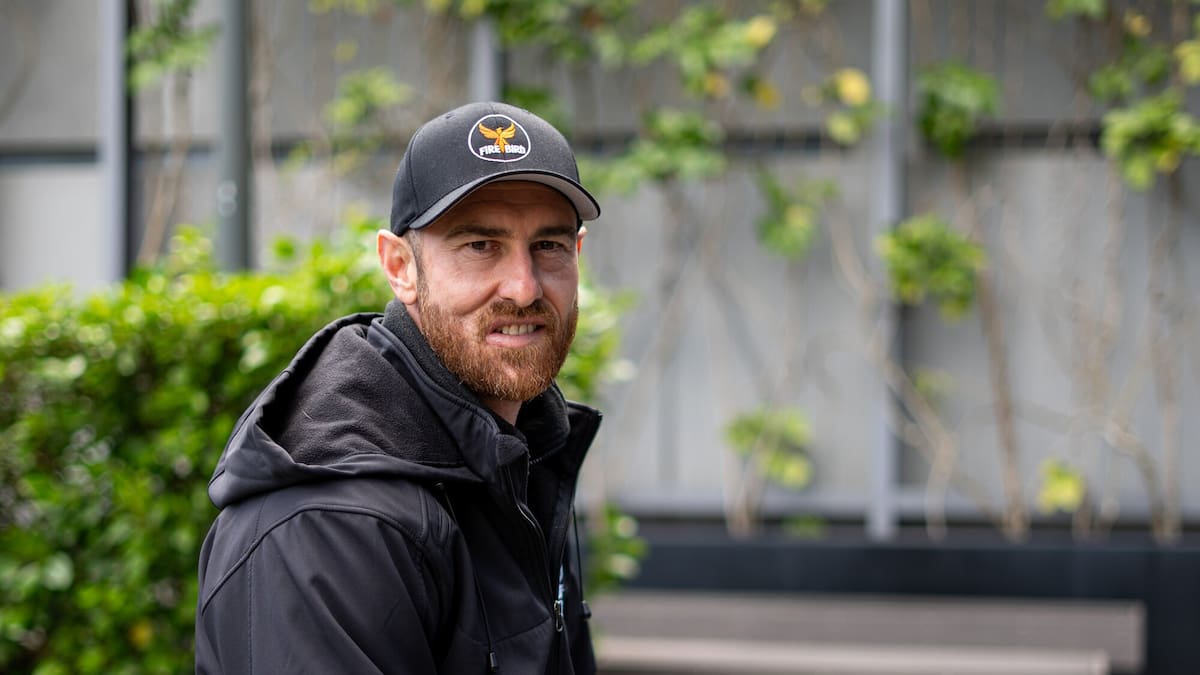
“Although I thought it was all done, it’s not quite,” Winstanley says. “I think it’s just a realisation that this might never be fully done. It’s just a part of life now.”
In 2023, Winstanley was part of the police tactical squad dispatched to downtown Auckland. A contractor had entered a Queen St building site with a shotgun. Matu Reid killed two fellow workers and injured multiple others, including emergency responders, before taking his own life.
Detective Shaun Winstanley in the immediate aftermath of a shooting at a building site in Queen St, Auckland, in July, 2023. Photo / Tony Johnson
Shaun “Winnie” Winstanley was seriously wounded. His jaw was shattered into at least 12 pieces; he lost five teeth and suffered thermal burns from the shotgun pellets that sprayed his face. His recovery has been long. In the early months, he couldn’t eat properly, drink much liquid, or tolerate anything hot.
Firebird Protein Coffee was born of frustration: a caffeinated kitchen-sink experiment that Winstanley turned into a business. And that’s how the Herald lifestyle desk first met him – flogging cold cans at last year’s Auckland Food Show.
Back then, getting Winstanley to agree to an interview wasn’t easy. He had a product to sell, and his injuries were the reason for its creation, but he didn’t want to be defined as the cop who was shot in the face.
Today, he greets the Herald with a confident grin. A different man? “Evolved,” he says, like the business as it launches a flavourless protein powder that hydrates in cold and hot liquids. From October 13, it will roll out nationwide as part of Z Energy’s barista coffee offering, available as a protein latte and protein iced coffee.
Winstanley couldn’t be happier.
“I was always going to hide behind the bird,” he says, referencing his company’s phoenix logo. “That’s also part of my identity now. That’s the stuff that gets me up in the morning. A brand that is going to be more than a brand … striving for bigger and better.”
The shooting forced an identity reckoning.
“I was always Winnie the rugby player, and then I joined the police and I was Winnie the police officer … And I felt really uncomfortable being ‘the police officer who was shot in the face’. I’ve since learned, and have been teaching myself, that identity is not a job.
“Identity is made up of multiple things. I’m a husband, I’m a dad, I’m a sports coach, I’m a police officer, I’m a guy who got shot in the face, I’m an advocate for mental health, I’m an entrepreneur … the incident is just part of me. It’s not the sole part of me.”
Firebird Energy founder Shaun Winstanley with the canned protein coffee developed as part of his recovery and the new powder (right) that can be added to hot or cold drinks. Photo / Alyse Wright
According to data reported last year, New Zealand’s frontline police encounter firearms nearly 10 times a day. Only some instances make headlines. Winstanley confirms he has spoken to the officer injured when fugitive Marokopa father Tom Phillips shot at police before being shot and killed himself.
At that time, Winstanley was two years into his own recovery, “still looking down the barrel – for lack of a better term – of many different operations”.
He saw his own early confidence mirrored: “That’s hard, because you think, ‘I’m gonna get there, and everything’s going to be back to normal’. It’s just bloody not.”
The pair’s families recently connected again.
“I’m not here to tell his story … but we’ve had three years, he’s hit one year, and it was like, ‘well, do we tell him that this s*** goes on forever?’”
Winstanley has previously spoken about not dwelling on the what-ifs and understanding his whys. Now, he says he’s been challenged to dig deeper because it’s too easy to list your partner and/or your children.
“Why are they your why? And for me, it’s because I want to be a role model.”
That means going out and seeing people when he doesn’t want to (“human connection is part of life”) and going to an operation instead of complaining about it.
“It’s about carrying on and showing up. Showing up is where it’s at … If you understand your ‘why?’ then you understand your purpose.”
Three images sum up his mental health approach.
“Me in my armed offenders uniform – an image of being indestructible; it’s all black, lots of weapons, you can barely see my face. Me after a run, and that’s just me being a human. And then the third one, which is a photo of one of my most recent X-rays, where you can still see 30 or 40 pellets in my face.”
The point, Winstanley says, is you can’t see that metal from the outside.
“Everyone has their bullets, everyone has these things. My story captures the ear and the eye because that’s the nature of it. Everyone’s going through their struggles, and that’s what really motivates me to talk about some of the things that have helped me get through some of the adversity I’ve faced – in the hope that if it helps one other person, then it’s worth talking about.”
Before the shooting, he had a “harden up and move on” mindset.
“That’s hard to say now, because I’ve experienced some mental health challenges myself. I couldn’t just harden up and move on.
“I had to start talking about it, and talking to people. And, more importantly, showing some vulnerability. It’s amazing, if you show some vulnerability to another person and you’re genuine about it, what you get from other people. It blows me away what people are going through and the challenges they have.”
It was a Thursday morning when Winstanley and his colleagues were dispatched to the 21-storey building at the bottom of Queen St. His wife Nicky was at home with their boys. She was kneeling, tying up a shoelace, when one of them looked past her at the television screen and said, “oh, there’s a police officer covered in blood and steam”.
That officer was Winstanley. Four days later, he might not have been there. His bags were packed for a Special Tactics Group qualification course he was due to start that Monday and he says that would likely have been his life for the next three to five years.
“Our family structure would have been quite different. I would have been on call, I would have been away a lot. Now, I’ve been able to be at home with my children and Nicky has been able to retrain.”
She now works as an emergency medical technician with Hato Hone St John. Winstanley speaks openly about the separation anxiety he experienced when she had to attend a residential course.
Shaun and Nicky Winstanley at home in 2025. Photo / Michael Craig
“I went under a rock. I didn’t respond to friends. I didn’t like going out. I really was the opposite of who I usually am, who loves being out there and stuff. It almost made me feel physically ill, to think ‘I’ve got to go to this group gathering’.
“That’s part of the reason why I started doing a bit of public speaking. It was my way of trying to force myself, and to say ‘it’s okay, it’s just a phase …’ And I’m still dealing with that a little bit.”
Surgeons still remove the occasional shotgun pellet. Metal implants mean his reconstructed face still aches in cold weather. Eating a burger is hard work and he understands fatigue in a way he’d never experienced before, but the way he speaks about his recovery is more matter-of-fact than it was a year ago.
“My last operation was a lip thing. I was getting a whole lot of saliva and food caught up in here and I was dribbling quite a bit.”
He jokes to people in the front row of his talks that they risk a weather report and that physically, while he can’t open his mouth as much as he used to, “I think people won’t moan too much about that!”
Winstanley says: “I’ve come a hugely long way.”
On long-term unpaid leave, he still hopes to return to the police force. He says the thrill of the job is bringing a calm head and the right training into a chaotic situation.
“There’s just nothing better … The camaraderie is amazing, but that camaraderie is built on a purpose – to help people who can’t help themselves at that time. So, yeah, I’m very, very passionate about the police and the work that they and all the emergency services staff do. They can be undervalued, but 99.9% of us do it for the right reasons, and that’s to serve people effectively.
“I didn’t run into that building that day because my family or friends were in there. I ran into that building because people I had never met in my life were getting shot, killed, or running from harm, and I didn’t have a second thought about it.
“But going back requires me to be 100%. My colleagues, the public, the people we serve, rely on us to be the best we can be … and I just think there’s a little bit of work to be done to be where I want to be.”
Winstanley is unused to not knowing what’s next in his life.
“Before, I was always quite methodical – this is what’s going to happen tomorrow, next month – I’ve always looked forward.”
Now?
“It’s quite a daunting thing to think that nothing’s actually really in your control. That’s the stuff I’m talking about and trying to work through.
“There’s a huge amount of positivity and gratitude. I’ve just got to acknowledge that I’m lucky enough to walk out of that building. To have a second chance.”
Kim Knight joined the New Zealand Herald in 2016 and is a senior journalist on its lifestyle desk.