
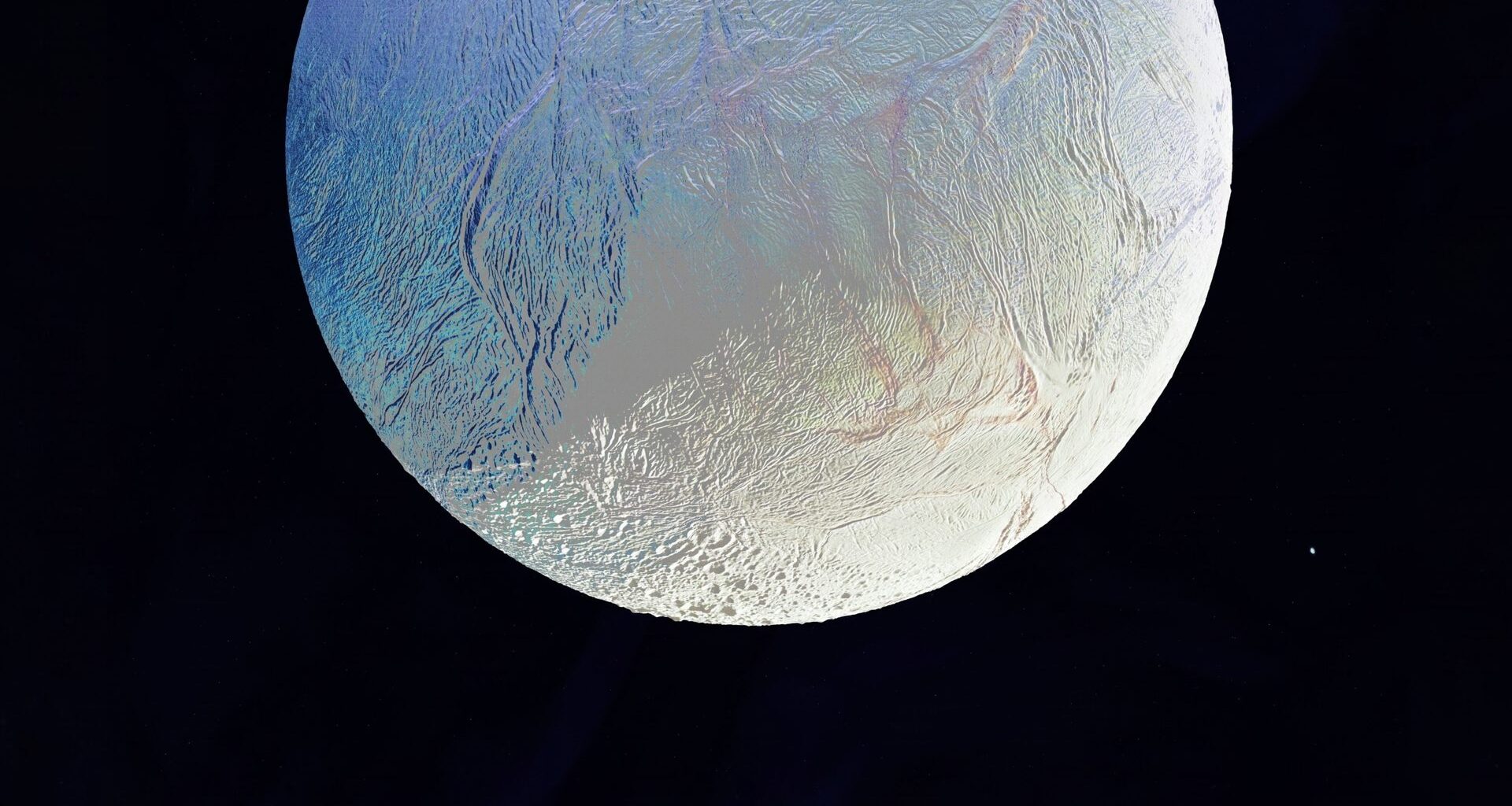
Enceladus’ ocean spray freezes slowly and shatters into grains that each carry mostly one salt, which could make signs of life easier to spot.
To study an ocean, you’d usually have to go there. Enceladus, a small icy moon of Saturn, sprays bits of its hidden ocean into space instead, and a spacecraft can fly through the spray.
New work suggests those ice grains aren’t a jumbled mix.
As the droplets slowly freeze, different salts separate from one another. Collisions then shatter the frozen droplets into tiny grains, many containing high concentrations of a single substance.
That could make any trace of life far easier to spot. It doesn’t mean there is life there.
An ocean under the ice
Enceladus hides a global ocean beneath its ice crust, above a rocky core. At its south pole, jets of water vapor and ice burst through cracks, feeding a faint ring around Saturn.
From 2004 to 2017, NASA’s Cassini spacecraft carried an instrument that measured the makeup of single ice grains as they hit it. Earlier studies used those readings to find salts and organic compounds that come from the ocean.
Frank Postberg, a planetary scientist at Freie Universität Berlin, led the new study with colleagues in Germany, Japan, China, the United Kingdom and the United States.
One salt per grain
The team looked again at about 1,000 salt-rich grains Cassini recorded between 2004 and 2008. Most were between 0.4 and 4 micrometers across, far smaller than the width of a human hair.
These grains weren’t all alike. The team sorted them into at least five main types, each dominated by a different salt, such as table salt, sodium carbonate, sodium phosphate or potassium chloride. Mixed grains were rare.
This finding challenged the idea that instant freezing would lock all the salts together in every grain.
In an interview with Earth.com, Postberg said the results overturned a long-held view.
“For over a decade we thought they would flash freeze from evaporative cooling, but we apparently were wrong,” he said.
Freezing in the lab
To test the idea, the team froze salty water mixed to resemble Enceladus’ ocean. They also ran chemistry models of how the salts come out of solution as it cools.
Different salts drop out at different temperatures. When droplets froze slowly, each salt had time to gather in its own patch before the next one formed.
The separation matched Cassini’s grains only when droplets were larger than about 10 micrometers.
They also had to cool at a rate of less than about 36°F (20°C) per minute. Faster freezing left the salts mixed.
The team thinks the ocean spray starts as droplets hundreds of micrometers wide, flung up when gas bubbles burst at the water’s surface.
Enceladus’ weak gravity helps those droplets grow larger than similar spray on Earth.
Smashed on the way out
A frozen droplet that big doesn’t match the tiny grains Cassini saw. The team’s answer is collisions.
Rushing up narrow cracks in the ice at more than about 220 miles per hour (100 meters per second), the frozen droplets slam into the walls and shatter. The fragments tend to carry a single, concentrated salt.
Postberg told Earth.com this also explains a long-standing puzzle about why the plume’s grains are so small.
Large grains, he said, get broken up by those high-speed collisions before they’re ejected.
The same sorting should apply to organic compounds. A rare ingredient in the ocean would end up in only a few grains, but concentrated in those grains. In Cassini’s data, phosphate showed up in just 9 of the 962 salty grains.
A head start for future missions
Picking out rare molecules usually takes careful chemistry in a lab.
“Enceladus actually does a lot of the work for us in preparing samples for analysis that usually take a lot of effort in chemical labs on Earth,” Postberg said.
The authors call this good news for future missions, as long as they analyze grains one at a time. Mixing many grains together would undo the sorting.
The European Space Agency is planning a mission to Enceladus, and Postberg said its launch is foreseen in the early 2040s.
A second study published the same day, led by researchers at LMU Munich with Postberg as a co-author, grew a methane-making microbe in a lab copy of Enceladus’ alkaline ocean.
The microbe kept growing up to a pH of 11, far beyond its known limit, fed by hydrogen from rock-water reactions.
Postberg said the result has changed how he views the possibility of life on Enceladus.
Microbes that live without oxygen are good stand-ins for Enceladus’ seafloor, he said, but its highly alkaline ocean had been thought too harsh for them.
Earlier plume studies have raised hopes for life there. One lab test showed a single grain could carry cell material that instruments detect.
Questions that remain unanswered
The new work doesn’t show that anything lives in that ocean.
The lab droplets weren’t perfectly round, and fragments can pick up pure ice from vapor along the way. That makes exact ocean concentrations difficult to determine.
Cassini’s instrument also couldn’t tell some salts apart, such as carbonate from bicarbonate. And the old grains were recorded years ago, drifting in Saturn’s ring rather than fresh from the jets.
A future spacecraft could test whether Enceladus naturally concentrates the chemical ingredients needed for life. Its icy plumes may offer a promising place to search for life beyond Earth.
The full study was published in the journal Science Advances.
—–
Like what you read? Subscribe to our newsletter for engaging articles, exclusive content, and the latest updates.
Check us out on EarthSnap, a free app brought to you by Eric Ralls and Earth.com.
—–