
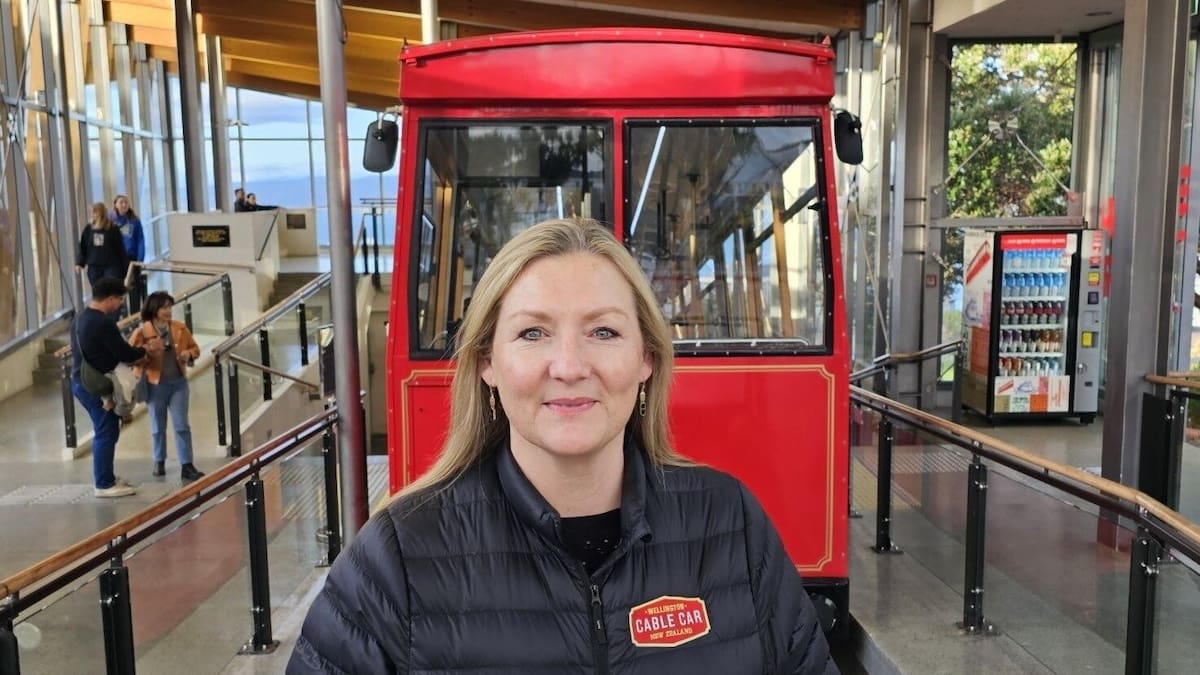
Cable Car chief executive Tansy Tompkins said they were expecting an $800,000 drop in profit compared to two years ago because of the situation.
She said “almost nothing can make up” for the reduction in cruise visitors, which raises funding questions around how they will afford the much-needed cable car replacements between 2030 and 2035.
Tompkins said they have tried to recuperate the cost with more wedding bookings and selling more merchandise – sales doubled last year and contributed an extra $27,684.
She said they have also worked closely with Takina, Wellington’s events centre, to attract conference goers.
But she said the reality is nothing can replace an $800k gap.
Wellington tour company Ka Rawe is also bracing for significant impact, with the majority of the business’ 4000 guests coming from cruise ships.
Owner Nathan Greenham is not expecting this season to be an easy ride, with other high costs – particularly fuel – adding extra pressure.
“It’s really tough to run your own business,” Greenham said.
Ka Rawe Tours owner Nathan Greenham is taking on the tough season with a positive lens. Photo / Supplied
New Zealand Cruise Association (NZCA) chief executive Jacqui Lloyd said there is hope on the horizon, with an 83% increase in port calls expected over the next two years.
But she appreciates things are tough in the short-term.
“We can’t sit back and go, it’s all fixed, because this is a long-term process, we need to continue going forward.”
NZCA is trying to make all companies aware of the dip and encourage them to hold out until next season’s wave.
For Greenham, a self-confessed “glass half full” kind of guy, he’s using the lull as an opportunity to adjust and focus on cost management.
He’s increased the frequency of their private tours and has decided to expand to where the cruise ships are – Auckland.
“I wasn’t necessarily geared up to expand this season, but again based on a variety of different factors I thought s***, well, we may as well pull the trigger now again in lieu of next season.
“You can’t just sort of sit still and lie in the corner and suck your thumb and cry about it.”
Greenham will also conduct many of the tours himself rather than hiring more casual employees.
With the expansion, adding new tour routes and switching to new hybrid vehicles rather than diesel, Greenham hopes they will be able to get through this season ready for brighter years ahead.
Wellington’s Ka Rawe Tours is expanding to Auckland this season. Photo / Supplied
According to NZCA’s 2025 report, the reduction in cruise ships is due to the country’s biofouling rules, perception of the New Zealand industry being “difficult to work with, unwelcoming and unpredictable”, and uncertainty with new regulations and costs introduced in the booking window – when cruises can no longer pass costs onto the passenger.
New Zealand was also among the most expensive locations for liners to visit, with costs from Customs, Ministry for Primary Industries, Maritime NZ and the individual ports.
“We need to have the right cost settings, the right operational settings and we already have the strong demand, and we have the high passenger ratings,” Lloyd said.
“If we can just fix the other two and keep that going, I think we’ll be in a good spot.”
Tompkins, who is also chair of NZCA, said nationally the number of visitors lost equalled the size of the entire German or Indian market.
“Unfortunately, we’ve had to go through this, I think, for people to actually realise how important the cruise sector is to the 17 or 20 regions that it touches directly, plus people stay on before and after and go and see other regions. Like it’s the whole country.”
Costs have been lowered, and Tourism Minister Louise Upston attended the annual Seatrade Cruise Global conference in Miami alongside national cruise representatives, to sell New Zealand as a destination.
These changes, accompanied by work by individual ports and local tourism groups, have increased port calls rapidly, which Tompkins said is unheard of in a short span of time.
An increase of 40,914 passengers is expected next season, and a further 22,742 by the following year, reaching a total of 140,281 passengers nationwide in the 2028/2029 season.
The 2025/2026 cruise season brought $1.23 billion to New Zealand shores. Photo / Supplied
In a press release, WellingtonNZ and Centreport said they have worked hard to promote the city and the country, including hiring a ‘Cruise Strategy Delivery Lead’ at Wellington NZ, starting a new berth trial and establishing a permanent shuttle hub on Wakefield St to improve visitor experience and flow into the city.
NZCA said it was not only tourism companies which benefited from the cruise visitation.
The 2024/2025 season brought in a total of $1.23 billion and supported 8253 jobs for New Zealanders.
Spend from the cruise lines themselves made up $260.6 million, including $11.3 million for Kiwi produce, wine, beer, kaimoana etc.
A further $131.6 million was spent through port charges and fees.
Lloyd said a profitable port supported local councils through dividends, which reduced the burden on ratepayers.
“While it might look like a passenger is the one that is creating all the benefit, in fact it’s a broader, much broader level there of cruise line spend and crew spend.”
A key rating on passenger surveys conducted by the liners, is the welcoming nature of the townships.
Lloyd said New Zealand rates “incredibly high”, which is something that will be crucial moving forward.
“If we can continue to do that for our cruise passengers, but also for all visitors coming into New Zealand regardless of whether they come on a ship or by a plane, we will see a benefit to our country and repeat visitation going forward, which is what we all want.”
Grace Symmans is Wellington-based reporter who covers news in the capital. Grace joined NZME in 2025 as a producer for Wellington Mornings on Newstalk ZB. She can be emailed at grace.symmans@nzme.co.nz.