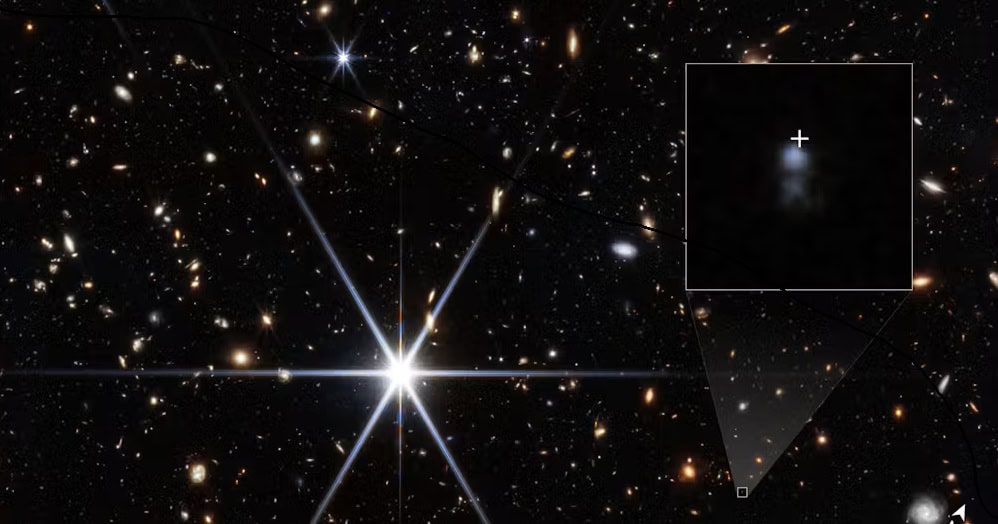
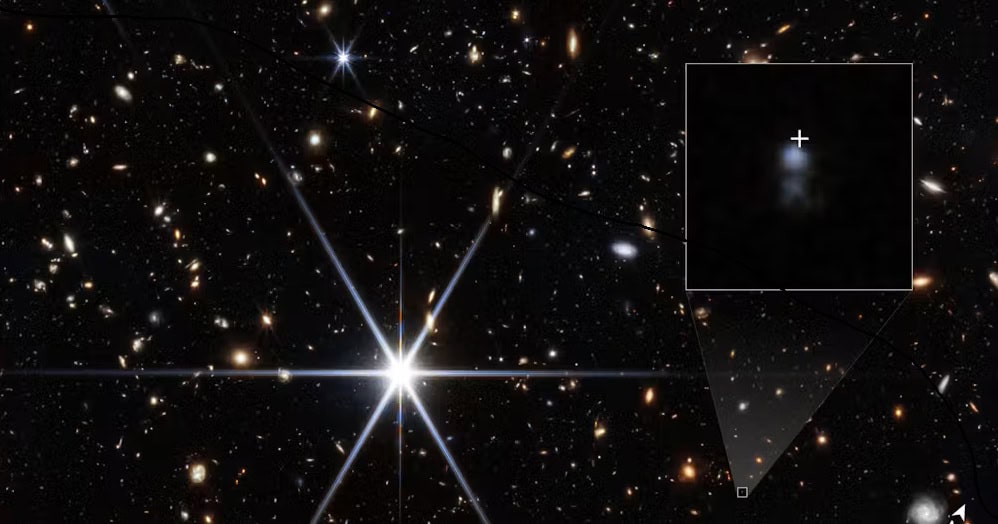
 JWST’s near-infrared camera (NIRCam) image of the sky around the origin of the fast radio burst. The inset shows the host galaxy of the radio signal, with the signal’s location marked by a white cross. Credit: NASA, ESA, CSA, STScI
More than 10 billion years ago, a distant galaxy sent out a flash of radio waves that lasted only a few milliseconds. The signal traveled across most of cosmic history before reaching Earth. Astronomers have now traced it to its source, making it the most distant fast radio burst with an identified host galaxy.
The burst, coined FRB 20240304B, originated when the universe was approximately three billion years old. That makes it more than twice as distant as the previous record-holder, according to research published in Science.
Fast radio bursts (FRBs) are powerful pulses of radio waves. Their sources remain uncertain, and the flashes are so brief that astronomers have to catch and locate them quickly. The MeerTRAP project detected this one with the MeerKAT radio telescope in South Africa.
From the get go when the signal for this source was identified, astronomers knew they were dealing with a very distant object. Different radio frequencies arrive at our Blue Dot at slightly different times, an effect called dispersion. Electrically charged material in space slows some frequencies more than others. Measuring that delay helped researchers estimate how far the signal had traveled and pinpoint its position in the sky.
Ground-based telescopes could not see a galaxy at that position; it was too faint. The team turned to the James Webb Space Telescope, whose infrared camera revealed a tiny galaxy near the burst’s location. Webb’s observations of the galaxy’s light also let researchers calculate how quickly it is moving away as the universe expands, confirming that they were seeing it as it was about 10.6 billion years ago.
The host galaxy is remarkably small, with a mass about 10 million times that of the Sun — a tiny fraction of the Milky Way’s mass.
“The galaxy hosting this burst is surprisingly small, metal-poor and undergoing a very active episode of star formation,” said Laura Driessen, a co-author at the University of Sydney. “That gives us an important clue about the environments in which FRBs are born and shows that these brief radio flashes can tell us not only about the distant Universe, but also about how galaxies and their stellar populations evolve.”
The team cautions that not all FRBs share the same origin. Still, a burst’s host galaxy can help researchers determine which stars and environments produce different types of flashes.
×
Thank you! One more thing…
Please check your inbox and confirm your subscription.
“This is an extraordinary glimpse into the distant universe,” commented lead researcher Manisha Caleb of the University of Sydney.
The burst’s value extends beyond identifying one distant galaxy. As the radio signal traveled, it passed through gas and other material between galaxies, picking up clues about what it encountered. That includes information about how electrically charged particles are spread through the cosmic web — the vast network of matter connecting galaxies — and about magnetic fields that are otherwise difficult to study. Such magnetic fields can subtly twist the orientation of radio waves, leaving another measurable trace in the signal.
The discovery shows that FRBs were already occurring when the universe was around three billion years old, a period when stars and galaxies were forming rapidly. The researchers say distant bursts could help map electrically charged matter across about 80% of cosmic history. Finding more will be difficult: the bursts grow fainter with distance, and their host galaxies can be too dim for ground-based telescopes.