
This is where, come Sunday evening at Darwin’s Mindil Beach Market, vendors sell “Slappas Thongs” and toddlers (little larrikins in the making) paddle at the water’s edge frequented by saltwater crocs.
Fear not, the locals have a sophisticated system to determine whether the water poses a threat: if it looks “a bit croccy”, you don’t get in.
Also in the NT is Kakadu National Park, home to more than 15 Aboriginal clan groups and the main set for the 1986 global hit, Crocodile Dundee.
Kakadu National Park was a major set for the 1986 global hit, Crocodile Dundee. Photo / Rimfire Films
The film, which was released in the US 40 years ago last month, details the fictitious Mick Dundee – raised in the bush and possessor of an enormous knife. Arguably Australia’s most famous larrikin.
The Dundee effect
A three-hour drive southeast of Darwin, we’d barely set foot on Kakadu dust before I was subject to an adage I’ve heard countless times before:
“Crocodile Dundee put Australia on the map.”
It’s no secret that Paul “Hoges” Hogan, the man (the myth, the legend) behind Mick Dundee, also fronted the 1984 Australian Tourism Campaign and famously coined the catchphrase “shrimp on the barbie”.
However, as a 6-year-old Pommy watching Crocodile Dundee in 90s England – a rather uppity place even then – the film didn’t so much put Australia on the map; rather, it put Australians on the map. Seemingly crazy folk who shrug at snakes and roughhouse with kangaroos. In the years since, I’ve realised not all Australians are made this way, but plenty have Dundee’s signature laid-back magnetism. Dundee is a quick-witted charmer – likeable by default – but he’s not an enigma. Australia is full of Mick Dundees.
The film put Indigenous clans in focus, including their land and their culture. Photo / Rimfire Films
Perhaps more remarkable for the time, the film also put First Nations in focus, including their land and their culture and, as the storyline unfolds, it heroes larrikins and traditional landowners alike.
That’s the beauty of Crocodile Dundee, its success can be credited to two simple components: a great story and even greater characters. Likewise, Kakadu National Park mirrors the movie. This is a place full of memorable stories, people and landscapes.
Engaging stories, past and present
Thousands of years before Hogan and his best friend and producer John Cornell wrote Crocodile Dundee, stories flooded the plains of Kakadu lowland, told and retold by native Aboriginal ancestors for millennia.
In Ubirr, we meet our guide, Natasha Nadji, a Bunitj Traditional Owner whose Country stretches across the northeast of Kakadu National Park. Like generations before her, she’s a natural storyteller, gifted at bringing her mob’s folklore and ancient rock art to life. Here, we’re privy to some of the world’s most profound rock paintings. From sisters disguised as crocodiles to enormous barramundi and ancient handprints, Nadji effortlessly translates the ochre drawings – their lessons and laws – for a modern audience.
In Ubirr we meet our guide Natasha Nadji. Photo / Anna Sarjeant
It’s believed some of the rock art in Kakadu was created up to 65,000 years ago. In Ubirr, the paintings are mostly from the last 1500-2000 years, and although an exact age can’t be determined without disrupting the art, some are likely more than 15,000 years old. A fact that’s not lost on Nadji. While we cool off under a cave awning, she shares an insightful comparison: it costs thousands of dollars to fly to Europe and visit the Eiffel Tower – built in 1886, completed in 1889 – and yet visitors pay a pittance to enter Kakadu National Park and sit within an inch of ancient civilisation.
Visitors pay a pittance to enter Kakadu National Park and see ancient rock art. Photo / Anna Sarjeant
And while we allow our minds to be blown by this truth, Nadji casually mentions a snake attacked her dog this morning.
The puppy was fatally bitten by the snake, a 2m king brown – highly venomous – and a rather large threat to have slinking around your home of a morning. Or as Nadji puts it, “that’s a big bastard”.
But not as big as the two buffalo that almost killed her husband the week before.
Being wild, the bulls darted across the road and collided with the family ute, occupied by her husband and teenage son. Somewhat miraculously, both passengers survived, but neither the truck nor the buffalo fared so well. We’d already seen the remnants of their crumpled vehicle stranded roadside, but the buffalo had been removed – much to Nadji’s disappointment: buffalo is very tasty.
Wild animals in Kakadu. Photo / Anna Sarjeant
These extraordinary tales are recounted with signature Australian nonchalance, mentioned in passing, as everyday as commenting on the weather.
There’s no escaping formidable stories, past and present, in Kakadu.
A bit croccy
The next day we’re following Mandy Muir, senior custodian of the Murumburr Country, into open, notably wet pastures. Our group is searching for an iconic Dundee scene where Mick pretends to bare-shave with his (really big) knife to impress Sue – a “sheila”.
“Let’s move away from the water … Bit croccy,” remarks Muir.
Yes, let’s.
Fun fact. Crocodiles will attack you even if they’ve recently eaten. A fat buffalo chop might sustain a saltie for 10 days before he needs to eat again; months if food is scarce, but even a plump-bellied croc won’t think twice about dragging your body into the mud for a death roll. Your carcass will be stored for a later date – decomposed to perfection like a Michelin-grade marinade.
Crocodiles will attack you even if they’ve recently eaten. Photo / Anna Sarjeant
Art lessons and sex education
Rather than dip my toe into anything that resembled “croccy” water, I dip my toe into the world of Aboriginal artwork instead. While staying at Kakadu Crocodile Hotel, we partake in a painting workshop.
What you mostly need to know about The Croc is that the entire hotel is shaped like a crocodile. Looking at an aerial photograph, my room was just below the right leg, in the thick of the stomach, and about as close to a croc’s digestive tract as I’d like to get.
The distinctive Kakadu Crocodile Hotel. Photo / Journey Beyond
Jacqueline Cahill is our teacher for the afternoon, demonstrating traditional Aboriginal design while explaining how to gut and cook a short-necked turtle. The issue is the neck, or lack thereof. A regular turtle can be decapitated – its innards pulled up and out – whereas a short-necked turtle needs to be smashed side on, via its shell.
If we’d wanted another topic to discuss, didgeridoos were – in hindsight – not the best choice. Native to the Kakadu and Arnhem regions of the Northern Territory, dear Cahill did try to explain that, because of their phallic shape, women are forbidden from playing. Unfortunately, some of those a little too invested in their art didn’t hear this (or catch the faintest drift), at which point our workshop took an unexpected turn, and anyone passing may have assumed we were attending sex ed.
Fortunately, Cahill is good-natured and has a giggly, infectious laugh – and being mature adults, we blushed and suddenly became heavily invested in our drawings.
The Outback, upgraded
We wake to yet another 37C day and move on to Cooinda Campground and Caravan Park, which is situated within the grounds of Cooinda Lodge. Mercifully, because it’s the dry season, humidity sits about 5%, but come “The Build Up” between October and November, humidity climbs upwards of 80% and continues into the wet season. The Binini/Mungguy calendar recognises six seasons, with September falling into the fourth: kurrung. Its key features are hot and dry. Personally, I’d add the word “very”.
Cooinda Lodge offers a welcome oasis in the extremes of Kakadu National Park, with swimming pools, various misted dining areas and a collection of safari-style tents with ensuite facilities and air conditioning. There are also 200 camping spots for real tents – our glamping abode comes equipped with queen beds and luxury linen, so it’d be a stretch to claim I’ve gone “full bush” and camped in the Outback.
That’ll kill ya
With dusk approaching and the sun setting about 6.40pm, we board an open-air boat for a wildlife cruise with Yellow Water Cruises. So called because we’ll be sailing the Yellow Water Billabong – home to one-third of Australia’s birdlife, and most thrilling, myriad wild crocodiles.
To use the local terminology correctly, Yellow Water Billabong is most definitely “a bit croccy”.
Yellow Water Billabong is home to one third of Australia’s birdlife. Photo / Anna Sarjeant
Our guide, Dennis, ambles on board in true NT fashion – late and unfussed.
If ever there was a character to rival Mick Dundee, it might be Dennis. Dennis with two “Ns”, which he clarifies from the get-go. A Murumburr Traditional Owner and Kakadu guide for more than 15 years, here is a man who knows everything there is to know about flora, fauna and bone-crunching crocs. Many of which he eloquently summarises with his catchphrase: “Yep, that’ll kill ya”.
I don’t disbelieve it. In Kakadu National Park, I suspect even the water lilies could render you unconscious.
Dennis also knows John. A hefty-looking buffalo grazing in the distance. Dennis hollers his name from the boat; John, hearing the hollering, looks up and the pair lock eyes. Dennis nods, a silent acknowledgment between two backcountry bros. Then John goes back to eating his grass.
“John with two Ns,” Dennis says.
And yep, he’ll kill ya.
Buffalos graze in the distance of a cruise on the Yellow Water Billabong. Photo / Anna Sarjeant
A dip or a death roll
Our time in Kakadu is coming to an end, but not before a quick dip in a local waterhole. Something I promised my nearest and dearest – and even the woman at Darwin’s “Croc Wise” information tent – I absolutely would not do.
“Even in places deemed croc-free, you can never be 100% sure,” she’d said, before handing me a cheery sticker of a cartoon crocodile holding a fishing rod.
Taking a quick dip in a Kakadu waterhole. Photo / Anna Sarjeant
What I’ve found in the NT is that no one gives two hoots about being croc-wise; everyone is “croc-throw-caution-to-the-wind”. One fearless Darwin resident tells me she regularly swims with “freshies”, AKA freshwater crocs. They’re less likely to kill you, but might take a bite if you disturb them. Chatter erupts while a recent unexpected “freshy” attack is discussed.
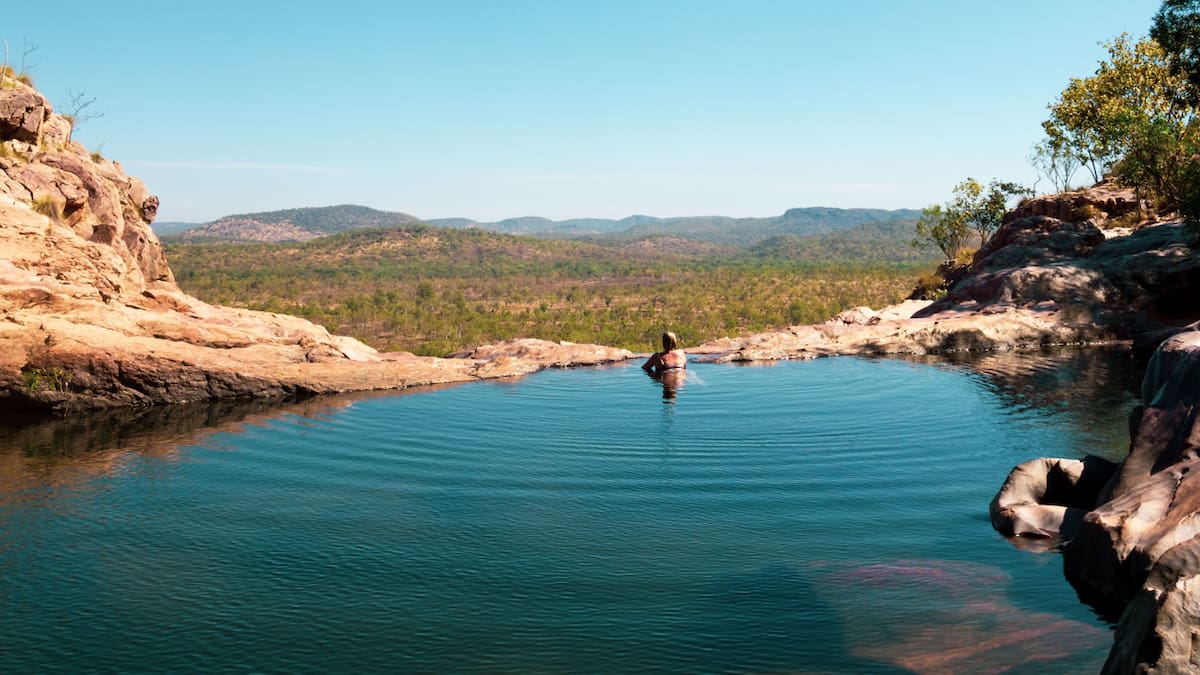
I didn’t intend to disturb anything – fresh, salty, or otherwise – but by the last day, I find myself swimming at Gunlom Falls in trademark gung-ho fashion. Clearly, I’ve adopted the locals’ indifference to danger, which seems linked to proximity; the closer you get to death, the more you’re inclined to dance with it.
It’s at Gunlom that Mick and Sue swim together in what was referred to as Echo Falls in the film. Forty years on, it’s still a beautiful spot, but a rather large croc has taken up residence in the pool where they frolicked, so we won’t be re-enacting this particular scene. I’m told that if you peer over from the top lagoon, you can often see the enormous, reptilian shape of a monster submerged – waiting, plotting, scheming – in the blue.
And that’s enough crocodile for one day.
It’s at Gunlom that Mick and Sue swim together in the film Crocodile Dundee. Photo / Rimfire Films
Adventure on the doorstep
Kakadu National Park, with its terrain, history and thrill of the threat, feels wildly different to life beyond its border. It’s a place I’ve wanted to visit ever since watching Crocodile Dundee, and here it is, on New Zealand’s doorstep: easy, accessible, incredible.
On my last day, while driving to Darwin Airport for my flight home, I’m chatting about travel and adventure with a Tourism Northern Territory rep, and in true NT fashion she drops an Australianism that not only sums up Kakadu, it could be straight out of the Mick Dundee phrasebook:
Yeah, she says, you’ve just got to give it “a red-hot crack”.
Checklist
KAKADU NATIONAL PARK, NORTHERN TERRITORY
GETTING THERE
Fly from Auckland to Darwin with one stopover in Melbourne, Sydney or Brisbane with Qantas.
Kakadu National Park covers nearly 20,000sq km. For reference, The Crocodile Hotel is a two-hour, 45-minute drive from Darwin.
DETAILS
The journalist travelled courtesy of Australia’s Northern Territory.