
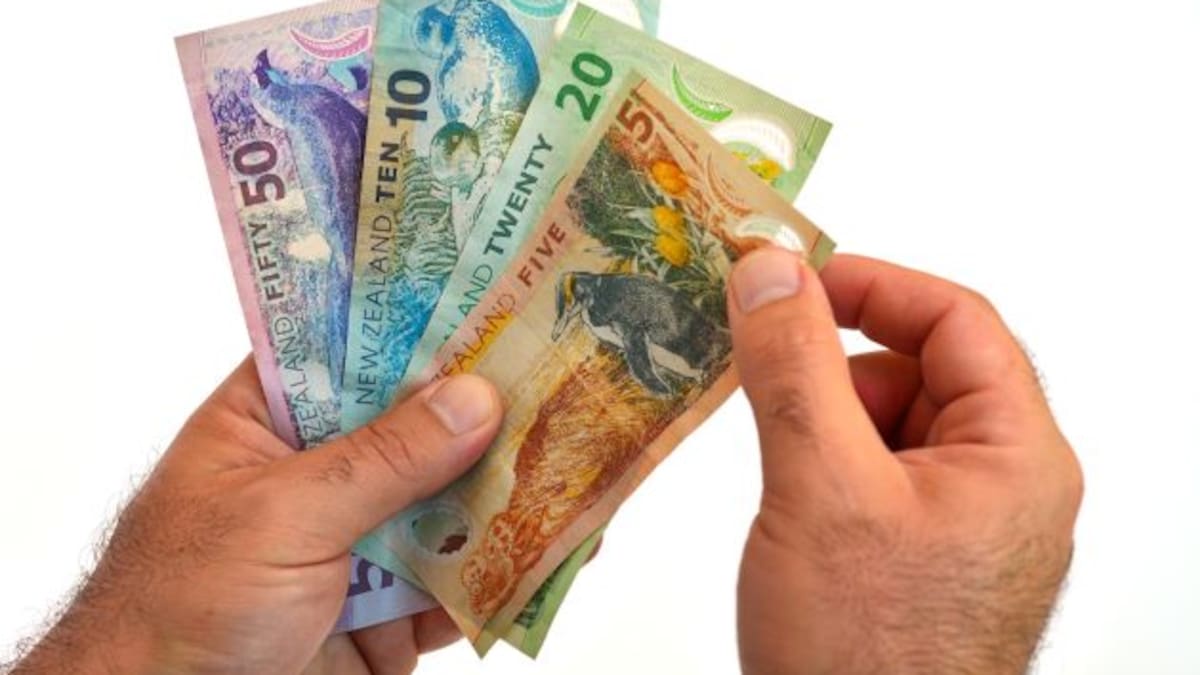
What I am getting at is: is GDP really increasing or is the cash GDP market declining?
Mark I.
A: Wow, well-timed question Mark. Just yesterday, the New Zealand Bankers Association (NZBA) released new data on the use of cash in the economy.
No surprises. It continues to decline and the latest bank figures show the decline is accelerating.
The number of cash transactions in branches decreased by 11.5% in comparison to the previous period, the NZBA said.
Cash transactions in branches decreased by 11.5% to 1.9 million, down from 2.1 million. Those cash transactions accounted for 2.5% of all branch transactions, down from 2.7%. In 2023 the proportion was 3.4%.
Of the total 2.2 billion customer transactions in the period, 1.6% were made at ATMs, down from 1.7% in the previous six months. For the same period in 2023, the proportion of ATM transactions was 1.9% of total transactions.
Reserve Bank research
The Reserve Bank (RBNZ) has also done a lot of work on cash usage; it has polled the public every two years since 2019.
In research out earlier this month, it found that everyday cash use has plateaued.
About 56.6% of adults used cash for everyday purposes in 2025, similar to the 2023 and 2021 surveys. The big drop was between 2019 and 2021.
But cash use is polarising. Those who hadn’t used cash in the past week rose from 30.9% in 2023 to 38.7% in 2025, while the share using it more than seven times a week rose from 5.6% in 2021 to 9.5%.
Meanwhile, cash hoarding has surged. Those storing cash outside a bank rose from 32.8% in 2019 to 69.5% in 2025, mainly for emergencies and quick access.
The RBNZ concludes that very few people have abandoned cash entirely.
In fact, those who never use it fell from 11.8% in 2023 to 5.1% in 2025.
Also, 19.5% reported they were unable to use cash at some point in the past three months because it wasn’t accepted.
The Reserve Bank has also just completed a public consultation on plans it has to ensure cash access is maintained for consumers throughout New Zealand.
It found that half of respondents were dissatisfied with current cash services in their district (48.50%) and across New Zealand (53.87%).
And 90% agreed (76% strongly agreed) that New Zealand needs a standard for cash access, and this was true whether they lived in urban or rural areas.
That question …
Anyway, as far as the first part of your question goes, I think it is safe to say we are still seeing a general decline in the use of cash over time.
But we don’t really have any way to separate the economic ups and downs of cash spending from the broader trend.
If anything, the card transaction data we use to model consumer spending is getting more comprehensive as cash use declines as a proportion of all spending.
As for the black market, well, there is some research suggesting that it is also declining (although more gradually).
There’s no official figure, but international estimates put the hidden economy at about 8-12% of GDP (gross domestic product), down from about 15% in the early 1990s.
It’s hard to be precise because generally New Zealand is included in global studies (IMF, EY, World Bank) that all use slightly different methodologies.
It’s not clear whether there is a correlation with the decline in cash use; unreported work can still be paid for by bank transfer.
Who knows, maybe the IRD has just got tougher.
Finally, it’s worth remembering that GDP isn’t derived from card transactions. Stats NZ builds it from surveys, tax data and other sources.
So the ups and downs of cash use and card transactions shouldn’t have a material impact on the GDP number.
It is more the case that they give us clues to how much consumer activity is occurring in the economy, which gives us a sense of how one part of GDP might be tracking.
Current account and kiwi dollar
Q: I’m interested in how the current account deficit actually works. At any given time, people and businesses are importing and exporting, taking overseas trips, tourists visiting NZ, etc.
Banks and insurance companies are taking profits overseas, and bond repayments are being met.
The economy never stops to total all this up so there has to be an ongoing mechanism to achieve balance.
Isn’t this the exchange rate of the NZ dollar?
John O.
A: Hi John. I’m always happy to do a current account explainer as it is one of the more complex parts of the economic system.
Let me start by saying you’re partly right about the currency.
It is one of the mechanisms that ensures our balance of payments always nets to zero.
I’ll come back to it …
The basics
Essentially, the current account is a measure of the money flowing into and out of the country. It can get confusing because of the jargon around its components, and around its place within New Zealand’s total balance of payments.
The easiest bit to understand is the inflow of foreign exchange we earn from exports and the outflow we spend on imports.
This is the trade balance, and it’s one component of the current account.
But the current account also includes investment income: the profits, dividends and interest flowing into and out of the country.
Because New Zealand’s banks are largely foreign-owned, their multibillion-dollar profits show up as a big outflow, as do insurers’ profits and the interest we pay on money borrowed from overseas.
That investment income deficit is one of the reasons New Zealand is almost always on the back foot when it comes to running current account surpluses (ie taking in more than we spend).
The grim reality is we are usually in deficit, at least since we opened the economy in the 1980s.
We did record a rare surplus in 2020, but that was a symptom of closing the borders and locking everyone down at home.
We barely bought any petrol; overall imports dived, and while tourism receipts collapsed too, imports fell further.
The other side of the ledger
You’re right that the economy never stops to total all this up. It doesn’t need to, because every transaction has two sides.
When a New Zealander pays for an import, a holiday or contributes to corporate profits that flow as dividends to an overseas owner, someone offshore ends up holding New Zealand dollars.
You’re right that the economy never stops to add all this up, but it doesn’t need to.
Every cross-border transaction has two sides.
Say a New Zealander imports a Japanese used car for $10,000. Someone in Japan ends up holding a claim on New Zealand. Usually that’s New Zealand dollars in a bank but it can apply to bonds or shares.
That’s how the national accounts balance: the spending shows up on one side of the ledger, and the foreign claim it creates shows up on the other.
The exchange rate is simply the price at which those New Zealand dollars change hands.
The current account is part of a broader measure of a nation’s financial position with the rest of the world, called the balance of payments, which Stats NZ publishes in full.
It has two halves that must offset each other.
The current account records what we earn from and pay to the rest of the world.
The financial account records how the deficit is funded, ie the net change in our foreign assets and liabilities.
If we run a current account deficit, as we usually do, the shortfall has to be financed from overseas, either by borrowing or by selling stakes in New Zealand assets such as property, shares and businesses to foreign investors.
So where does the exchange rate come in?
The New Zealand dollar floats, so it’s the price that clears the market.
If foreign investors become unwilling to fund the gap, the currency falls until they are.
But that doesn’t force the deficit to zero. We’ve run deficits for decades under a floating dollar, and a lower currency helps only slowly, by making exports cheaper and imports dearer.
The exchange rate also moves with interest rate differentials, commodity prices and global risk appetite, not just the trade balance.
Higher interest rates attract the capital that funds the deficit in the first place.
Ultimately, New Zealand spends more than it earns.
Households, businesses and the Government together don’t save enough to pay for everything we want to build (houses, roads, factories and machinery etc).
The shortfall has to be borrowed or raised from overseas, and that shortfall is the current account deficit.
So, in effect, we are a nation that lives partly on its overdraft, and when that blows out it can be worrying, especially to those with a conservative attitude to debt.
Don’t forget to check out the Herald’s new podcast, The Economy of Everything, with Liam Dann and Tamsyn Parker – thanks to CMC Markets.
Liam Dann is business editor-at-large for the New Zealand Herald. He is a senior writer and columnist, and also presents and produces videos and podcasts.
He joined the Herald in 2003. To sign up to his weekly newsletter, click on your user profile at nzherald.co.nz and select “My newsletters”.
For a step-by-step guide, click here. If you have a burning question about the quirks or intricacies of economics send it to liam.dann@nzherald.co.nz or leave a message in the comments section.