
If, a couple of weeks ago, you had been hoping to do some leisurely shopping on Grafton Street, you might have been a bit miffed to find it absolutely jammed: because U2 were playing on the balcony of Bewley’s cafe. And when you got home, having bought nothing, you could be forgiven for suspecting that, not content with ruining your day out, the band were also mocking you. Because, suddenly, U2 was everywhere.
As you know, this was because of the band’s 50th birthday: an event that probably prompted many weary groans across the country, even from people who weren’t thwarted shoppers. And that’s because of a long-embedded view that Bono, in particular, is a bit of a dose.
Doseyness, apart from not being a proper word, is impossible to measure in any objective sense. And we can all have our dosey days. Anyway, I suspect that for the Bono-allergic, that isn’t really the issue at all: it’s more that he doesn’t fit the template of what we expect from our musical stars.
In interviews, he likes to trot out the line about “four guys from the northside of Dublin”. If that is an attempt to appear more ordinary and relatable, it doesn’t work. Bono popped into the world stadium-ready. It’s almost impossible to imagine him any other way.
And that would be grand if he was from Chicago or Manchester. It’s just weirdly un-Irish. We like a bit of the tragic poet to our stars; something to ground them. A drinking problem. Drug convictions. Maybe an early death. Bono has singularly failed to give us any of that. He’s been married to the same woman for more than 40 years. His kids seem to like him. And for someone who can generate considerable animus, he has evaded any serious controversy. Yes, there was the thing with the tax. He was a bit slow to say anything about Gaza. But compared with many of his musical peers, he’s been Teflon.
Anyway, these are minor gripes. The main problem is that if Bono stands still, a pool of sanctimony forms beneath him. Any U2 gig will contain a homily masquerading as a piece of performance art, or just a straightforward homily.
But while a lot of artists might consider themselves “activists” because they wore a T-shirt or shouted a slogan or chucked a few bob towards a charity, Bono has got down and dirty with politicians. In the early 2000s, a series of meetings between him and the then US secretary of state Condoleezza Rice had a direct influence in the formation of PEPFAR, the US’s plan for HIV/Aids relief in Africa. By all accounts, Rice, sceptical at first, was deeply impressed by Bono’s grasp of the issue: the policy wonk stuff. She was meeting a rock star, but also a man channelling his inner Paschal Donohoe.
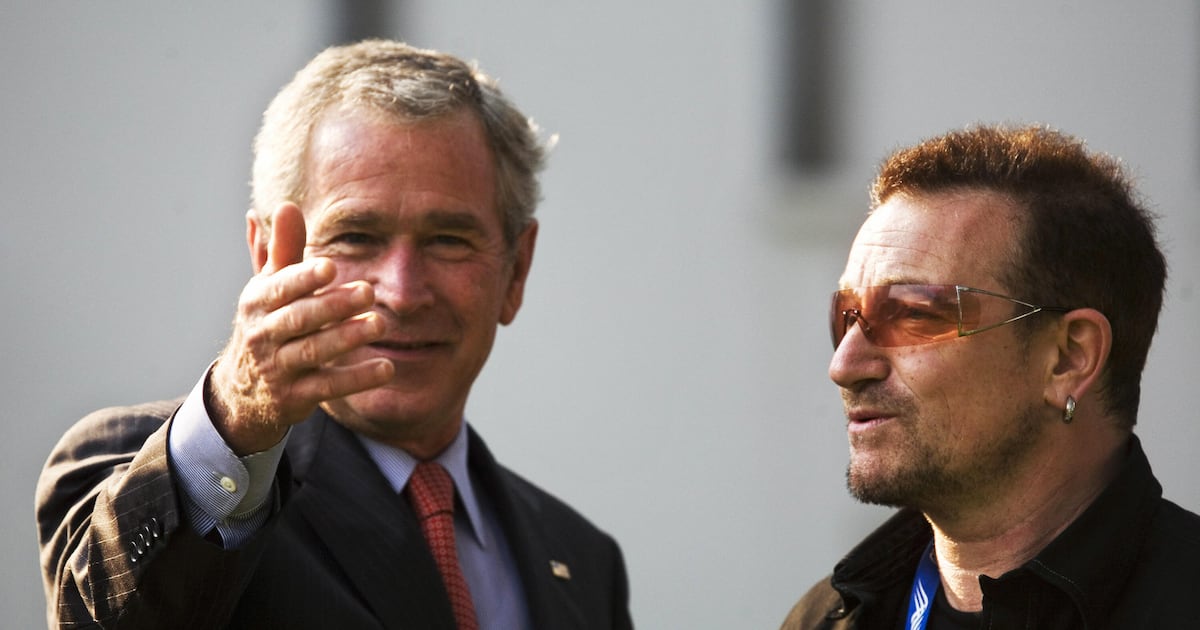
His understanding of politics also demonstrated his ability to be pragmatic. To get the issue over the line, he had to play nice with then US president George W Bush. They appeared on stage together, and since then have met up many times. It may have antagonised a few U2 fans, but Bono obviously felt it was a price worth paying.
None of this is very rock’n’roll. Neither is his lifelong Christianity and social democratic inclinations: a set of beliefs that belong more in an off-the-peg suit than a pair of leather trousers. But that’s Bono: a bewildering mess of contradictions. Or more precisely, someone who doesn’t feel the need to be one easily categorisable person.
And he knows it. He leans into it. He’s a preening, egotistical often pompous star mixed with an international development lecturer. The world’s most famous Irish person: one-word-name famous. And he’s delighted about it. Bono loves being Bono, and after five decades, we still don’t know what to make of him. That’s some achievement.