
Insider Brief
SAXON Q reported that its room-temperature diamond quantum computer achieved 77.3% success in a three-qubit Grover search, close to the cited superconducting benchmark of 78%.
The system achieved 87% success when searching for two targets among eight items, with both tests exceeding the classical success limits cited in the paper.
Researchers conducted the benchmark at Fraunhofer IWU in Dresden using a previous-generation system that consumes roughly 600 watts and requires no cryogenic cooling or vacuum equipment.
PRESS RELEASE — — SAXON Q, a leader in NV-center quantum computing, today released a paper showing that its room-temperature diamond-based system can perform on par with superconducting quantum computers cooled to near absolute zero.
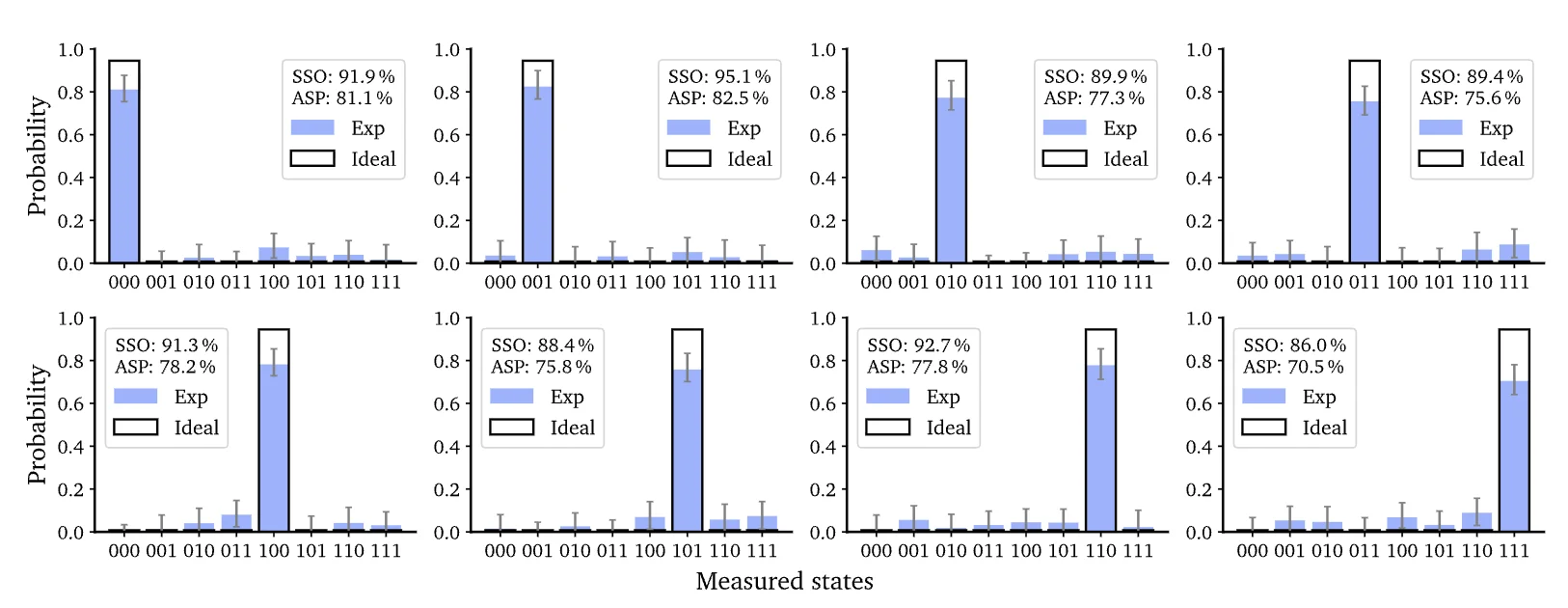
Running Grover’s search algorithm, a standard benchmark test for quantum performance, a SAXON Q system identified a single target state 77.3% of the time using three qubits, rivaling the best published superconducting result of 78%, which required a temperature roughly 15,000 times colder.
“The assumption in quantum computing has been that you trade performance for convenience. These results show that tradeoff isn’t necessary,” said Marius Grundmann, co-founder and CEO of SAXON Q. “Our system ran a complete quantum algorithm in an ordinary room at a customer site, and the results were similar to those of machines that require extensive infrastructure to cool them to near absolute zero.”

Grover’s algorithm — also known as the “quantum search algorithm” — has been used for years to benchmark quantum computers. It finds a marked item in an unsorted list, using fewer steps than any classical computing method can, and it is a building block for how quantum applications will approach optimization work, financial analysis, cryptography and more. It uses a sequence that includes the qubits, single and multi-qubit gates, repeated operations and a final readout, all of which work together. That means that it can measure the full performance of a quantum computer, as opposed to going component by component.
In the test, SAXON Q’s system used a three-qubit Grover search to look through a list of eight items. In the first test, it looked for a single target, and its quantum processor succeeded 77.3% of the time — by comparison, a conventional computer could only succeed in the same task 37.5% of the time, at best. The next test had it search for two targets. The result was a success rate of 87% for the quantum processor, compared to a conventional computer’s limit of 46.4%.
The results mark the highest three-qubit Grover search performance reported to date for any quantum computer at room temperature, and the first demonstration of this size on NV-center hardware.
The benchmark ran on a SAXON Q system installed at Fraunhofer IWU in Dresden, Germany, in June 2025. Fraunhofer IWU researchers co-authored the paper. The system operates at room temperature, all without special infrastructure such as cryogenic cooling or vacuum equipment.
“Our researchers worked on this benchmark alongside SAXON Q’s team, so we know exactly how these results were measured and what they mean for our work,” said Albrecht Hänel, head of Digital Production Twin at Fraunhofer IWU. “Seeing the system perform at this level on our own site gives us confidence to take on more demanding work in industrial optimization and robotics.”
The result came within a single percentage point of the best result ever published using a superconducting quantum computer, all with a fraction of the overhead. The SAXON Q system that was tested operates at room temperature and runs on roughly 600 watts. Superconducting quantum computers, by contrast, can demand upwards of 25 kilowatts and must be cooled to near absolute zero inside dilution refrigerators that require specialized facilities and chilled-water cooling. Trapped-ion and neutral-atom systems need ultra-high vacuum chambers and laser cooling.
SAXON Q’s systems offer a significant improvement over earlier electron-spin NV-center demonstrations by computing entirely on the nuclear spins of atoms within a diamond and storing quantum information roughly 1,000 times longer. The experiment was conducted on a previous-generation SAXON Q quantum computer, which predates its new SXQ128 and SXQ512 quantum computers announced in July. The SXQ128 is available to order now, and SXQ512 deliveries are scheduled to begin in the second quarter of 2027.