
//php echo do_shortcode(‘[responsivevoice_button voice=”US English Male” buttontext=”Listen to Post”]’) ?>
BARCELONA, Spain — In Spain, a new alliance between a state-backed investment entity, an industrial defense giant, and a deep-tech startup aims to offer a blueprint for building domestic alternatives in strategic computing infrastructure.
Qilimanjaro Quantum Tech, a Barcelona-based full-stack quantum computing startup, has completed a €19.6 million (~$21.3 million) first close of its Series A financing round. Spanish defense and technology multinational Indra Group led the round, investing €10 million (~$11.2 million) through its AI subsidiary, IndraMind.
The partnership is twofold: IndraMind acts as an investor and as a technology partner to develop quantum solutions for AI and cybersecurity, which are essential to protect areas of national and European interest.
The Spanish Society for Technological Transformation (SETT), a public fund under Spain’s Ministry for Digital Transformation and Public Administration, also renewed its backing with a €9.6 million (~$10.5 million) injection. This deal is part of a broader European effort to combine public funding with established industry partners to protect key intellectual property.

By Ayar Labs 10.14.2026

By ALI 10.14.2026

By EE Times Taiwan 10.14.2026
Qilimanjaro intends to use the funds to advance the development of quantum computing solutions and integrate them with high-performance classical computing in multimodal systems.
Hybrid capital model for deep tech
For deep-tech founders, securing multi-million-euro investments means managing technical development while continuously raising capital. “You always have the double job of working on the technological side and, on the other hand, looking for the money for it,” Qilimanjaro CEO Marta Estarellas told EE Times in an interview. Speaking about the initial Series A tranche, Estarellas emphasized that the capital raise remains an active process: “We were in this process of capital raising, and we still are. This is not a final closing of the round, simply the first entry of funds.”
Indra’s and SETT’s entry brought together two distinct financial levers. SETT channeled its contribution through instruments such as the PERTE Chip facility, designed to strengthen Spain’s microelectronics and semiconductor ecosystem under NextGenerationEU recovery funds.
Estarellas noted that the deal moved unusually fast because of institutional deadlines and corporate execution. “Everything came accelerated because SETT had to move a series of funds within specific dates, and Indra demonstrated diligence and agility to move this operation that was completely amazing,” she said.
She observed that Indra is undergoing a major internal restructuring to guarantee technological sovereignty in strategic industries. In an official statement, Estarellas summarized the rationale behind the partnership: “SETT’s renewed commitment and Indra’s entry bring together sovereign capital and industrial capital to protect, but also accelerate, national technological autonomy.”
From flood management to AI
This partnership marks a change in how defense companies work with quantum hardware specialists. “I had a vision of Indra as a very typical defense company, but what we have seen is that it is not like that,” Estarellas told EE Times. She highlighted Indra’s work in emergency management, space, and AI.
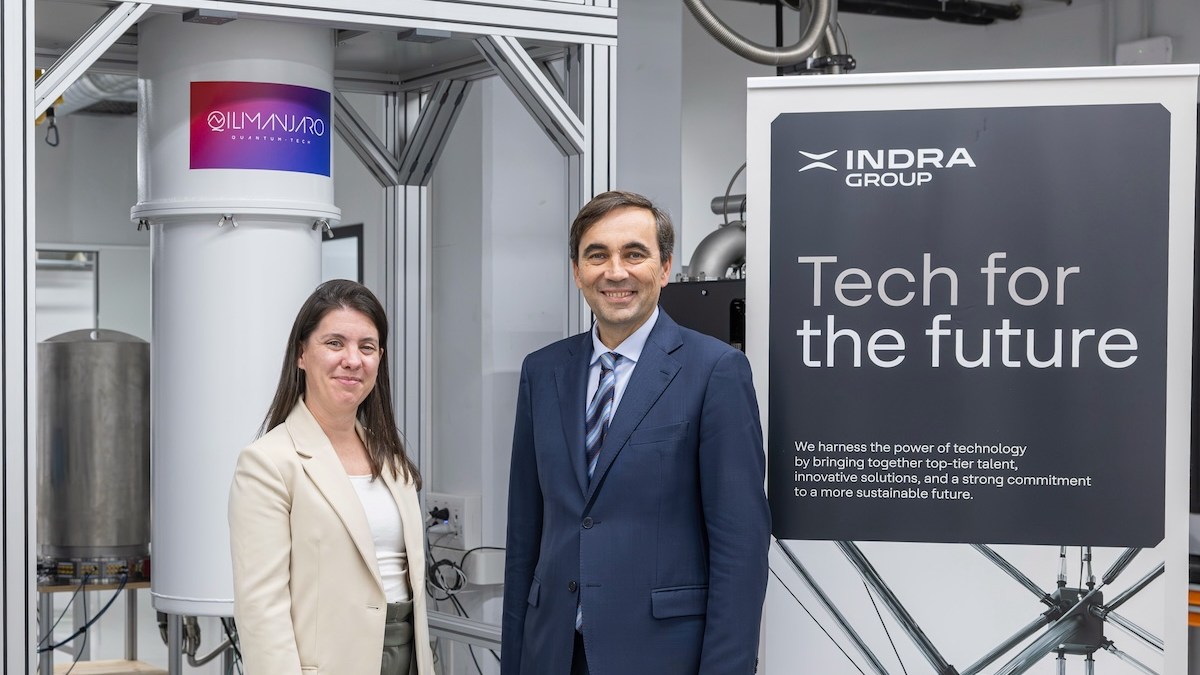
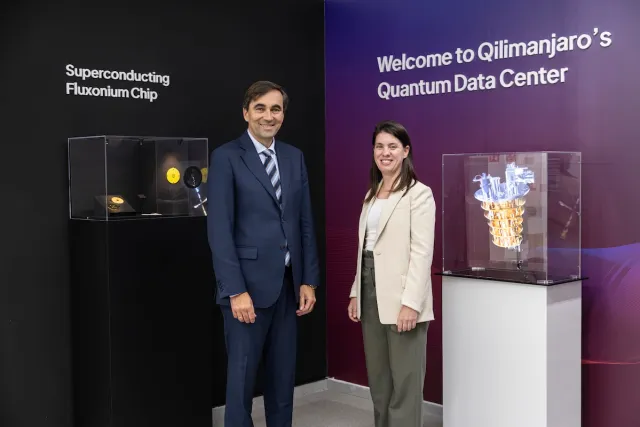 Enric Blasco, regional director, Indra Group, and Marta P. Estarellas, CEO of Qilimanjaro (Source: Qilimanjaro)
Among the immediate joint opportunities is emergency response—a pressing priority following severe floods in Spain. “The convergence of quantum computing along with quantum tech with space, and something that interests them enormously—and us as well—is the convergence between quantum computing and artificial intelligence,” Estarellas said.
Indra Group, with €5.46 billion (~$6.1 billion) in revenue in 2025 and operations in over 140 countries, gives Qilimanjaro access to markets such as transportation, logistics, and network optimization. Through IndraMind, Indra Group said it aims to integrate quantum AI across different projects, combining synthetic data, flexible architectures, and realistic environments.
For Qilimanjaro, the partnership with an established company provides access to distribution channels and markets that could help bring its technology to market. “It is very transversal, and for us it works well because it is like going with a big cousin who helps you, opens doors, introduces you to new markets, and ultimately helps you scale and grow,” Estarellas said.
Scaling hardware for the global race
Founded in Barcelona in 2019, Qilimanjaro employs 80 workers from over 22 nationalities and has deployed eight quantum systems. The company builds full-stack quantum platforms—integrating proprietary chips, control electronics, cryogenics, and software based on superconducting fluxonium qubits.
Three of its systems operate directly within the Barcelona Supercomputing Center (BSC). One of them is Europe’s first analog quantum computer integrated into a high-performance supercomputing hub.
Qilimanjaro initially focused on making analog quantum chips that can be used right away for simulation and optimization and require less error correction. Now, the company is expanding its technology approach by starting to develop digital quantum chips. “We are making a much more ambitious technological roadmap, and once we have it completely aligned, it puts us in a global race,” Estarellas told EE Times. “We are going a bit beyond what was purely analog quantum computing and starting to enter the digital modality, because our hardware is giving us very good results.”
By anchoring manufacturing and design capabilities in Barcelona, the alliance aims to ensure that European quantum research translates into long-term commercial value, rather than intellectual property that is developed or owned elsewhere. As Estarellas put it: “Together, we are joining forces to bring quantum computing closer to strategic industrial sectors and to ensure that the quantum technology built in Spain continues to grow in Spain.”
See also:
How BSC Contributes to Europe’s Hybrid Quantum Strategy
Qilimanjaro Pushes Analog Quantum as AI Compute Demands Surge
How Spain Built a Quantum Ecosystem Without Calling It One