
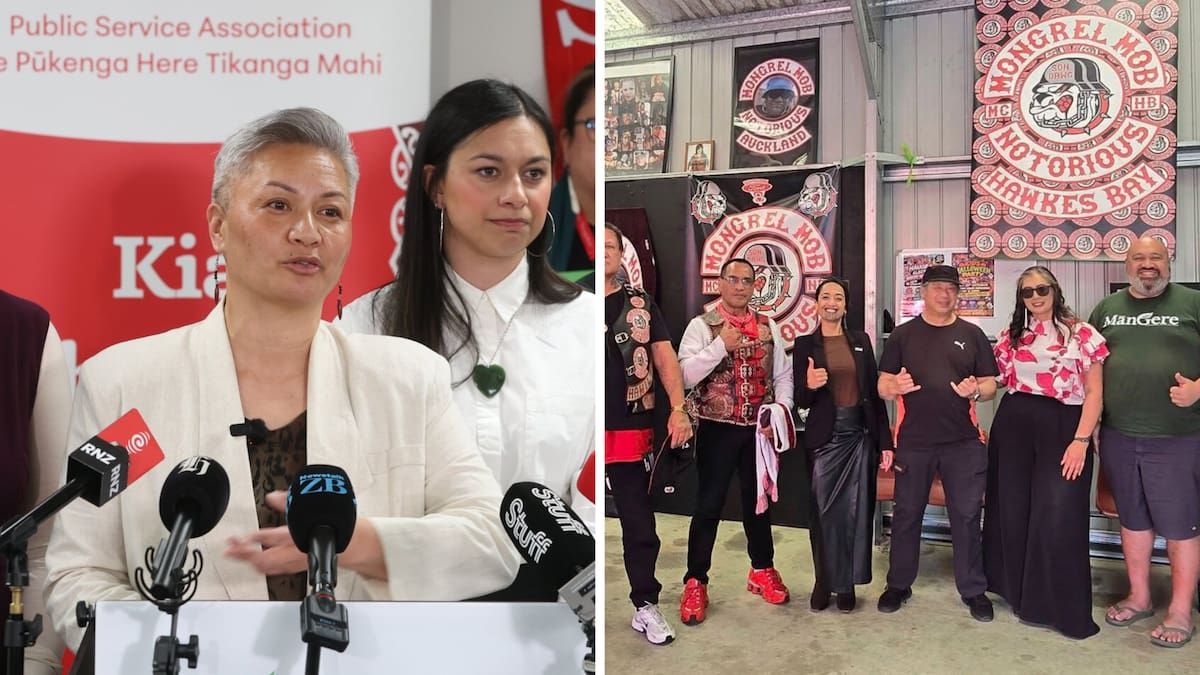
It is the oxygen it uses up on the story, instead of promoting other policies. It is Green Party co-leader Marama Davidson both validating and exacerbating the issue in follow-up stories by resurrecting the possibility of grants to gangs for drug addiction programmes.
And importantly, it opens up division on the left between Labour and its potential coalition partners over a problem that was completely avoidable.
Chris Hipkins had a split second to answer a question by host Ryan Bridge in the Herald’s leaders’ debate with Christopher Luxon whether he would rule out Greens and Te Pāti Māori from the police and Corrections portfolios. He had no option but to rule them out – although they were never in contention for them in the first place.
There may be some things worth dying for in a ditch during an election campaign. Having your photo plastered over the Mob’s social media surely isn’t one of them.
The Mob impact on Te Tai Tokerau
While the Mongrel Mob story could harm the left, it might have a positive impact on the chances of Green MP Hūhana Lyndon to take Te Tai Tokerau.
She was one of those happy to stand alongside the Mob for a photo and the pile-on could have a rallying effect.
Curia’s David Farrar concluded his detailed assessment of 71 electorate seats this week for his Patreon subscribers and concluded that it “leans Green”.
Te Tai Tokerau candidates: Te Tai Tokerau Party Mariameno Kapa-Kingi (from left), Hūhana Lyndon (Greens), Willow-Jean Prime (Labour) and Aperahama Edwards (Te Pāti Māori).
It is a crowded field, with incumbent MP Mariameno Kapa-Kingi, Labour MP Willow-Jean Prime and Te Pāti Māori candidate Aperahama Edwards.
Whakaata Māori polling of the electorate will be published next week.
The very essence of pay equity
There’s one irritating line Luxon repeats whenever pay equity is raised in debates, as happened on Wednesday, and it is that the scheme got so out of hand that librarians were compared to fisheries officers.
The reason it is irritating is because that is not an aberration of the pay equity scheme. It is the very essence of it.
The suggestion that it is unreasonable to compare (better paid) male-dominated fisheries officers with (underpaid) female-dominated librarians is the sort of thinking that has entrenched gender pay gaps over generations.
Christopher Luxon (right) in the Herald Leaders’ Debate against Chris Hipkins. Photo / Dean Purcell
I talked extensively to employer groups and unions for a feature last year after the Government’s arbitrary move to cancel 33 live pay equity claims and make them start again.
For the record, a group of women workers is rarely compared to one group. Librarians were compared to several occupations, including fishery officers, parking compliance officers, cadastral surveyors, Corrections officers and Customs officers.
And the sort of comparisons made are for skill, responsibility, effort and conditions, and measure 14 factors reflecting the complexity of the work, such as problem-solving, organisational skills, emotional effort and responsibility for information.
You can make useful comparisons by comparing the same components in different jobs. Based on that evidence, you should eventually get to a point that you can say what a librarian’s job would be paid if it were done predominantly by men.
Campaign quiz
How many Māori seats did New Zealand First win in 1996? (answer below)
Looking ahead
Friday: Chris Hipkins will be in Gisborne, Chlöe Swarbrick and Marama Davidson will be in Auckland; Shane Jones has a public meeting in Balclutha, 6pm.
Saturday: David Seymour will be in Ōrewa, Warkworth and Wellsford; Winston Peters has a public meeting in Botany, 2pm.
Quiz answer: All five of them [there are now seven].
Don’t miss these stories
ICYMI, here are some verdicts on the NZ Herald Leaders’ Debate. Colleague Derek Cheng was at “the other debate” in Queenstown, the annual ASB debate of finance spokesmen and women, and he filed this report of the event, including Nicola Willis’ put-down of David Seymour and where his loyalties lay.