
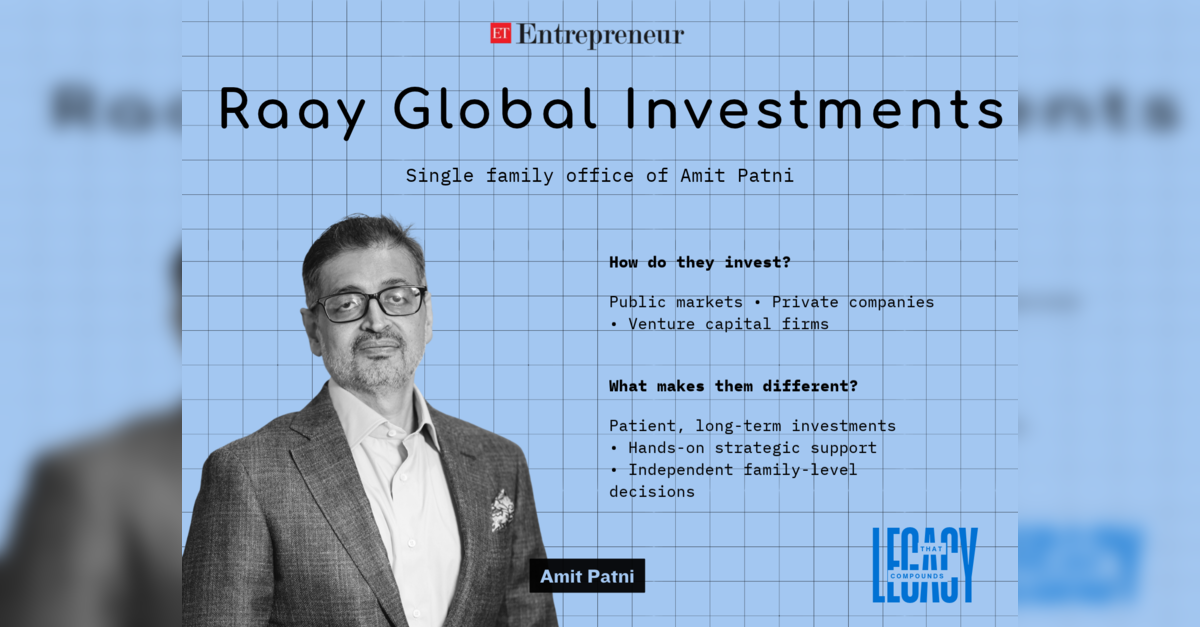
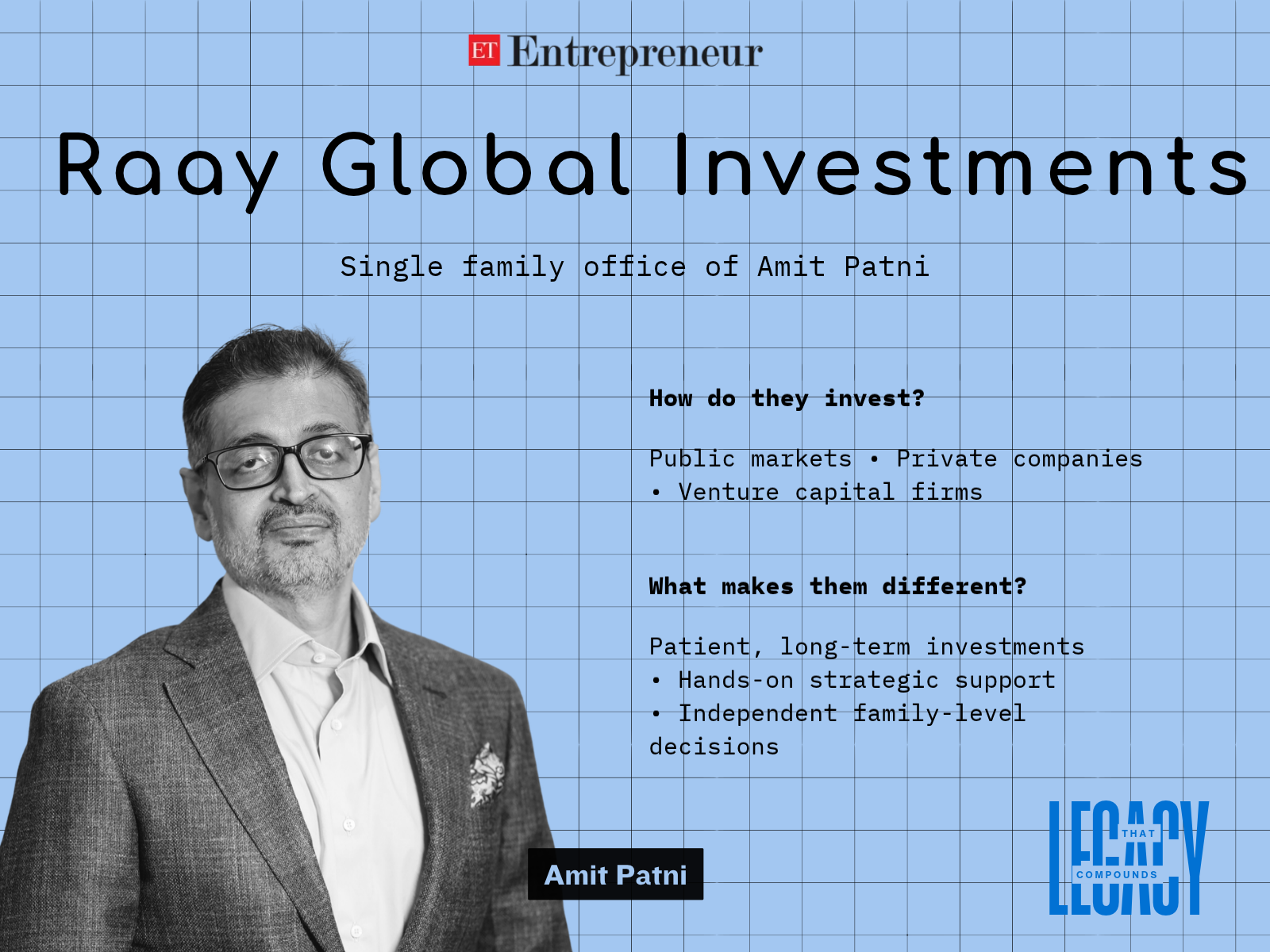
 Amit Patni’s Raay Global Investments balances intergenerational wealth preservation with patient investing and a renewed ambition to build businesses.
Amit Patni’s entrepreneurial roots stretch back generations.
His great-grandfather migrated from Marot, a village in Rajasthan, to Kishangarh, where he set up a textile mill with his brothers. Later, his grandfather and other family members moved to Agra to trade in jute. Long before Patni Computers, the family’s story was shaped by migration and building businesses from scratch.
When Patni was about 10, he would meet Narayana Murthy at the Patni family’s office in Mumbai. Murthy was among the engineers who joined Patni Computers before going on to start Infosys.
“I used to meet Narayana Murthy as a kid, and he used to tell me, ‘I’ll train you as an engineer when you grow up,’” Patni recalled.
Engineering, however, was not where his interests lay. After completing his bachelor’s degree in accounting from HR College in Mumbai in 1987, he pursued an MBA at Babson College in Boston. He wanted to stay in the US and work after graduating, but his father expected him to return to India and take on a leadership role in the family business.
Patni spent the following years working across the business, including setting up a computer-parts factory and contributing to the company’s expansion from hardware into software. Patni Computers went public in 2004 and was sold in 2011.
The sale marked a turning point. For Patni, the regret is not simply about the financial outcome but the opportunity to keep building an enterprise.
“If it was in my power, we would not have sold our company. We sold it too early,” he said.
From a shared family office to RaayThe transition after the sale was eased by a structure his father had established in 2002 to manage the family’s wealth separately from the treasury operations of its businesses.
Succession planning was also put in place to distribute holdings among family members and subsequent generations.
“We decided that we needed a separate team who would manage the wealth of the family other than the corporate treasury of the operating companies,” Patni said.
After Patni Computers was sold, the family office managed the proceeds across individual portfolios. But coordinating investments for family members with different preferences proved challenging. Patni subsequently established Raay Global Investments as a single-family office for his own family, giving him greater control over financial planning and investment decisions.
“That was one of the problems when I was part of the larger family office, where there were a lot of investments happening across the various individuals at the same time, whether they would want it or not,” he said. “And I think that was one of the reasons I felt that it is better that I have my own planning.”
Patni also wanted the office to outlast his own involvement. Trusts were established for his children and grandchildren, with systems intended to support continuity across generations.
“It is a family office where I said that it has to be a legacy that will continue beyond me,” he said. “It has to continue for my children and whoever takes over.”
Investing for the longer termHaving spent years building businesses, Patni approached wealth management with a preference for measured risk. He gave his chief investment officer a moderate-risk mandate and favoured a balanced portfolio over aggressive bets.
“I don’t want to take a risk where I have sleepless nights,” he said.
He was also deliberate about leaving investment decisions to his team rather than reacting to every market movement.
“I keep a little distance and make sure that we are not [overly] involved, because you can make wrong decisions,” he said. “So I leave it to my CIO to make sure that she manages the return we expect without trying to micromanage.”
That caution has not prevented him from backing early-stage businesses. Patni and his younger brother, Arihant, anchored Nirvana Venture Advisors, a $40 million fund focused on startups, when India’s internet economy was still nascent. At the time, the country had an estimated 70-75 million internet users.
Patni recalled that he learnt about Flipkart only after his doctor recommended the company, a reminder of how unfamiliar the emerging startup ecosystem was even to experienced business families.
The brothers subsequently backed IdeaSpring Capital, which focused on deeptech, the Internet of Things and specialised products. Patni also invested strategically in Waterfield Advisors, supporting the development of its multi-family office business, and helped establish Camden Family Connect, a peer network for family offices.
His approach to private-market investments remained patient, particularly when he believed a company had room to grow.
“As a family office, I think we are not that much in a hurry to disinvest in startups. If we believe, we stay for the longer game,” he said.
That patience did not mean backing technology for its own sake. Patni assessed businesses on their promoters, products, addressable markets and ability to scale, while looking for evidence that their offerings could generate revenue.
That patience has also shaped how Patni handles exits. He recalled an investment in Shiprocket where some co-investors wanted to sell as their fund timelines came to an end. Rather than exit alongside them, Patni and his brother took the shares in their personal names and continued holding the investment.
Patience, however, cannot eliminate the risks of investing in young businesses. Patni recalled backing a craft-beer company that had been performing well and had raised money from several investors. When COVID-19 disrupted operations, the business lost money and struggled to secure the funding needed to restart.
The experience offered a counterpoint to the long holding periods he favours.
Returning to entrepreneurshipInvestment management did not fully satisfy Patni’s appetite for building businesses. In 2025, he launched Raay Neo Pharma, a branded-generics marketing and distribution business, after evaluating potential models with external advisers.
The company has been building its distribution network across 22 states and pursuing export opportunities. Patni said the decision reflected his confidence in India’s pharmaceutical market and rising consumption in smaller cities and towns.
“I think the Indian market is a big market which I am excited about,” he said. “I think that’s one of the reasons we chose to enter the Indian pharmaceutical market, because it’s a growing market and high growth.”
Raay’s investment approach remains sector-agnostic, although Patni prefers areas he understands, including financial technology and consumer businesses. His interest in artificial intelligence is similarly tied to commercial applications. He cited companies using AI for multilingual dubbing and recruitment, where the technology serves a specific business purpose.
“We make sure that it is related to the product which is actually helping or generating revenue,” he said.
Building beyond the salePatni’s approach to wealth is rooted in preserving capital across generations, even if that means accepting lower returns in some years.
“I think wealth preservation is where you don’t lose capital. We have made sure that we have not lost capital,” he said. “We may make less returns. I think that as long as you preserve capital, it will grow in the long term.”
Yet his reflections on his career reveal a distinction between managing wealth and creating a business. Raay provides a structure for preserving and transferring the proceeds of the family’s earlier enterprise, while Raay Neo Pharma gives him another opportunity to build an operating company.
“Because building a company is more difficult. Selling is easy. And then recreating a new business is more and more difficult today,” he said.
For Patni, the ambition now is not just to manage the wealth left by one successful business, but to build another enterprise that can endure.
Published On Oct 15, 2026 at 10:36 AM IST
Join the community of 2M+ industry professionals.
Subscribe to Newsletter to get latest insights & analysis in your inbox.
Get updates on your preferred social platform
Follow us for the latest news, insider access to events and more.