
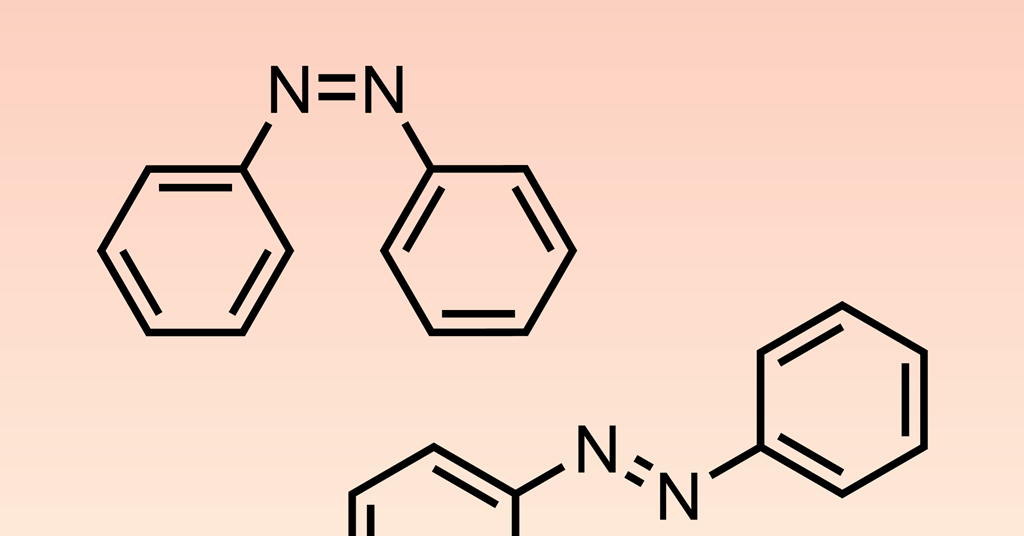
Firing femtosecond x-ray pulses at azobenzene has helped chemists study how its structure changes as it flips between isomers in solution, finding that a twisting of the carbon–nitrogen bond initiates the reaction.1 The researchers behind the work say that this is the first time that their technique has been used on molecules made up of only lighter atoms. The team also suggests that their technique could be used to study other fast, light-driven reactions.

Hyotcherl Ihee at the Korea Advanced Institute of Science and Technology describes azobenzene as ‘the textbook molecular switch’. Exposing the molecule to light causes the central nitrogen–nitrogen double bond to rapidly switch from a trans to a cis configuration. Light-responsive materials, molecular machines and certain drugs use this feature as the isomers of azo-containing compounds often have different physical properties.
Despite their prevalence, the mechanism of how molecules like azobenzene change from one isomer to the other remains contentious. Researchers have suggested various theories, including rotation, inversion and a hula twist (the simultaneous rotation of the single C–N bond and double N=N bond), though they have not reached a conclusion on which theory is correct.
‘The speed of the transition is not the obstacle,’ says Ihee. He explains that current spectroscopic experiments mean that researchers can only infer the structure of intermediates, rather than study them directly.
Ihee’s team has now used a technique known as time-resolved x-ray liquidography to overcome this challenge. This method involves exciting azobenzene with an ultraviolet laser, before firing femtosecond x-ray pulses from an x-ray free-electron laser at the molecule at different time points. Atoms in the molecule scatter the x-rays, which the team can then use to determine the distance between atoms and build up a picture of the molecule’s structure. ‘The data [collected] allowed us to follow, step by step, how the shape of the molecule changes on its way from trans to cis,’ says Ihee.
‘We found that the reaction does not begin with a twist around the central N=N double bond [as previously suggested],’ says Ihee. Instead, he describes how their analysis shows that‘a pedal-like motion of the azo group’ initiates the reaction, changing the angle between the phenyl rings and azo group, before the N–N bond rotates. This mechanism challenges that idea that the reaction happens simply through rotation or inversion.
‘This direct structural view of the [mechanism] will be very important for future developments of theoretical tools able to simulate this key class of reactions,’ says Kristoffer Haldrup at the Technical University of Denmark, who has previously used x-ray scattering experiments to study chemical dynamics. However, Haldrup says that he would have liked to see a more direct comparison between the researcher’s final structural results and the data used for the analysis.
Aside from being the archetype of photochemistry reactions, Ihee notes that studying azobenzene ‘is also a demanding test case for [x-ray liquidography]’. Carbon, nitrogen and hydrogen – the atoms found in azobenzene – scatter x-rays weakly, meaning that the signal generated is small. As such, the technique has previously only worked for molecules containing heavy atoms, like metals.
Kelly Gaffney, a photochemist at Standford University, US, adds that ‘to date, x-ray scattering studies of chemical dynamics in organic chemistry has been dominated by [gas phase studies]’. ‘I am optimistic that this [technique] will enable a more detailed and incisive study of how solvent and condensed phase environments influence chemistry,’ he says.
Ihee’s group helped establish x-ray liquidography around 20 years ago when studying a short-lived iodine radical splitting off from diiodomethane.2 ‘We call the method “liquidography” by analogy with crystallography: it gives structural information, but for molecules in liquids rather than in crystals,’ he says.
X-ray liquidography has other applications beside studying photoswitches like azobenzene. Ihee explains that chemists could use this method to better understand proton-transfer reactions, ring openings and photoactive proteins. ‘Spectroscopy tells us about electronic states and energies, but it gives only indirect information on molecular geometry,’ he says. ‘Liquidography complements it by providing the structures directly.’
The team is now hoping to use the technique to see how chemical modifications to photoswitches like azobenzene change its motion from one isomer to another. ‘The dynamics of ordinary organic molecules in solution, which is where most chemistry takes place, are now within reach of direct structural observation,’ says Ihee.