
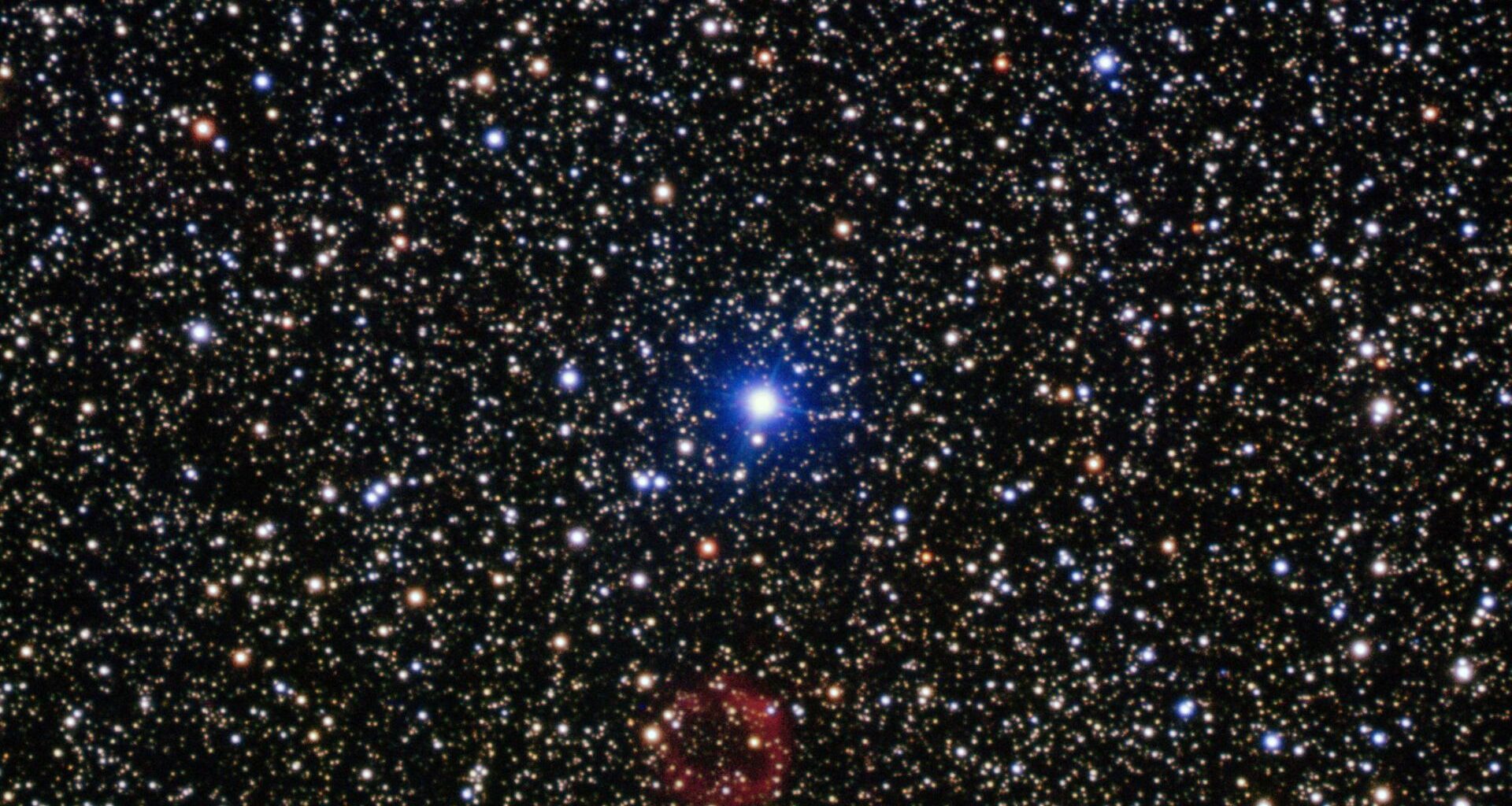
Sakurai’s Object, a star that flared back to life, is now reheating and blowing a strong wind, but more slowly than one model predicted.
Most stars evolve over millions or billions of years, far too slowly for humans to watch major changes unfold. But one dying star in our galaxy has undergone a remarkable transformation in just a few decades.
Sakurai’s Object was spotted in 1996, flaring back to life after it had already stopped burning nuclear fuel. It swelled up and threw off clouds of gas and dust.
Now it is heating up again and blowing off a powerful wind of carbon and helium. It’s also warming more slowly than one earlier prediction said it would.
The star lets astronomers test their ideas about how stars die against one that is actually in the process of doing it.
Wagner Marcolino of the Observatório do Valongo in Rio de Janeiro led the work with Albert Zijlstra of the University of Manchester’s Jodrell Bank Centre for Astrophysics.
Nobody can see the star itself in a picture, so all they found comes from its light, spread into colors and matched against computer models.
How a dying star came back
A star like the Sun ends its life as a white dwarf, the hot, dense core left behind after an ordinary star dies. Sakurai’s Object was already on that path.
Then a layer of helium deep inside it suddenly reignited.
The flash made the star swell and cool, and it threw a large amount of material out into space. For a while it looked like a giant again.
That is why astronomers call it a born-again star.
Theory says it should then reheat and resume its path toward becoming a white dwarf, with a very different surface than before.
Only two stars have ever been caught in the act. The other is V605 Aquilae, which went through the same kind of rebirth about 80 years earlier.
Thick dust hid the dying star
The star brightened for about five years after its helium reignited, and it was discovered in 1996.
Soon after, the dust and gas it had thrown out closed around it and hid it completely.
As of 2020, no one had found the telltale features of a hot star in its light. In 2025, several of the same researchers reported faint signs of them.
To confirm them, Marcolino’s team used the Very Large Telescope in Chile, run by the European Southern Observatory.
Peter van Hoof of the Royal Observatory of Belgium gathered the data in 2023, 18 exposures of about 15 minutes each.
Carbon and helium gave it away
Hot gas gives off light at particular colors, and each chemical element has its own set. Spreading the star’s light into its colors, the team found bright lines from carbon and helium.
They concluded that those lines come from a wind, a steady stream of gas blowing off the star’s surface, rather than from the old cloud.
In their best model, the wind reaches about 310 miles (500 kilometers) per second. All of that light forms within about twice the distance between Earth and the Sun.
The material thrown out in the 1990s has spread about 300 times farther than that.
The wind has the characteristics of a Wolf-Rayet star, although Sakurai’s Object comes from a much lower-mass star than the massive stars usually associated with that name.
Its surface has changed, too. Shortly after the outburst, measured by weight, it was about 90 percent helium and 7 percent carbon.
The team’s model fits best with about 43 percent helium and 51 percent carbon.
The star is reheating slowly
The carbon lines also work as a thermometer. The team’s best match puts the star’s surface at about 54,500°F (30,500 K). Their fits rule out anything cooler than about 48,000°F (27,000 K) or hotter than about 64,000°F (36,000 K).
That’s roughly five times hotter than the surface of the Sun. It’s also the first measurement of temperature for the star since 1998.
A model published in 2005 predicted the star would reach about 161,500°F (90,000 K) by 2020. The new measurement is far below that, while a different model from 2006 broadly agrees with it.
“Our measurements show that the star is reheating more gradually than some earlier models predicted,” Zijlstra said.
“That gives us an important way of testing which theories best describe what happens when a dying star briefly springs back to life.”
Theorists care about the gap because it tests how gas churns inside a star during the helium flash.
The 2005 model only matched the star’s fast brightening if that churning was slowed down on purpose.
The 2006 model didn’t need that, using finer time steps and a slightly lighter star instead.
Where Sakurai’s Object may be headed
V605 Aquilae shows where Sakurai’s Object may be headed. It was about 8,500°F (5,000 K) in 1921 and about 170,000°F (95,000 K) by 2001.
“Most stars evolve so slowly that major changes take place over timescales far longer than a human lifetime,” Zijlstra explained.
“As a result, we usually have to piece together snapshots of stellar evolution by comparing different stars at different stages of their lives.”
Here, the two snapshots belong to the same rare kind of star. Sakurai’s Object is much cooler than V605 Aquilae and ranks among the cooler Wolf-Rayet stars, which puts it at an earlier point on the same road.
What remains unknown
The star’s light is blurry at this level of detail, and glowing gas from the surrounding cloud gets mixed into it.
The team couldn’t match every feature. One faint line may come from a hotter form of carbon, or from something else entirely.
The team also modeled the wind as the same in every direction, and it may not be. Its light may also reach Earth only after bouncing off dust, which could change what the team measured.
Nobody has measured its distance directly, and estimates range from about 6,000 to 26,000 light-years away.
The team plans to keep recording the star’s light as it heats up. If it gets hot enough, lines from that hotter form of carbon should grow strong.
Each new temperature will add a point to the reheating curve that the competing models disagree about.
The full study was published in the journal Monthly Notices of the Royal Astronomical Society.
—–
Like what you read? Subscribe to our newsletter for engaging articles, exclusive content, and the latest updates.
Check us out on EarthSnap, a free app brought to you by Eric Ralls and Earth.com.
—–