
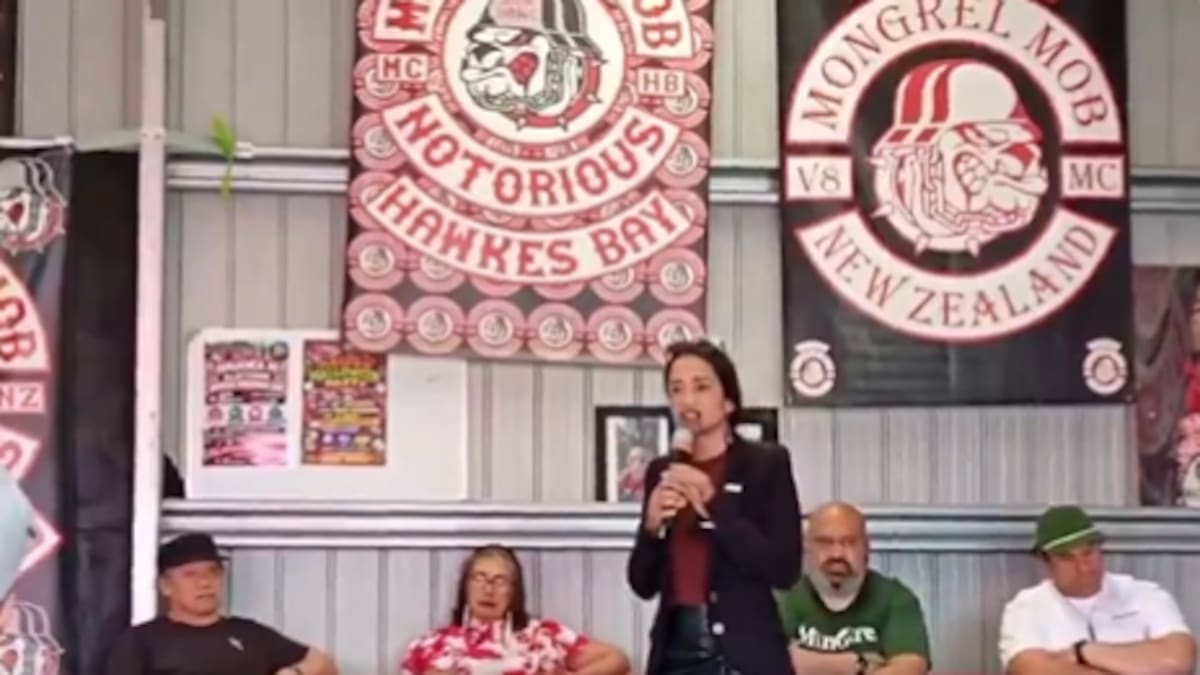
“Our policies reinstate what should have always been.”
The clip of Kaipara’s speech began with the words “that I think everyone should be quite scared about”. It was unclear what that was in relation to.
Te Pāti Māori has been approached for comment.
Photos published to social media last week showed Mongrel Mob members meeting with Green MP Hūhana Lyndon and candidate Michel Mulipola, as well as Te Pāti Māori MPs Oriini Kaipara and Hana-Rāwhiti Maipi-Clarke.
After seeing the footage today, National’s justice spokesman Paul Goldsmith was scathing.
“This is outrageous. There is no excuse for gang sympathy. They peddle misery and havoc throughout New Zealand. Unlike Te Pati Māori, National has been focused on restoring mana to victims, not the gangs. This is just another example of why we cannot let them anywhere near law and order. They’ll undermine all of our hard work.”
Last week, Green Party co-leader Chlöe Swarbrick refused to say if she would have advised MP Lyndon against meeting with members of the Mongrel Mob.
Oriini Kaipara speaks to members of the Mongrel Mob in Auckland.
Labour leader Chris Hipkins this morning told media his party would not support any rights for gangs.
“No, I think gangs are a scourge on society, they do enormous harm, they peddle drugs, they perpetuate violence.
“I’ve dealt with victims of gang violence including women who have fled gang relationships where they have been the subject of violence.
“I have no time for the gangs, they will not get any support from any government that I lead.”
He said Labour would not support any changes to the current ban on gang patches.
He earlier labelled the move as a “huge error of judgement” and later ruled out both Te Pāti Māori and the Green Party from holding major ministerial roles if they came to form a government.
Green Party co-leader Marama Davidson, who also posed with gang leader in 2021, said she was “unapologetic” for engaging with marginalised communities.
Act deputy leader Nicole McKee said she wanted to know what Te Pāti Māori is proposing for Māori victims of crime.
McKee cited the New Zealand Crime and Victims Survey which found 33 per cent of Māori adults experienced at least one criminal offence in 2025, compared with 28 per cent of New Zealanders overall.
“Much of this misery will have been either directly or indirectly due to gangs, whether it’s their violent acts or because of the meth they peddle.
“Te Pāti Māori say they want to restore their mana. They have none. They lost it when they chose a life where their profits come from the misery of others.”
Mongrel Mob National Trust administrator Cherie Kurarangi said last week the real problem was the cost of food and petrol.
“This is just something like a regular go-to that the Government has about … gang whānau … we’ll be the scapegoat again, instead of focusing on something that’s real. We’re not the problem right now.
“You know what the problem is? The cost of food, the cost of petrol. Real, basic, essential issues. Not us.”
She described the political pushback over the meeting as “not a new tactic”.