
Oliver never expected job hunting in Brussels to be this hard. He was prepared to pay his dues — no one enjoys churning out self-promotional cover letters, grinding through networking events or firing job applications into the void. But he never imagined he’d still be looking for a job a year later. He was told international relations students often face a spell of unemployment after graduation. Despite the warning, Oliver had expected to land an entry-level job within a few months.
At 26, his resume seemed built for Brussels: a Blue Book traineeship, an internship at the U.N., a prestigious master’s degree, native-level English and a wealth of international experience — all the credentials the EU bubble appeared to prize.
But after more than 400 applications and a mere four interviews, his confidence has begun to fade. “A lot of people come to Brussels for the traineeship at the Parliament or at the Commission thinking that it’s the gate to a stable career,” Oliver said over the phone. Too often, that promise goes unfulfilled.
Oliver, a pseudonym to protect his identity, is far from alone in the increasingly daunting quest facing young graduates trying to break into the EU bubble.
The rise of artificial intelligence and mounting recession fears are making Brussels-based consultancies and organizations wary of hiring, particularly for entry-level roles. In Brussels, like elsewhere, large companies are restructuring to allow for automation and redirect investments into AI. Eurozone growth has slowed, while inflation climbed to 3.8% in September, up from 3.2% in August, according to the latest Eurostat data.
For the thousands of young jobseekers seeking to make it in Brussels, often to escape weaker job markets at home, the squeeze threatens to close off a route to employment they once saw as more promising. Applicants from Italy and Brazil described Brussels’ job market increasingly resembling the very ones they had sought refuge from.
Unemployment rates for people aged 15 to 29 holding tertiary education in Brussels are rising again after declining since 2013. In the Brussels region, unemployment among young people stood at 8.2% in 2023 but rose to 12.1% in 2025.
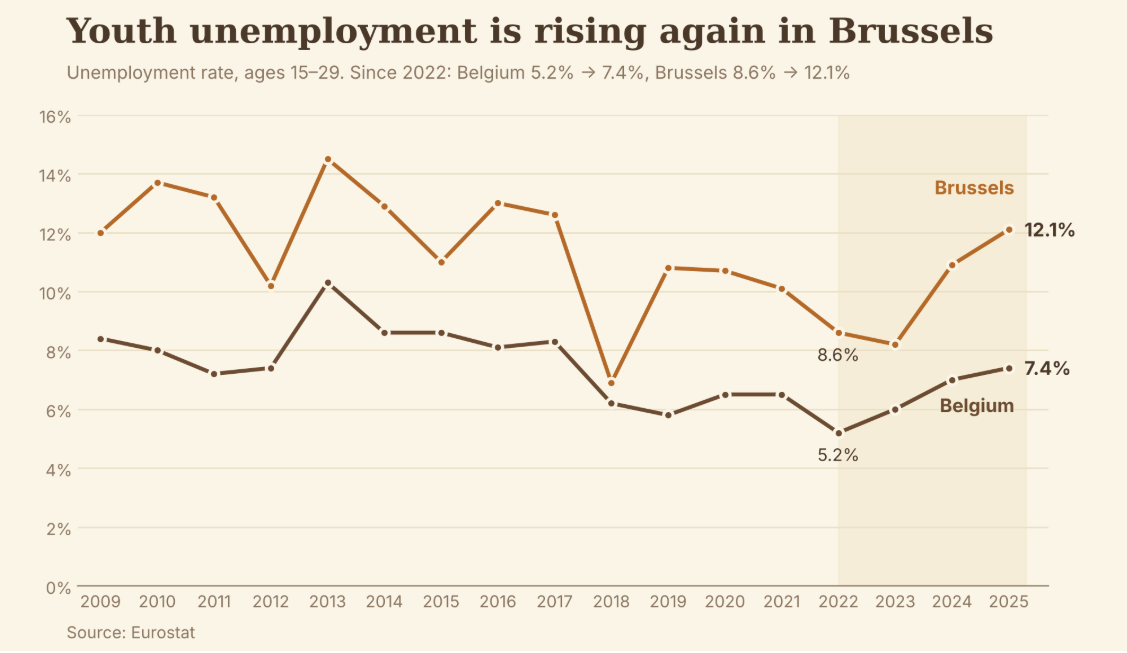
That said, youth unemployment was significantly higher in the aftermath of the 2008 financial crisis, peaking at 14.5% in Brussels in 2013.
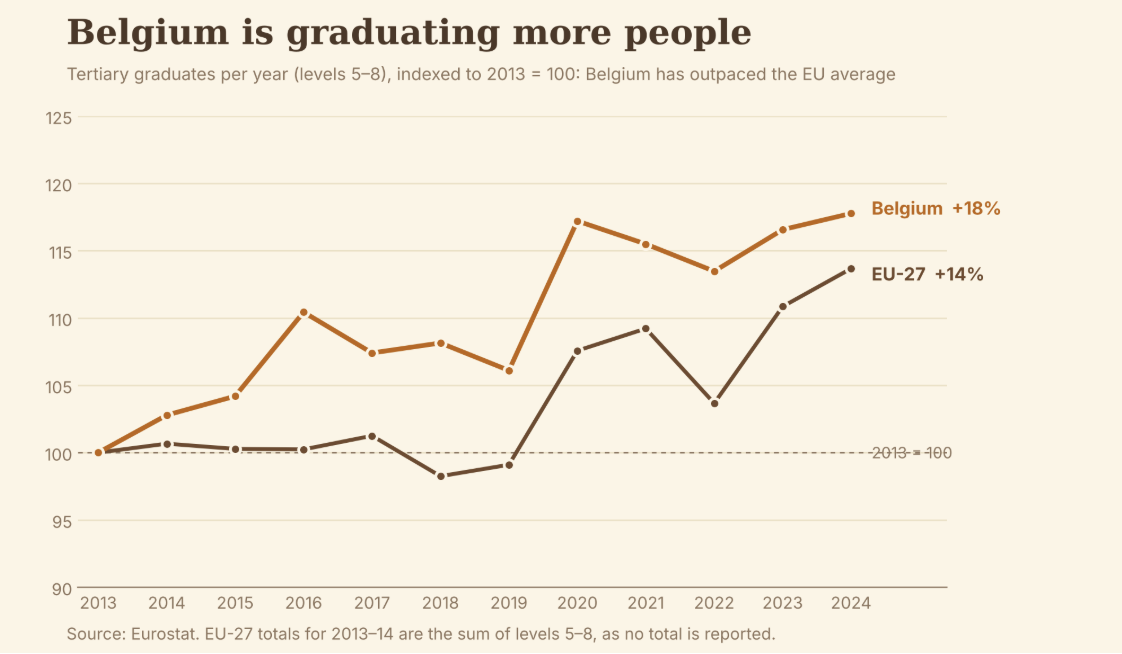
At the same time, the pool of Master’s graduates has grown sharply, from just under 37,000 in 2013 to nearly 48,000 in 2024.
The application race
Applying for an entry-level position has become a balancing act of using AI to craft the perfect application while making sure no one can detect it.
As AI makes applying easier and fewer jobs are advertised, job seekers are competing with a far larger pool of candidates.
“Ninety percent of the cover letters are the same,” said Máximo Miccinilli, who works on climate and transport policy at consultancy FleishmanHillard. Miccinilli said the recruitment process had to be tweaked to allow for extra interviews with the candidate, including a 20-minute AI-free writing assignment.
“Everybody tells me that entry-level talent is really difficult [to find],” said David J. Webber, an executive recruiter in the Brussels bubble, pointing to a “disconnect” between the abundance of 20-something job seekers and organizations struggling to find the talent they need.
Bianca Bittencourt, a strategic communications coordinator at the Cool Heating Coalition, screened over 350 applications for a full-time junior position.
“I was so surprised when I discovered just how insanely competitive it is,” she said, adding that over 200 applicants had a fitting profile.
Asked whether the job market has changed since she arrived in 2022, Bittencourt said she sees fewer vacancies and a growing expectation that candidates bring skills that would once have been spread across several roles.
The struggle to find work extends beyond recent graduates. Flavio, a 35-year-old researcher who’s now trying to leave academia after eight years, found the job market a rude awakening. Flavio, whose name has been changed, once competed with over 260 candidates for a nine-month maternity cover — a job that matched the expertise he’d developed for years and for which he had a referral. He didn’t even make it to the interview stage.
That’s a very different situation from when Flavio found his first job. “My Master’s class of 2018 entered the job market relatively quickly,” he recalled.
Christina, a 25-year-old trainee from France who withheld her real name as she was actively seeking work, said that even internships have become so competitive that many of her friends are turning to volunteering instead, where they see better chances to secure a first professional experience.
“I didn’t know it would be this bad,” she said about her experience looking for a job while still at university. While her parents were empathetic she has sometimes felt that people from other generations don’t quite grasp the scale of the problem.
“A lot of advice would be: ‘follow up after the interview,’ but that’s even if you have the interview, which is extremely rare,” she said.
Internship hopping
As landing junior positions becomes harder, some graduates find themselves hopping between low or even unpaid internships.
For Tilda Lennartsson Lambert, a 25-year-old communications assistant at NGO Bellona Europe, it took a year of earning €1-1,500 net a month before securing a permanent contract.
“I have a lot of privilege, and the job market was still incredibly difficult to break into,” Lennartsson Lambert said.
Davide Bertot is one of the lucky ones. He landed a job as consultant at FleishmanHillard at the end of an internship, a trajectory he says should be the norm. Still, his girlfriend and most of his peers are still fighting to get a job after completing more than two internships.
The result is that graduates tend to fill junior positions later in life. A case in point: Bittencourt, the Cool Heating Coalition employee, said the last junior they recruited was 29.
In other cases, disgruntled graduates pivot back to what they know best: studying. Oliver said it’s not uncommon for people his age to embark on even more prestigious Master’s degrees in the hope to gain a competitive edge.
“I’ve heard stories of people chaining three or four Master’s degrees one after the other,” he said.
However, that’s not a route that Webber, the recruiter, would recommend.
“More academia is not the answer,” he said. “Nobody is going to recruit you because you’ve got two Masters … it will not replace the value of real experience.”
AI comes to Brussels
Global trends are beginning to filter through the European capital, threatening to reshape the white-collar workforce that powers its policymaking machinery.
AI investments are “creating an oversupply of manager-level, hyper-experienced policy job seekers for very few positions,” said a Brussels-based senior professional working for a multinational company asking not to be named because her employer doesn’t permit her to speak publicly.
Meanwhile, anything from policy monitoring to mapping out C-suite stakeholders is something that AI can do just as well, and much more efficiently, than most people, said Miccinilli, the senior consultant.
As a result, organizations increasingly turn to AI to absorb growing workloads. “It’s not like there’s a decision from above that says: ‘Use AI and don’t hire,’” said Victor, a young consultant who asked to remain anonymous. Rather, he said, AI has changed expectations of how much each employee should be able to deliver. “Now you can’t really say, ‘I have more work, I need to hire someone.’ It’s more, ‘I have more work, I need to use AI to deliver faster.’”
Still, Miccinilli argued it offers a competitive edge to young people who have learned how to master Claude, the conversational AI assistant.
“If you have a 20-year old who can carry out a C-level positioning analysis using an AI software and show you the results in a couple of hours, and without him, you would need 30 hours, 3 seniors, 2 mid-level and a junior to spend €40,000 to do the same, it’s a revolution,” he said. He added that public affairs agencies are now entering a time when they can only be competitive if they rely on “Claude geeks.”
The result, Miccinilli said, is that young graduates hoping to make it in Brussels need to combine a solid understanding of policy with AI skills. Today, “a person who’s very knowledgeable content-wise but doesn’t master AI is a problem,” he said.
The limits of a diploma
Just like Oliver, many graduates say their universities left them ill-prepared for the grind of job hunting.
Universities, of course, aren’t responsible for the economic downturn or the pace of technological change. They are also grappling with a crisis of their own, as AI makes knowledge increasingly accessible.
But employers told The Parliament that a degree from a respected university is no longer enough to convince them to take a chance on a candidate.
Layla Sawyer, secretary general at CurrENT Europe, which represents grid technology providers, said she isn’t impressed by degrees. “Ninety percent of the people who apply have similar degrees, so [that] doesn’t stand out.” By contrast, she said, curiosity, genuine interest, conversational skills and subject experience matter way more.
At the same time, top universities are racing to prove they’re adapting to AI. The College of Europe, a longtime training ground for aspiring Eurocrats, told The Parliament it has adopted a “prudent” approach, banning AI use in some classes while encouraging students to experiment with the technology to ensure they keep pace with its development.
IE University, the prestigious Madrid-based college, is taking a similar approach, tapping AI-powered software to help its students train their public speaking and negotiation skills while banning its use in writing and programming, where students should be able to learn without taking shortcuts.
“The university needs to find a balance,” said Borja Santos Porras, vice dean at the IE School of Politics, Economics & Global Affairs.
Yet, even the best universities struggle to help their students bridge the widening gap between academia and the job market, with career departments often too understaffed and out of sync with the latest technological developments.
Krisztina Iszák, a College of Europe graduate herself, turned to career coaching after spending several years as an economic advisor in Brussels. She can easily relate to the struggles of recent graduates.
“I had no idea how to make a CV that looked professional in an international environment,” she said. “I had no idea how to write a cover letter that was to be accepted. Iszák eventually paid a business coach to help her learn the ropes as a young grad.
Iszák now mentors College of Europe students for free. “Young students cannot afford to go to a business coach for €1,500.”
No connections, no job
Graduates, employers, career coaches and recruiters who spoke to The Parliament agreed: networking has become even more essential as LinkedIn applications fail to get candidates through the door.
“A lot of people in Brussels hire through networks or contacts,” Iszák said. That’s why she wants her mentees to focus on personal branding and establishing their personal network, regardless of how uncomfortable it may feel.
“I push them to reach out to people, even if it’s hard. Not so that they give them a job but to get interested in the person and what the other person does,” she said. “It’s about establishing a connection.”
Webber agreed there’s no way around networking. “If you don’t want to do the networking, ultimately, you’ll find it very difficult to be successful here.”
Of course, introducing yourself as a job seeker can be tricky in a city where status and titles carry weight. Christina, the intern from France, said she’s been pushing herself to show up at events and meet people, even when it feels intimidating.
“When I make a connection with someone, I usually try to arrange a quick coffee chat or even just a call just so that I’m memorable,” she said. “It’s a bit forward what I do but I think it’s important.”
Oliver knows networking matters, and he tries to do his share. But a year of unemployment has taken its toll. To make ends meet, he supplements the little money he receives from his parents each month by dogsitting through the Pawshake app. He has struggled to find steady work in bars, which tend to favor student hires.
Still, he considers himself luckier than some of his friends who have left Brussels to move back in with their parents. Oliver is now waiting to hear back following an interview — just not for a job in Brussels.
Sign up to The Parliament’s weekly newsletter
Every Friday our editorial team goes behind the headlines to offer insight and analysis on the key stories driving the EU agenda. Subscribe for free here.