
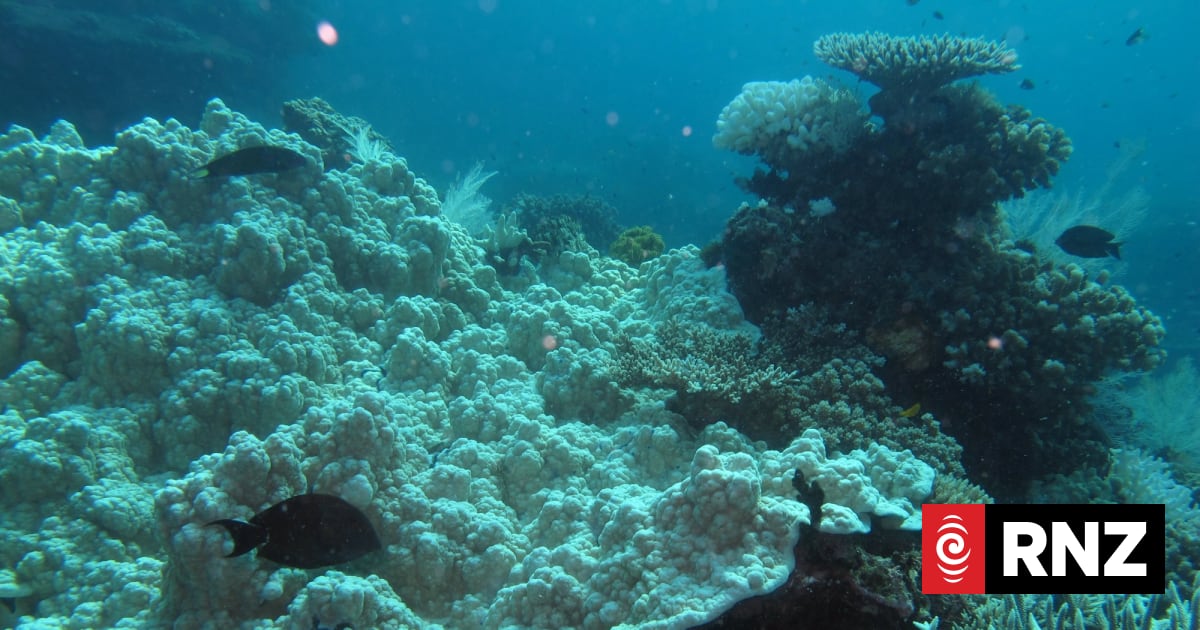
New Zealanders – from ministers to pest control experts – are in the forefront of helping save the world’s coral reefs from bleaching
The surprising ecology of saving coral reefs
They’re among the most extraordinary ecosystems on Earth and a lifeblood for many communities – but Pacific coral reefs are under threat, with warming oceans pushing them to the brink.
A world expert in this area believes we’re not yet at a tipping point, and there are things we can do to bring the life and colour back.
Distinguished professor Nick Graham, chair of marine ecology at Lancaster University in the UK, tells The Detail that doesn’t mean the situation isn’t really serious and the looming super El Niño will be another blow, but “there’s more resilience baked into them than we fear”, he says.
Graham is the lead author of a new international study looking at the positive effect of seabirds and native vegetation against sea-level rise. Yes, seabird poop can help coral islands fight rising seas.
Rewilding tropical islands with native plants helps return seabirds, holds soil in place and can help the islands themselves adjust to climate change.
Along with researchers from across the globe, including New Zealand, Graham analysed ecological data from 28 islands and found their reefs grew faster without invasive rats, which eat the birds’ eggs and scare them off the islands.
Their study has been released just three weeks before COP31, which will emphasise the importance of coral reefs in climate action.
“When you have seabirds on islands, which should be the norm, but many islands have got introduced rats on them or converted vegetation, which reduces the use of the islands by seabirds,” Graham tells The Detail.
“When you do have lots of seabirds on an island, the seabirds are feeding typically out in the open ocean. They’re flying hundreds of kilometres, often out to the open ocean, to feed on small pelagic fish and squid and so on.
“Then they return to the islands and they deposit huge quantities of nutrients onto the island through their droppings.
“What we’ve been showing is that those nutrients leach off the islands – or many of them do – and get integrated into the coral reef food web. We’ve shown, for example, that corals grow about twice as fast when the reefs are next to an island bathed in seabird nutrients.
“The reefs bounce back and recover about one year quicker from these coral bleaching events. The return time that I was mentioning is faster and the fish themselves are also growing quicker.
“We’ve found that fish grow about 25 percent faster – there’s more and bigger fish on the reefs. Those fish are providing really important ecosystem processes.”
He says, for small islands, such as in atoll nations, the reefs are crucial – they reduce the wave energy that reaches the shorelines of the islands, reducing the erosion that those islands face.
Right now, the Pacific’s coral reefs are in crisis, with rising ocean temperatures turning vibrant underwater worlds into ghostly white wastelands.
“The situation is really serious,” Graham says. “Climate change has already devastated coral reefs with major bleaching events.
“We’ve had four global coral bleaching events to date.”
The Super El Niño building at the moment is “particularly worrying”, he says.
“It’s something that we’ve never seen before. It’s unprecedented.
“It’s likely to cause a lot of coral mortality…. there may be some individual reefs that struggle to recover.”
COP31 begins in Türkiye (Turkey) next month and Graham hopes a highlight there will be “getting the local management right for coral reefs, which will give them a fighting chance”.
“That local management means managing fisheries effectively, so that’s marine protected areas, but also fisheries management, and it means getting the water quality right.”
Graham praised New Zealand for being “a leader in rat eradication and dealing with island predators”.
“New Zealand’s held up in that space as well. In fact, I do a lot of work in the Indian Ocean, and some big projects are being built in the Indian Ocean to eradicate rats and restore natural processes in island nations.
“It’s New Zealanders who are the consultants that are helping that happen, so New Zealand’s really leading the way in many ways in supporting the future for coral reefs.”
New Zealand has just become the 23rd country to sign the High-Level Climate-Resilient Coral Reefs Commitment.
Check out how to listen to and follow The Detail here.
You can also get in touch with us by emailing thedetail@rnz.co.nz