
“The system’s completely different now to what it was in winter ′24,” he said.
“For a start, there’s a lot more renewables that are being built and there’s a lot more batteries in the system.
“We’ve got together with the others [Meridian, Mercury and Contact] and guaranteed 600,000 tonnes of reserve fuel [coal] at Huntly and the Government’s put 90 million litres of diesel in reserve at Marsden Point.
“I think the system is in a quite materially different place to where it was in winter ′24.”
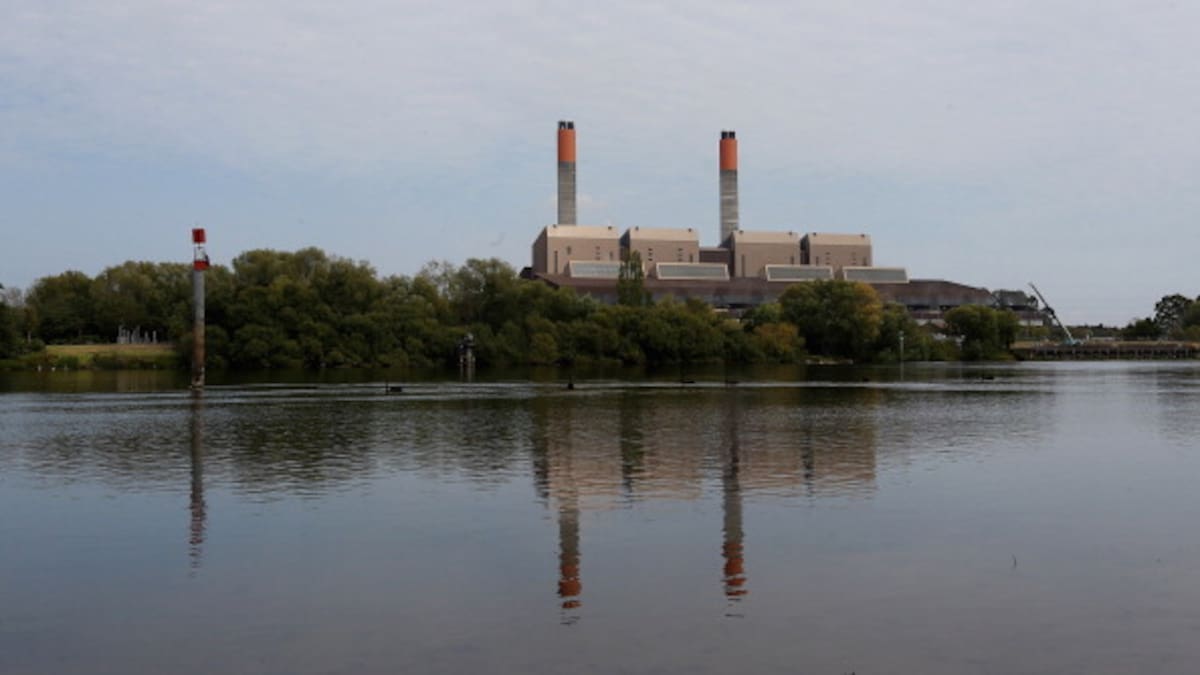
Genesis boss Malcolm Johns says the company expects to see biomass at the Huntly Power Station – “it’s just not going to be in the next three to five years”. Photo / NZME
Johns said the company was starting to see the impact of the El Niño weather pattern in its various catchments.
“The southern lakes are doing pretty well but the Mackenzie lakes are starting to show some signs of retreat, while North Island lakes are below average.”
Genesis Energy’s coal and gas-fired Huntly Power Station backs up the hydro- and wind-dominated system when the weather is not co-operating.
Johns said the company expects to burn a reasonable amount of coal this summer to support the system.
“It’s playing out largely in line with the scenario that we saw, but I think we will go into a dry phase, particularly in the North Island over the summer.”
Genesis said a review of its 400MW Huntly-based gas turbine, Unit 5, will take 12 months to complete.
Until recently, Unit 5 – which by itself can meet the power demands of about 400,000 households – has been an integral part of New Zealand’s power system.
Unit 5 has not operated for half of each of the past two years.
“As we and others build new renewables, with additional water storage now in play and in an energy-only market, it is challenging to currently see an attractive commercial case for Unit 5 beyond the very near term,” Johns said.
Several billion dollars worth of renewable energy projects are underway at the moment and several projects are in the pipeline.
“It’s going to come in at a volume which means that the amount of time we’re going to need to run Unit 5 is going to go from 12 months a year to probably three to four months a year and then it will disappear altogether.”
Crunch time for Unit 5 would be in 2029, when tens of millions of dollars would need to be spent on extending its lifespan.
“We know that there is an interest for these types of units internationally, and we’re struggling to see a commercial case for them in New Zealand at the moment,” Johns said.
Genesis chair Barbara Chapman.
Genesis chair Barbara Chapman said a reduction in the company’s emissions over its last financial year reflected good hydrology, strong trading, and emissions reduction efforts across the business.
The company’s total greenhouse gas emissions decreased to 2014 kilotonnes, down 47% from financial year 2025 and the lowest level recorded since 2020.
“While our emissions are trending downward over time and will continue as we invest in new renewable generation, hydro and wind conditions will continue to influence outcomes,” she said.
Meanwhile, Genesis is walking back its ambitions for biomass.
Johns said the company was committed to biomass “but we can’t buy it at the price that beats coal and gas”.
For Genesis, that price needs to be sub-$500 a tonne, he said, “and we can’t buy it for that at the moment”.
“So we’re staying in touch with everybody.
“We are prepared to contract and displace coal as soon as the economics arrive.
“Our thinking is that’s probably around 2030 to 2035 when the economics will come into orbit and so we still expect to see biomass at Huntly – it’s just not going to be in the next three to five years.”
Jamie Gray is an Auckland-based journalist, covering the financial markets, the primary sector and energy. He joined the Herald in 2011.
Stay ahead with the latest market moves, corporate updates, and economic insights by subscribing to our Business newsletter – your essential weekly round-up of all the business news you need.