

Published October 20, 2026 • By Staff
The presence of optic disc drusen or hyperreflective lines correlates with better structural and functional outcomes.
With non-arteritic anterior ischemic optic neuropathy (NAION) getting increased attention thanks to its widely publicized and much-debated elevated risk with use of GLP-1 drugs, clinicians should be more attuned to identifying those who are more at risk than others. In a recent study published in Eye, researchers from Stanford investigated clinical and imaging signs and demographics of patients with optic nerve-related complications.
Approximately 2% of the general population are diagnosed with optic disc drusen (ODD). An early marker of this condition is hyperreflective lines, which can be observed with enhanced-depth imaging OCT. These patients can develop NAION, but the clinical impact of hyperreflective lines on this nerve injury has yet to be studied. By examining NAION patients with ODD, those with hyperreflective lines and those without these optic nerve features, researchers were able to determine standout characteristics among their study’s population.
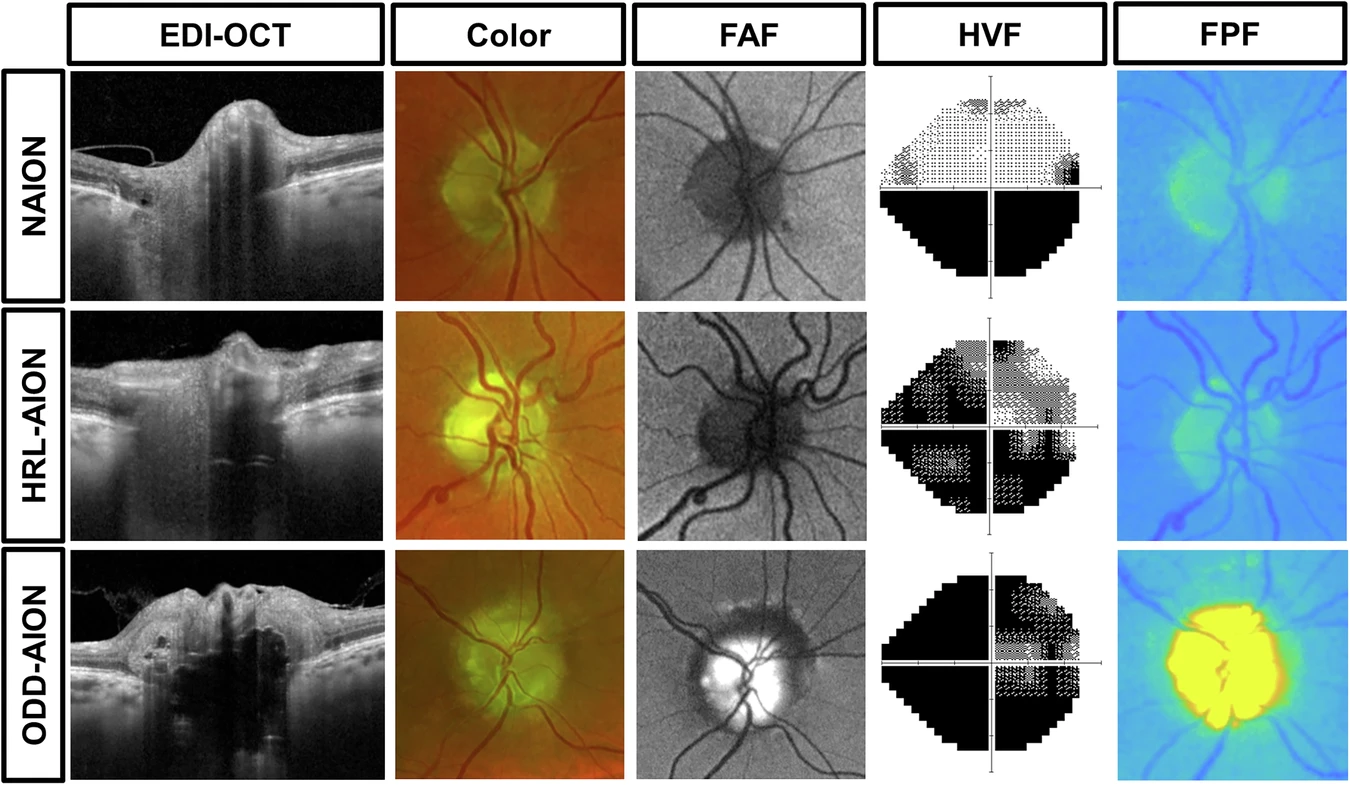
It’s known that optic disc drusen (ODD) is a risk factor in patients who have early-onset NAION. Although hyperreflective lines are an indication of ODD, the present study has found that they do not increase the risk of early-onset NAION. These images from the study show representative examples of patients with NAION, NAION with hyperreflective lines and NAION with optic disc drusen. Photo: Alkhabaz A, et al. Eye. October 9, 2026. Click image to enlarge.
In order to collect characteristic data, researchers analyzed OCT images and assessed patients’ visual acuity, Humphrey visual field mean deviation, ganglion cell complex (GCC), retinal nerve fiber layer (RNFL), Bruch’s membrane opening and flavoprotein fluorescence imaging. A total of 177 NAION patients were selected for the study’s dataset, including 17 patients with ODD, 25 patients with hyperreflective lines and 45 without either optic nerve features. Key results are as follows:
Optic nerve features (ODD and hyperreflective lines) were present in 23.7% of NAION patients.Patients with optic nerve features were younger at diagnosis than those without (62 vs. 65) and had better visual acuities (20/35 vs. 20/69 Snellen).Patients with optic nerve features had higher GCC compared to those without (60μm vs. 55μm) and higher RNFL thickness (61.5μm vs. 59.5μm).Bruch’s membrane opening was smaller in patients with optic nerve features compared to those without (1.41mm vs. 1.53mm).NAION patients with ODD were predominantly female and showed earlier onset.NAION patients with hyperreflective lines were described as having “typical NAION demographically” while presenting with more favorable structural and visual outcomes.Lower global flavoprotein fluorescence signal was examined in NAION hyperreflective lines compared to those with ODD and those without an optic nerve feature (7.4 vs. 10.1 vs. 9.5).
“These findings underscore the importance of understanding imaging features on OCT and how they impact visual outcomes,” concluded the researchers in their paper. “Future histopathological and imaging studies to improve our understanding of hyperreflective lines are warranted.”
Click here for the journal source.
This article was developed by the editorial staff in conjunction with experts in the field. In the process, AI may have been among the editorial tools used to meet the goals of human editors, who approved all content.