
Kasey Devine credits his Catholic parish’s small group as the primary motivation behind his start-up and shares how prayer has shaped his marriage, career and life choices.
SENT is a faith-based organization focused on equipping Catholic leaders for their entrepreneurial pursuits. Founded in Vienna, Virginia, SENT has rapidly expanded since its opening in 2020, with nine chapters across North America.
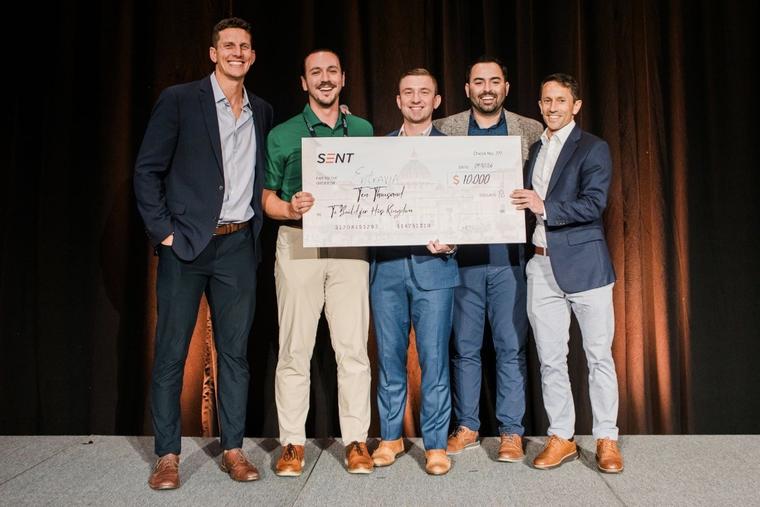
Known for its annual SUMMIT Pitch Competition, SENT invites individuals to connect with values-aligned investors and business leaders while competing for a cash prize of $10,000. Kasey Devine, founder and CEO of Entravia, which, through its technology platform, simplifies how small and midsize businesses compare and select Professional Employer Organizations (PEOs) to manage their human relations services, earned first place for his Minneapolis-based tech start-up at the 2026 competition, held in September in Denver.
In an interview with the Register, Devine credits his Catholic parish’s small group as the primary motivation behind his start-up and shares how prayer has shaped his marriage, career and life choices.
Tell us a little about yourself and your professional journey. What first drew you to entrepreneurship?
I’m a St. Louis kid who went to Mizzou thinking I’d be a history teacher and high-school sports coach. Sales found me instead. I spent more than a decade in payroll, benefits, HR and PEOs: ADP in Kansas City, then the Twin Cities in 2018, TriNet through COVID, VP of revenue at Procare HR, then back to ADP.
I’m a former atheist, and I was baptized, confirmed and received the Eucharist at the Easter vigil in 2021. Erin and I had our marriage convalidated that same year, and we have two little kids now.
I’m not the classic entrepreneur with a notebook full of ideas. I had one for about 10 years.
What was your primary motivation for wanting to create Entravia?
Honestly, my small group at my parish. Through the Cana Family Institute (an organization focused on building community rooted in Scripture, reflection and fellowship), I spend time in formation with a small group at Our Lady of Grace in Edina, and most of the year was on the dignity of work and Rerum Novarum. Leo XIII’s argument is plain: Labor isn’t a commodity to be priced as cheaply as the market allows; it’s how a person provides for a family. That changed my entire view of business.
PEO is the best benefits tool a small employer has … but buying a PEO [a company that manages HR functions] is so painful that as many as half of the small businesses that start shopping give up before they finish.
So we’re fixing the front. Entravia loosely means “the way in” (entra-via), and our logo is an open door on purpose. When PEOs are easier to reach, small businesses become more dignified, and their people get more dignified work. The way I put it in my pitch: “The mission isn’t attached to the product; it is the product.”
As an entrepreneur, how did it feel to win the first-place award in SENT’s Pitch Competition?
Humbling — and a little surreal. My day started with reconciliation, Mass and adoration. Then I walked over and pitched. In most investor meetings, I keep my “why” in my back pocket and stick to market timing. In Denver, I led with it.
We were one of the three finalists, and we won both the judges’ prize and the crowd favorite — apparently, the first time those two lined up. Then I got to carry a giant check with [an image of] the Vatican on it through the Denver airport, which is its own kind of evangelization.
I try to keep it in perspective. A pitch competition isn’t a customer, but standing in a room full of Catholic founders and investors — talking about Rerum Novarum and PEO in the same breath — watching it meant more to me than the check. We’re still beyond stoked about the check though.
What’s the best business advice you have ever received?
When I was leaving a VP role at a PEO, the founder I worked for pulled me aside and said, “I don’t know what it’s going to be, but I think you should start a business. You’re not very employable.” It’s great advice to hear from someone who’s already built something, and, terrifying, because your first thought is, “How am I going to do that?” But that conversation set the ball in motion. It took a parish small group and a lot of prayer because I actually acted on it. He saw it before I did.
SENT is committed to help Catholic leaders achieve their entrepreneurial goals and flourish in their personal vocations. What does it mean to have fellowship with experienced mentors, coaches and like-minded individuals who are dedicated to serving their communities?
Starting a company is lonely, especially as a solo founder, and I had a hard time finding my tribe — people who take both business and faith seriously. Iron sharpens iron. SENT turned out to be that tribe.
How does your faith influence your business life as an entrepreneur?
It’s the reason the company exists, so it shows up everywhere. Four places in particular:
Why we build: Work is made for the person, not the person for the work. St. John Paul II said this in Laborem Exercens, and it’s the filter for everything we do.
How I lead: Christ washing his disciples’ feet was a radical idea, and servant leadership still is. I exist as CEO to serve the people who said “Yes” to this mission with me.
How we use technology: Pope Leo XIV signed his first encyclical, Magnifica Humanitas, this May on the 135th anniversary of Rerum Novarum. It warns that AI too often “forces workers to adapt to the speed and demands of machines, rather than machines being designed to support those who work.” That’s our product philosophy in a sentence: Take the paperwork off people’s plates so humans can do the human parts. We’re not trying to replace anybody.
Who we partner with: When investors ask about my end goal, my honest answer is that I believe I’m called to do this. I’d turn down a deal that was twice as good if we weren’t aligned on why we exist.
Was there a low point in your professional journey where prayer really helped you?
Yes, late 2025 was the scariest stretch of my career. I had a great job at ADP, a toddler at home, and our second baby on the way. Life was comfortable.
I was in a parish small group, reading Jordan Peterson’s We Who Wrestle With God, and praying through Genesis, and I kept getting stuck on Abraham: a settled, comfortable man whom God calls to leave everything for a promise. In prayer, I kept hearing three words: “Leave your tent.”
I argued, but the call kept getting louder. So, a week before our son was born, I left ADP with no backup plan to build Entravia. Prayer didn’t take the fear away. I was deeply, deeply scared. But it gave me enough peace to take the next step anyway — and then the one after that.
Looking back, every time I took a step, something “fell out of the sky”: the introduction I needed, the connection that made the next thing happen, even the firm that led our pre-seed [funding, the initial capital raised by a start-up], M25, for Matthew 25, the Parable of the Talents. I don’t believe in coincidences.
Do you have any advice for Catholics who are looking to start their own businesses?
My first piece of advice is to take it to prayer. Ask what He’d like you to do — as opposed to what you’d like yourself to do. Not only will it be a more coherent life, but you will also lead a more interesting life than whatever you conjured yourself up for.
I’d say the second that can be overlooked is to find a problem that exists and then solve that. Do not create something hoping you find a problem that it solves.
I happened to just draw upon my own experience in my industry, solving a problem I’d known for a decade existed.
If you find yourself being called into entrepreneurship, go look in your community, whether that’s geographically or more broadly. Find out what folks are struggling with, what would decrease suffering, what would increase quality of life.