
She was unable to walk her dog, which she had had only a few weeks, until her ribs healed, disrupting important “bonding”, she said.
Lindsay reported the incident to Whanganui District Council the next day and was called by a staff member who said the section was repaired.
“It should never have been sitting there like that.”
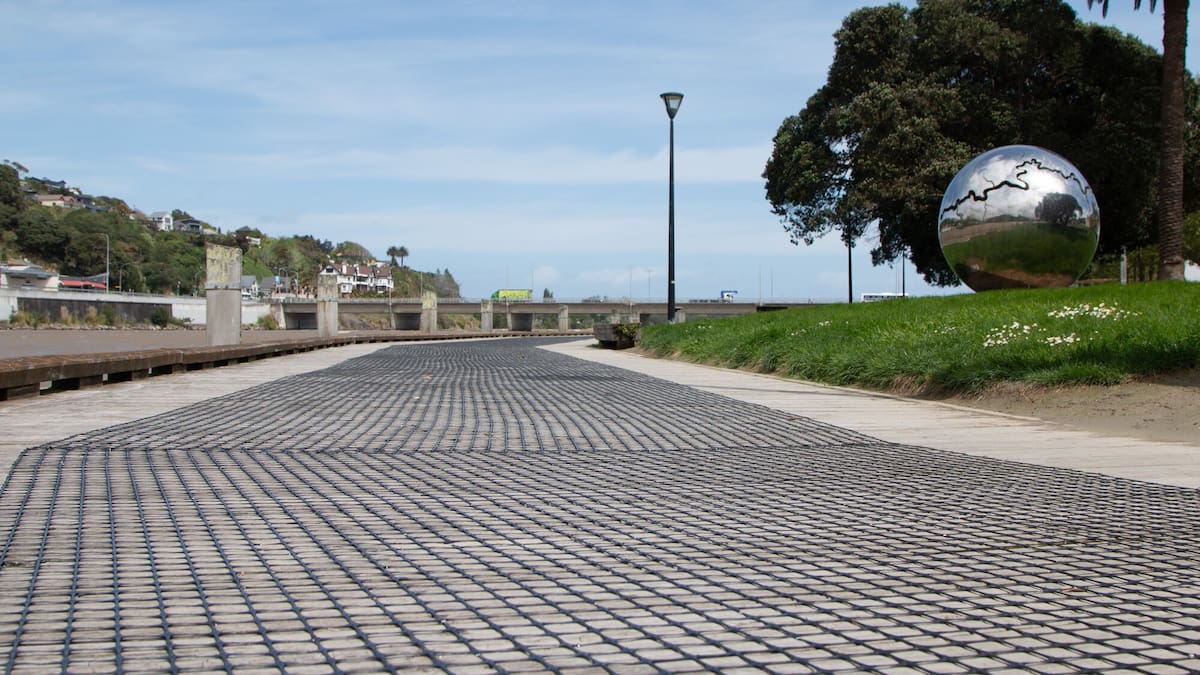
The damaged section of plastic mesh on the Whanganui River boardwalk that Shonagh Lindsay tripped on before Whanganui District Council repaired it.
Lindsay said when she asked if the mesh was on a regular maintenance schedule, the staff member said it was not.
The council told the Chronicle its land transport team was “regularly inspecting the boardwalk” and investigating another report of curling and areas “wearing sooner than expected”.
Chief infrastructure officer Lance Kennedy said the council had received no other injury reports.
“We were concerned to hear that someone was injured and the mesh in that area was repaired the following day,” he said.
The council could not constantly monitor its large network of walkways, and community reporting was important to identify issues and respond quickly, he said.
“We inspect and maintain them based on condition, risk and available funding.
“But conditions can change quickly, and wear, weather or deliberate damage can create issues between checks.”
Plastic mesh complied with the NZ Cycle Trails Design Guide and was widely used on boardwalks and trails in New Zealand, Kennedy said.
The council installed the plastic (polymer) mesh treading in August after reports of cyclists receiving punctures, and safety concerns led it to remove wire mesh treading installed months earlier.
There was also a report of a child who had metal stuck in their foot.
The council spent $15,948 on the metal mesh, about $10,000 to remove it, and $17,295 on the plastic mesh.
Lindsay, who trained in urban design and worked for Auckland Council for two and a half years, said the Whanganui council should make infrastructure decisions more “carefully”.
“It is quite incredible what mistakes councils can make,” Lindsay said.
“There’s so many nice things here, but the council don’t seem to really understand what you would want to do if you were to attract people to live in the city.”
Lindsay said the council should not make decisions solely on cost.
“It’s a basic to get right because you’ve got people’s health at stake.”
“They need to look at the best option because, things like that, they do matter to people.”
The council considered wire mesh (Bayonet Welded Mesh), plastic mesh and grip treads (R-grip), estimated at $150,000 to $500,000, to improve the boardwalk’s traction.
The council told the Chronicle in February the plastic was not “considered durable enough for this high traffic area” and the grip treads’ high cost led it to originally select wire.
Erin Smith is a multimedia journalist based in Whanganui.